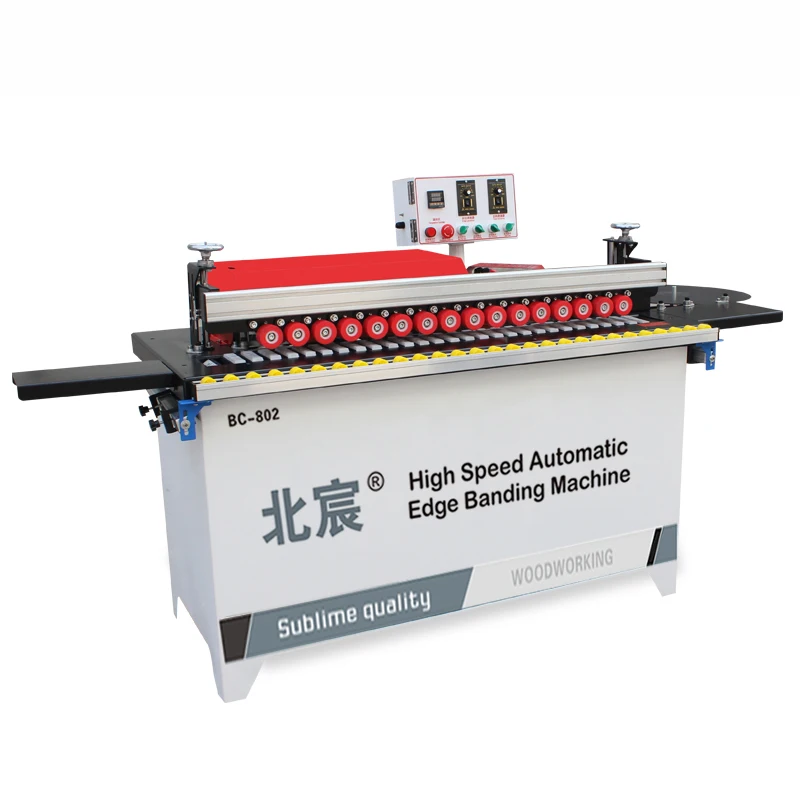
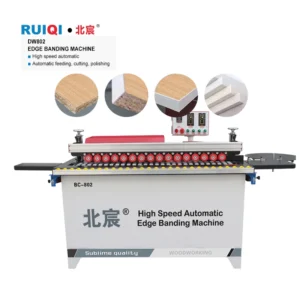
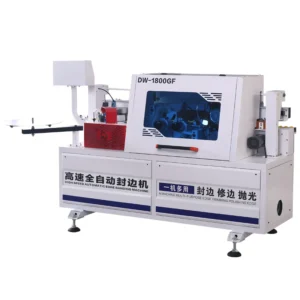
Voltage-First Manufacturing — every DW802 order begins with a confirmed electrical specification before the frame is welded, so the machine arrives wired for your market.
Technical Specifications
| Parameter |
Value |
| Model |
DW802 |
| Product Type |
Automatic Edge Banding Machine |
| Total Power |
4200W |
| Trimming Power |
800W × 2 |
| Polishing Power |
180W × 2 |
| Vacuum Power |
1200W |
| Edge Feed Power |
140W |
| Transmission Power |
140W |
| Voltage |
220V / 380V / customizable (frequency to be confirmed) |
| Plug Options |
EU, USA, AU, UK |
| Edge Banding Thickness |
0.3–3 mm |
| Edge Banding Height |
0–50 mm |
| Minimum Sheet Length |
25 cm |
| Minimum Sheet Width |
10 cm |
| Glue Pot Capacity |
4000 ml |
| Air Source Pressure |
0.4–0.8 MPa |
| Overall Dimensions (L×W×H) |
130 × 60 × 95 cm |
| Net Weight |
135 kg |
| Language Options |
Chinese + English standard; English-only, Spanish, or other languages on request |
| Key Features |
Gluing, trimming, polishing, automatic head and tail cutting, vacuum hold-down |
Application Suitability
| Application |
Material or Output |
| Custom cabinet door edge sealing |
MDF and particleboard with PVC edge banding |
| Wardrobe panel finishing |
Plywood and ecological board with melamine strips |
| Small-batch furniture production |
Solid wood panels with veneer edge banding |
| Home decoration workshop runs |
Straight-edge boards in batch or one-off cutting schedules |
Why the Voltage Conversation Must Happen Before the Order
A machine built for 380V/50Hz will not start on a 220V/60Hz supply — and rewiring after arrival is rarely an option.
I have watched containers arrive at ports where the edge bander inside could never be plugged in. The buyer assumed the seller knew their local grid; the seller assumed the buyer would specify. An Edge Banding Machine OEM that does not ask about voltage and frequency before quoting is leaving this gap wide open. The DW802 is manufactured only after a signed electrical confirmation sheet, covering voltage, frequency, and plug type, so the unit on your floor matches your panel board from the first hour [NEED_CITE: voltage and frequency standards by export market].
How Private-Label Manufacturing Works on This Machine
Private-label capability means more than printing your logo on the side panel. When an Edge Banding Machine factory builds a DW802 under your brand, the control panel overlay, the operator manual, and the startup screen all carry your identity. Distributors who resell woodworking machinery need this consistency — their end customers expect a single brand experience from unboxing to first service call.
Component Traceability Across the Assembly Line
Every DW802 carries documented sourcing for motors, bearings, and pneumatic valves. Buyers evaluating an Edge Banding Machine OEM need to know where critical components originate, because service availability depends on it. If a trimming motor fails in year three, the distributor must be able to source a replacement locally or from a known supplier. Component transparency is provided in writing before production begins [NEED_CITE: CE machinery directive requirements for industrial equipment].
What the Numbers Mean on the Shop Floor
The dual 800W trimming motors handle the bulk of material removal after the edge strip is applied. Higher trimming power maintains consistent cut quality when working through PVC or wood veneer at continuous feed, reducing the chance of tear-out on the panel edge. The 4000 ml glue pot is sized so that a small workshop can run a full morning shift without stopping to refill — a detail that matters when batch schedules are tight. Edge banding thickness of 0.3–3 mm covers everything from thin melamine strips to thicker solid wood lipping, while the 0–50 mm height range accommodates the standard board thicknesses used in cabinet and furniture work.

When the Wrong Configuration Costs More Than the Machine
A distributor who orders a batch of edge banders without matching the glue pot temperature range to the local climate risks adhesion failures across an entire shipment. I once saw a workshop in a humid coastal city lose a week of production because the adhesive was not holding on particleboard — the machine was fine, but the glue specification had not been adjusted for ambient moisture [NEED_CITE: adhesive performance relative to humidity in woodworking].
Why This Factory Builds Differently
In-house manufacturing means the DW802 frame, feed mechanism, and trimming assembly are all produced under one roof, giving distributors a single point of accountability. Patented cutting mechanisms are verified to the tolerance stated in the specification sheet, not claimed and left untested. Four-stage quality control — incoming material, in-process, finished product, and pre-shipment verification — is documented with records the buyer receives before the crate leaves the factory. Voltage, language, and branding customization are treated as standard order parameters, not special requests that add lead time. An engineer reviews every configuration before production starts, catching mismatches between the buyer’s requirements and the machine build.
Documentation & Verification
- CE declaration of conformity covering the DW802 electrical and mechanical safety scope
- ISO 9001 certificate valid at the time of production
- Factory test record run on buyer-specified panel thickness and edge material before dispatch
- Electrical schematic with confirmed voltage, frequency, and plug type annotated per order
- Operation and maintenance manual printed in the language selected at order confirmation
- Packing photographs showing crate condition and machine securing before container loading
Installation, Commissioning & Support
- The 130 × 60 × 95 cm footprint fits through standard workshop doors without disassembly
- A dedicated circuit matching the confirmed voltage and 4200W total draw must be in place before delivery
- Air supply at 0.4–0.8 MPa with a clean, dry line connected to the machine inlet before first run
- Glue pot filled to the 4000 ml mark and heated to the adhesive manufacturer’s specified temperature before panel feeding
- Trimming and polishing stations adjusted to the actual edge banding thickness used in production during commissioning
What We Need to Configure Your Machine
To match the DW802 to your market, share your local voltage and frequency, the edge materials your customers most commonly run, and the language your operators need on the control panel. If you are distributing under your own brand, let us know the logo placement, panel color, and manual language you require. Sample test runs on your chosen board and edge stock can be arranged before bulk production is confirmed.
Frequently Asked Questions
Q: What can be customized under a private-label Edge Banding Machine OEM arrangement?
A: Logo placement, machine color, control panel graphics, operator manual language, and packaging branding are all configurable. Each customization point is confirmed in writing with visual proofs before production. Software interface language can also be aligned to your market. The goal is a machine your end customer recognizes as yours from crate to control screen.
Q: When must voltage, frequency, and plug type be confirmed?
A: Electrical specifications are locked before the machine frame enters assembly. Changing voltage or plug type after wiring is complete requires rewiring and re-testing, which extends lead time. We request confirmation at the quotation stage so the build proceeds without interruption. A signed electrical sheet is standard before production.
Q: How is component sourcing documented for distributors?
A: Motors, bearings, PLCs, and pneumatic components are listed with manufacturer names and countries of origin in the technical file supplied with each unit. Distributors use this list to plan local spare parts inventory. If a specific component brand is required for your market, this is discussed during configuration.
Q: What does four-stage quality control cover?
A: Incoming material inspection verifies raw components before assembly. In-process checks confirm alignment and torque during build. Finished-product testing runs the machine through its full function cycle. Pre-shipment verification includes a panel feed test on the buyer’s specified material, with photographs and records provided before crating [NEED_CITE: quality control stages in machinery manufacturing].
Q: Can I order a sample unit before committing to a bulk batch?
A: Yes. A pre-production sample is built to your exact specification, including branding and electrical configuration. Test results from the sample feed back into the bulk order setup. Lead time for a sample follows the same production workflow as a full order, ensuring the batch units match exactly.