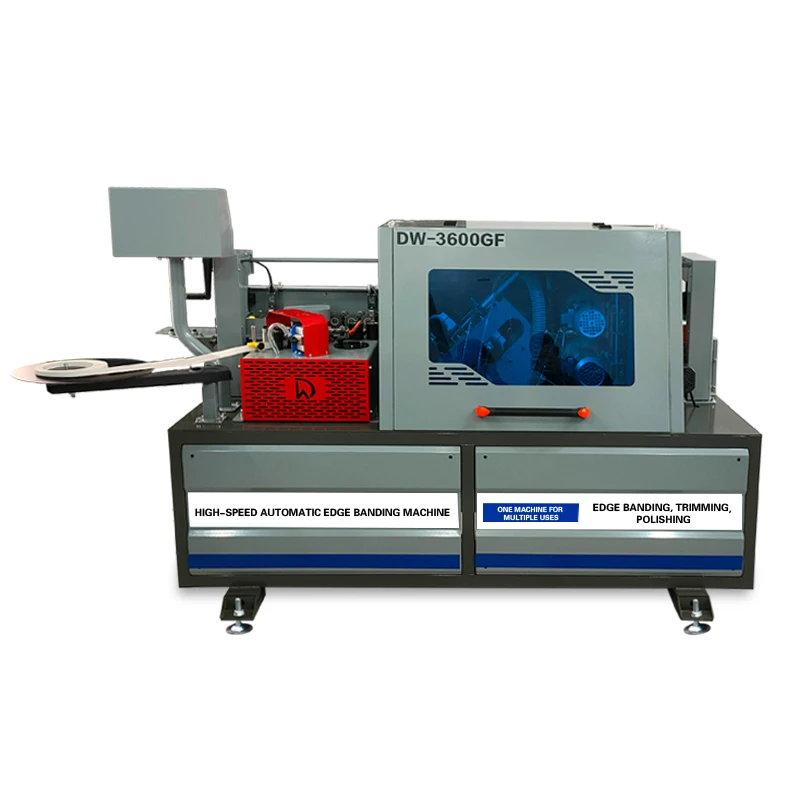
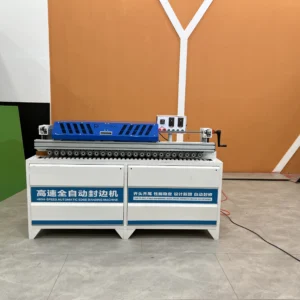
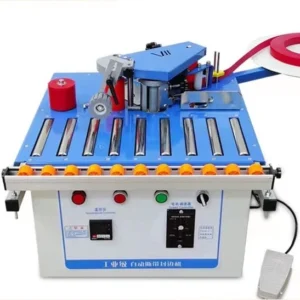
Precision-verified compact edge bander — every DW-3600GF leaves the Ningjin facility with a four-stage QC file documenting tolerance verification on your specified panel stock, not just a packing list.
Technical Specifications
| Parameter |
Value |
| Model |
DW-3600GF |
| Product Type |
Compact Automatic Edge Banding Machine |
| Total Power |
4.9 kW |
| Voltage & Frequency |
380V three-phase four-wire (frequency configurable 50Hz / 60Hz) |
| Overall Dimensions |
2200 × 650 × 1250 mm |
| Net Weight |
320 kg |
| Edge Banding Type |
Straight edge banding |
| Edge Band Height Range |
0–50 mm |
| Edge Band Thickness Range |
0.3–3 mm |
| Minimum Panel Length |
200 mm |
| Feed Speed |
0–14 m/min |
| Trimming Station Power |
800 W × 2 at 24,000 r/min |
| Polishing Station Power |
400 W × 2 |
| Gluing Station Power |
160 W |
| Transmission Power |
180 W |
| Air Supply Requirement |
0.4–0.6 MPa |
| Functional Stations |
Gluing, dual trimming, front & rear trimming, scraping, dual polishing, vacuuming |
| Control Language Options |
Chinese, English (additional languages configurable) |
| Assembly State |
Fully assembled before dispatch |
| Certification |
CE |
Application Suitability
| Application |
Material or Output |
| Custom cabinet door edge finishing |
MDF and particleboard with PVC banding |
| Wardrobe panel straight banding |
Plywood and melamine-faced boards with veneer or PVC |
| Small-batch furniture component banding |
Solid wood panels with wood-veneer edge band |
| Workshop transition from manual to automated banding |
Mixed panel stock typical of job-shop environments |
Why the Voltage Question Must Precede the Quotation
A mismatched frequency setting can disable the inverter before the crate is even opened.
I once watched a container arrive in Spain carrying a fully automatic edge bander configured for 400V/50Hz. The workshop ran on 480V/60Hz. The variable frequency drive tripped immediately, and the customer waited two weeks for a step-down transformer before the machine could power on. That experience sits behind every voltage confirmation form we now require before a single DW-3600GF enters production. [NEED_CITE: voltage and frequency standards by export market]
For an edge banding machine OEM, the implication is straightforward: a distributor stocking machines for multiple territories needs each unit built to the exact electrical standard of its destination, not adapted in the field with external transformers that add cost and failure points.

How Component Sourcing Shapes OEM Consistency
The DW-3600GF uses a dedicated 180 W transmission motor separate from the 160 W gluing motor, giving the compact edge bander factory independent control over feed rate and glue application. This separation matters when an OEM partner private-labels the machine for markets where operators expect to fine-tune banding speed without altering glue pot temperature or roller pressure.
Precision-ground trimming spindles and scraping blades are sourced and inspected in-house, so an importer ordering a batch of twenty units receives consistent edge finish quality across every machine — not a mix of tolerances from different subcontracted component lots.
Four-Stage QC as a Distributor’s Liability Shield
Incoming material inspection catches dimensional drift in castings before they reach the assembly bench. In-process checks verify spindle runout and conveyor flatness at the point where errors are cheapest to correct. Finished-product testing runs actual panel stock through all eight stations. [NEED_CITE: ISO 9001 quality management requirements for machinery manufacturing]
The pre-shipment verification step produces a signed test record that travels with the machine. For a distributor, this document becomes evidence of due diligence when a customer questions banding quality on their first production run, and it reduces the back-and-forth that delays commissioning.
Reading the Specs That Actually Matter on the Shop Floor
The 24,000 r/min trimming spindle speed directly influences the surface quality of PVC and thin veneer edges; slower speeds leave visible chatter marks that the polishing station cannot fully recover. Feed speed variability from 0 to 14 m/min allows an operator to slow down for narrow panels under 250 mm, where a fast feed would cause the trimming cutters to grab and chip the leading corner.
The 0.4–0.6 MPa air supply requirement is typical for pneumatic scrapers and polishing wheels; shops operating multiple machines on a single compressor must account for cumulative demand or risk pressure drops that leave adhesive residue unscraped. Total power draw of 4.9 kW means the machine can share a standard workshop panel without requiring a dedicated high-capacity circuit, which simplifies installation for importers placing units into small retail or training environments. [NEED_CITE: CE machinery directive requirements for industrial equipment]
The Cost of Skipping the Configuration Conversation
A distributor who orders a batch of machines with a generic 380V plate and no confirmed frequency may find half the shipment sitting idle in customers’ workshops until electricians install phase converters. Each converter adds a point of failure, generates harmonic distortion that can confuse sensitive PLC inputs, and voids portions of the CE declaration when the installation deviates from the tested configuration.
Equally costly is delivering a control panel in a language the operator cannot read; commissioning stalls while the distributor arranges ad-hoc translation, and the customer attributes the delay to the machine brand rather than the importer’s oversight. [NEED_CITE: operator interface language requirements under EU machinery safety guidelines]
Manufacturing Depth That Supports Private-Label Commitments
In-house precision grinding of trimming spindles means replacement parts for the DW-3600GF carry the same tolerance as the originals, which matters when a distributor promises their service team can restore a machine to factory edge quality.
Full OEM scope covers logo application on the machine body, nameplate, control panel splash screen, and packaging — not just a sticker swap. Voltage adaptation from 110 V to 440 V is handled at the transformer and motor specification level, not through external add-ons. The patented cutting mechanism inside the trimming stations gives private-label partners a technical talking point that generic sourced machines cannot offer.
Documentation & Verification
- CE declaration of conformity listing the DW-3600GF by model number and applicable harmonized standards
- ISO 9001 certificate covering the manufacturing scope relevant to woodworking panel machinery
- Electrical schematic confirming voltage, frequency, and wiring diagram for the destination market
- Factory test record showing edge banding results on customer-specified panel thickness and material
- Operation and maintenance manual translated into the agreed operator language
- Spare parts list with OEM part numbers matching the private-label branding
Installation, Commissioning & Support
- Place the 2200 × 650 mm footprint on a level concrete floor with 150 mm clearance on the infeed side for panel loading
- Connect to a dedicated 380 V three-phase circuit rated for at least 4.9 kW with appropriate overcurrent protection
- Verify incoming air supply delivers 0.4–0.6 MPa at the machine inlet before activating pneumatic scrapers and polishers
- Run calibration panels through all eight stations to set trimming depth and polishing pressure for local banding material
- Train operators on feed speed adjustment between 0 and 14 m/min based on panel width and edge band thickness
- Stock consumable trimming cutters and polishing wheels using the OEM spare parts list to maintain edge finish quality
Structuring an Inquiry That Gets a Usable Quotation
Send the destination country’s standard voltage and frequency so the electrical package is configured before production starts, not corrected after arrival. Specify the edge banding materials — PVC, ABS, or wood veneer — and the panel substrates most common in your market so the gluing station and trimming cutters are set up for those combinations.
If you plan to private-label, provide the logo artwork, nameplate layout, and the operator language for the control panel at the inquiry stage; these details affect lead time more than most buyers realize.
Frequently Asked Questions
Q: What OEM and private-label customization is available for the DW-3600GF?
A: Customization covers logo placement on the machine body and packaging, private-label nameplates, control panel splash screens, and operation manuals in your brand identity. Voltage, plug type, and operator language are configured per destination market. Artwork and layout approval happen before production starts to avoid rework delays.
Q: How does the four-stage QC process protect my bulk order?
A: Each stage — incoming material, in-process assembly, finished product, and pre-shipment — generates a signed record. For bulk OEM orders, these records confirm that every unit meets the same spindle runout, conveyor flatness, and edge finish standards, giving you documentation to share with your own customers.
Q: Can voltage and control panel language be adapted for different territories?
A: Yes. The electrical system supports 110 V to 440 V at 50 Hz or 60 Hz, configured at the motor and transformer level rather than through external converters. Control panel text is set to the operator’s language before dispatch, preventing commissioning delays caused by unreadable interfaces.
Q: What is the typical production lead time for a batch OEM order?
A: Lead time depends on order volume and customization complexity, such as non-standard voltage configurations or multi-language control panels. Sharing these details at the inquiry stage allows an accurate schedule before commitment, with typical multi-week lead times for standard configurations.
Q: Are spare parts and technical training available for our service team?
A: A full spare parts list with OEM part numbers accompanies every shipment. We provide technical documentation covering trimming cutter replacement, polishing wheel servicing, and pneumatic system maintenance so your service team can support end customers without routing every call back to the factory.