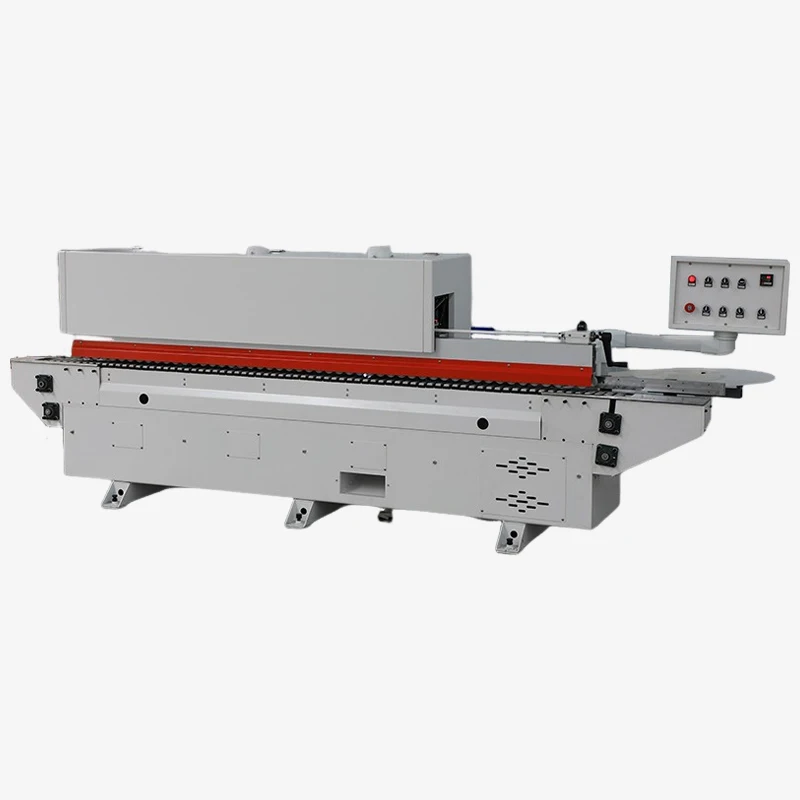
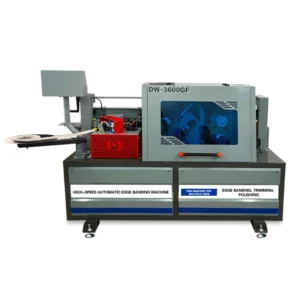
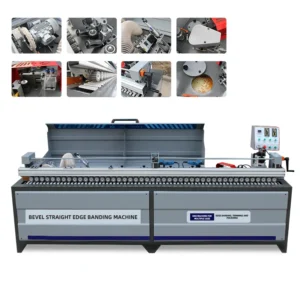
In-house OEM manufacturing — every DW330 automatic edge banding machine leaves our Ningjin workshop with factory test records, verified voltage configuration, and your private label applied before crating.
Technical Specifications
| Parameter |
Value |
| Model |
DW330 |
| Product Type |
Automatic Edge Banding Machine |
| Conveying Motor |
1.5 kW |
| Trimming Motor |
0.55 kW × 2 |
| Glue Feeding Motor |
0.37 kW × 2 |
| End-to-End Motor |
0.37 kW × 2 |
| Polishing Motor |
0.37 kW × 2 |
| Total Motor Count |
8 |
| Transmission Motor |
1500 W, 1:40 speed ratio |
| Feeding Speed |
18 m/min |
| Narrowest Sealing Plate Width |
120 mm |
| Minimum Machining Size |
L 200 mm × W 100 mm × T 9 mm |
| Maximum Plate Thickness |
50 mm |
| Edge Banding Thickness Capacity |
Up to 3 mm |
| Heating Rod |
380 V, 300 W × 4 |
| Control System |
7-inch PLC panel, multilingual compatible; push-button box optional |
| Beam Height Adjustment |
Digital display hand crank (manual) |
| Pressure System |
Double-row pressure rollers, aluminum profile pressure beams |
| Glue Pot |
Enlarged capacity, large gluing shaft, single-sided board gluing |
| Trimming |
Contour trimming with alloy knife, curved scraper with contouring device |
| Polishing |
Enhanced industrial polishing motor |
| Glue Volume Adjustment |
Manual device |
| Outline Dimensions |
350 × 71 × 122 cm |
| Net Weight |
750 kg |
| Gross Weight |
800 kg (basis to be confirmed) |
| Certification |
CE, ISO 9001 |
Application Suitability
| Application |
Material or Output |
| Custom cabinet door edge finishing |
MDF and particleboard with PVC edge banding |
| Wardrobe panel edge sealing |
Plywood panels with melamine or veneer strips |
| Furniture factory batch production |
Board thickness 9–50 mm, width from 120 mm upward |
| Small-batch joinery workshop output |
Solid wood panels with thin veneer edge banding up to 3 mm |
| Regional distributor demonstration stock |
Mixed substrate testing for local buyer evaluations |
Why the Voltage Question Must Come Before the Quotation
A machine that cannot power on at the destination port is not a machine — it is 800 kg of dead weight sitting in a container.
I watched a batch of automatic edge banding machines ship overseas with 380V/50Hz heating rods and motors, only to arrive at a facility running 220V/60Hz. The customer could not energize the glue pot or the conveying motor. Three weeks of on-site rewinding and transformer sourcing followed. Since that incident, every DW330 we crate gets its electrical schematic cross-referenced against the destination country’s voltage and frequency standard before the first test run begins [NEED_CITE: voltage and frequency standards by export market]. For an OEM partner or distributor, this verification step protects your reputation with the end user who expects to plug in and produce.

How OEM Partners Use the DW330 Platform
Distributors building a regional product line need a machine that carries their branding without exposing their supply chain. The DW330 supports full private label application — your logo on the body panels, your color scheme, and your chosen control panel language loaded onto the 7-inch PLC screen before the unit leaves our Ningjin production floor. This automatic edge banding machine manufacturer capability means your downstream customers see your brand, not ours.
Voltage and Language Customization as Standard Practice
The control panel accepts multilingual configuration, so a unit shipping to South America can run Spanish interface prompts while one heading to Southeast Asia loads Bahasa or Vietnamese. Voltage customization spans 110V to 440V, covering single-phase and three-phase configurations. Each configuration is validated on our test bench with the exact heating rod and motor winding specified for that order. We photograph the electrical cabinet, the nameplate, and the PLC boot screen as part of the pre-shipment record [NEED_CITE: CE machinery directive requirements for industrial equipment].
Reading the Specs That Matter for Edge Quality
The double-row pressure roller system with aluminum profile beams clamps panels as narrow as 120 mm without lateral drift, which directly affects glue-line consistency on cabinet side panels. The enlarged glue pot paired with the 1500 W transmission motor and 1:40 speed ratio maintains adhesive flow during continuous runs on thick particleboard, preventing the starved glue joints that show up only after the customer has assembled carcasses. Contour trimming with the alloy knife and curved scraper handles up to 3 mm edge banding thickness, producing a finished radius that requires no secondary hand-scraping before the panel moves to boring or hardware insertion. Feeding speed at 18 m/min sets the throughput rhythm for a small-to-mid-size furniture cell.
When the Wrong Configuration Reaches the End User
A distributor who stocks a single voltage variant and then sells into a market with different mains supply forces the end user into expensive field modifications. Control panels locked to one language stall commissioning when the local operator cannot navigate the PLC menus. Edge banding machines specified without confirming the customer’s panel thickness range arrive unable to process 50 mm stock or produce visible scoring on 9 mm thin board. These mismatches generate warranty claims that erode the distributor’s margin and damage the brand in that territory [NEED_CITE: common causes of edge banding machine warranty disputes in export markets].
Why OEM and Distributor Partners Source This Machine Here
Our Ningjin facility manufactures the DW330 from frame welding through final assembly, which means OEM modifications do not require negotiating with a third-party integrator. The four-stage quality control process — incoming material inspection, in-process checks, finished product verification, and pre-shipment testing — generates documented records you can share with your own compliance team. Patented cutting mechanisms deliver tolerance that you can verify on sample panels shipped with the machine. We accept single-unit orders through large production runs, so a distributor testing a new market can start with one container and scale without changing supplier. Factory visits are open for you to witness test runs on your specified panel material and edge banding stock.
Documentation & Verification
- CE declaration of conformity covering the DW330 edge banding machine assembly
- ISO 9001 certificate available for your compliance audit file
- Factory test record with photographs taken on your specified panel thickness
- Electrical schematic confirming voltage and frequency matched to destination market
- Operation and maintenance manual in your agreed language with full spare parts list
Installation, Commissioning & Support
- Foundation must support 750 kg net weight across the 350 × 71 × 122 cm footprint
- Dedicated circuit required matching confirmed voltage from 110V to 440V range
- Machine ships fully assembled; only dust extraction ducting and power connection needed on arrival
- PLC control panel boots in pre-loaded language; beam height set via digital display hand crank
- Alloy trimming knives and curved scraper blades supplied as initial spare parts kit
- Glue pot cleaning cycle demonstrated during remote commissioning guidance
What We Need to Quote Your OEM Configuration
Provide your target market’s standard voltage and frequency so we can specify the correct heating rods and motor windings from the outset. Share the panel materials and edge banding types your customers most frequently process, along with the board thickness range you need the machine to cover. Let us know the control panel language your operators require and whether you want your logo and color applied to the body panels.
Frequently Asked Questions
Q: What OEM customization options are available for the DW330?
A: We apply your logo, body color, and branding to the machine panels. The 7-inch PLC control panel loads your chosen operator language. Voltage is configured from 110V to 440V to match the destination market, with matching heating rods and motor windings validated on our test bench before dispatch.
Q: How do you verify manufacturing tolerance before shipment?
A: Each DW330 passes four inspection stages — incoming material, in-process, finished product, and pre-shipment testing. We run sample panels through the machine, photograph the edge finish and glue line, and include these records with your shipment so you can verify tolerance claims independently.
Q: Can we visit the factory and witness a test run?
A: Yes. We welcome distributor and OEM partner visits to our Ningjin facility. Bring your panel samples and preferred edge banding material, and we will run them on the DW330 so you can evaluate edge quality, feed stability, and trimming accuracy firsthand before placing your order.
Q: What spare parts and technical training do you provide?
A: Every shipment includes an initial spare parts kit covering alloy trimming knives, scraper blades, and wear components. We provide a full parts list with part numbers for reordering. Remote commissioning guidance covers glue pot maintenance, pressure roller adjustment, and PLC menu navigation in your operator’s language.
Q: What is the lead time for OEM orders?
A: Single-unit orders for stocked configurations dispatch within typical multi-week lead times. Larger OEM production runs with custom voltage, branding, and language specifications require additional scheduling. We confirm the timeline at quotation stage and provide production milestone updates through completion.