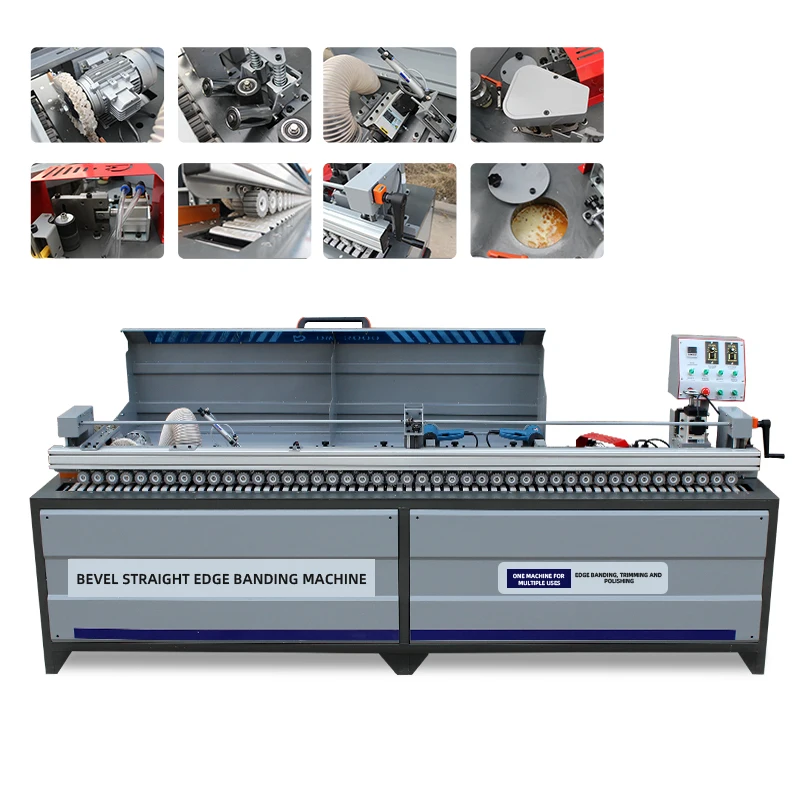
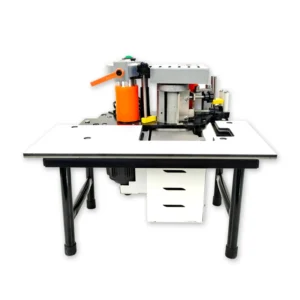
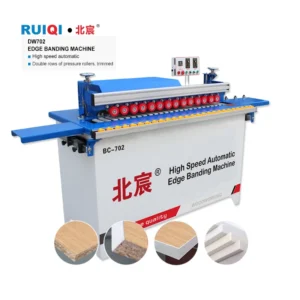
Precision Ground Build — Every DW3000 frame and pressure wheel assembly is machined in-house and verified through a four-stage QC protocol before it leaves the Shandong floor.
Technical Specifications
| Parameter |
Value |
| Model |
DW3000 |
| Product Type |
Automatic Edge Banding Machine (45 Degree Bevel and Straight Edge) |
| Total Installed Power |
11 kW |
| Voltage and Frequency |
380V / 415V (frequency 50 Hz or 60 Hz to be confirmed at order) |
| Pre-milling Motor |
2.2 kW |
| Heating System |
2.2 kW × 2 (double heat gun design) |
| Trimming Spindle Motors |
2.2 kW × 2, plus dedicated spindle trimming unit |
| Polishing Motors |
0.4 kW × 2 |
| Vacuum Dust Extraction |
550 W |
| Edge Feeding Motor |
160 W |
| Transmission Motor |
180 W |
| Glue Pot Capacity |
4000 ml |
| Required Air Source Pressure |
0.5–0.7 MPa |
| Feed Speed |
0–12 m/min |
| Minimum Sheet Length |
30 cm |
| Minimum Sheet Width |
15 cm |
| Edge Banding Height Range |
0–50 mm |
| Edge Banding Thickness Range |
0.3–3 mm |
| Oblique Pressure Wheels |
8 groups, angle adjustable 30–90° |
| Working Stations |
Pre-milling, 30–90° edge banding, trimming, scraping, polishing |
| Overall Dimensions (L × W × H) |
299 × 65 × 130 cm |
| Net Weight |
430 kg |
| Assembly State |
Fully assembled |
| Control Panel Language |
Chinese and English standard; other languages configurable |
| Plug Options |
EU, USA, AU, UK |
Application Suitability
| Application |
Material or Output |
| Custom cabinet door edge finishing |
MDF and particleboard with PVC edge banding 0.3–3 mm |
| Panel furniture straight edge processing |
Plywood and MDF substrates up to 50 mm banding height |
| Beveled carcass edge treatment |
30–90° angled edges on particleboard and plywood panels |
| Veneer banding for joinery components |
Thin wood veneer strips on MDF and solid wood panels |
| Mid-volume workshop edge production |
Mixed panel batches requiring quick changeover between straight and bevel |
Why the Voltage Question Must Come Before the Quotation
Confirming local voltage, frequency, and plug type at the quotation stage prevents machines from sitting idle on the workshop floor.
I once visited a workshop in the Yangtze Delta where a fully automatic edge bander had been delivered with a 380 V / 50 Hz motor, but the local supply ran at 60 Hz. The main spindle ran overspeed on day one and burned out the trimming motor within a week. The operator had no electrical schematic to show the electrician, no voltage confirmation document, and no way to trace the fault. The line stood still while they waited for replacement parts [NEED_CITE: voltage and frequency standards by export market]. That kind of downtime costs more than the machine itself in lost production days. When sourcing an Edge banding machine OEM factory, the first document you should receive after an inquiry is a voltage and frequency confirmation sheet, not a price list.

Component Sourcing and Assembly Depth
An Edge banding machine OEM factory is only as reliable as the components it fits and the tolerances it holds during assembly. The DW3000 uses a dedicated pre-milling motor paired with three separate spindle motors, which means each trimming and finishing station runs on its own spindle rather than sharing belt-driven power from a single source. This arrangement keeps cutting forces consistent when the machine transitions from a dense MDF panel to a lighter particleboard sheet. The eight groups of oblique pressure wheels are individually adjustable across a 30 to 90 degree range, so the same machine handles both straight edge and bevel banding without a fixture swap.
Private-Label and Branded Configuration Scope
Distributors evaluating an Edge banding machine OEM factory need to know exactly where customization starts and stops. For the DW3000, the scope covers custom logo placement on the machine body and control panel, voltage selection from the standard 380 V / 415 V base up to 440 V configurations, and multilingual control panel interfaces beyond the default Chinese and English [NEED_CITE: CE machinery directive requirements for industrial equipment]. Plug types are fitted at the factory in EU, USA, AU, or UK standards so the machine arrives ready to connect. Color and cosmetic panel finishes can also be specified for private-label lines, allowing a regional distributor to present a cohesive branded range to their end-user market.
How the Specs Translate on the Workshop Floor
The 2.2 kW × 2 double heat gun design is not a marketing feature — it addresses a real adhesion problem. A single heat source struggles to maintain consistent glue temperature when the ambient workshop temperature drops or when thick 3 mm PVC banding draws heat away from the glue line. The second heat gun compensates, keeping the glue pot at a stable working temperature across the full 0–12 m/min feed speed range. The 4000 ml glue pot capacity supports continuous runs without mid-batch refills. Pre-milling at 2.2 kW removes saw marks and minor sizing errors from the panel edge before the banding meets the substrate, which directly improves edge adhesion and reduces visible glue lines on finished panels. The flexible edge scraper station cleans residual adhesive from the panel face, cutting down manual post-processing time before the panel moves to drilling or hardware fitting.
What Happens When Configuration Is Skipped
Machines quoted without confirming local voltage and frequency arrive and cannot run. Control panels printed in a language the operator cannot read stall commissioning for days while someone translates the menu. A single machine bought without checking feed height compatibility sits beside an existing saw that feeds panels at a different thickness. These are not hypothetical failures — they show up in service calls regularly [NEED_CITE: common causes of commissioning delays in imported woodworking machinery]. The hidden cost is never the machine price; it is the lost production, the electrician call-outs, and the operator frustration that erodes trust in the equipment brand.
Why This Factory Is Built for OEM Partnerships
In-house manufacturing means the DW3000 is assembled from precision-ground components under one roof, not sourced from multiple workshops and bolted together. A four-stage QC process covers incoming material inspection, in-process checks during assembly, finished product testing, and pre-shipment verification, with a factory test record generated for every unit. Patented cutting mechanisms are fitted and verified at the factory, not added as an aftermarket modification. The full product range — from entry-level edge banders to complete production lines — means a distributor can source a matched equipment set from one factory without juggling multiple suppliers. Engineer-led configuration is confirmed with a formal quotation, ensuring the machine that ships matches the specification agreed upon.
Documentation & Verification
- Factory test record run on your specified panel thickness and edge banding material before dispatch
- CE declaration of conformity and ISO 9001 certificate included with every shipment
- Electrical schematic with confirmed voltage, frequency, and plug type issued before production
- Operation and maintenance manual produced in the buyer’s agreed language
- Spare parts list with part numbers and recommended stock quantities
- Packing photographs documenting machine condition at the point of crating
Installation, Commissioning & Support
- Floor space of approximately 3 m length required with clearance on both sides for panel loading
- Dedicated 3-phase circuit matching confirmed voltage with appropriate breaker rating for 11 kW total load
- Machine ships fully assembled; only dust extraction ducting and air supply hose require on-site connection
- Air compressor must deliver stable 0.5–0.7 MPa with adequate volume for continuous cylinder operation
- First-run parameter setting covers glue temperature, feed speed calibration, and pressure wheel angle adjustment
- Pre-milling and trimming spindle alignment verified during commissioning against your sample panels
What to Include with Your Inquiry
Provide the panel materials you run most frequently, including substrate type, thickness range, and the edge banding material and thickness you intend to use. State your local voltage, frequency, and preferred plug type so the electrical configuration is locked before production begins. If you are evaluating for distribution, specify the language required for the control panel and operation manual, and indicate whether private-label branding is needed on the machine body or packaging.
Frequently Asked Questions
Q: What customization is available for private-label distribution?
A: The DW3000 supports custom logo application on the machine body and control panel, voltage configuration from the 380 V / 415 V base to 440 V options, plug types in EU, USA, AU, or UK standards, and multilingual control panel interfaces. Color and cosmetic finishes can be specified to match a distributor’s branded range. All customization is confirmed in the specification sheet before production begins.
Q: How can I verify manufacturing depth before placing an order?
A: The factory operates precision grinding and assembly in-house with a four-stage QC process covering incoming materials, in-process assembly, finished product testing, and pre-shipment verification. A factory test record is generated for every unit. Buyers are welcome to arrange a factory visit or request a sample processing test using their own panel materials before order confirmation.
Q: What documentation arrives with the machine?
A: Each shipment includes a CE declaration of conformity, ISO 9001 certificate, factory test record, electrical schematic with confirmed voltage and frequency, operation and maintenance manual in the agreed language, spare parts list, and packing photographs. These documents support customs clearance and provide end-user reference material from day one.
Q: What is the typical lead time for a large-volume OEM order?
A: Lead time depends on order volume, customization scope, and current production scheduling. Single units from stocked configurations ship faster, while large-volume OEM runs with custom branding and voltage specifications require extended production slots. Phased delivery scheduling can be arranged to align with a distributor’s inventory planning and warehouse capacity.
Q: How is spare parts supply handled for distributor partners?
A: A detailed spare parts list with part numbers and recommended stock quantities is provided with every order. Distributors can establish a standing spare parts supply arrangement to maintain local inventory for their service teams. Technical training for the distributor’s own service personnel can be arranged at the factory to support independent after-sales capability in the local market.