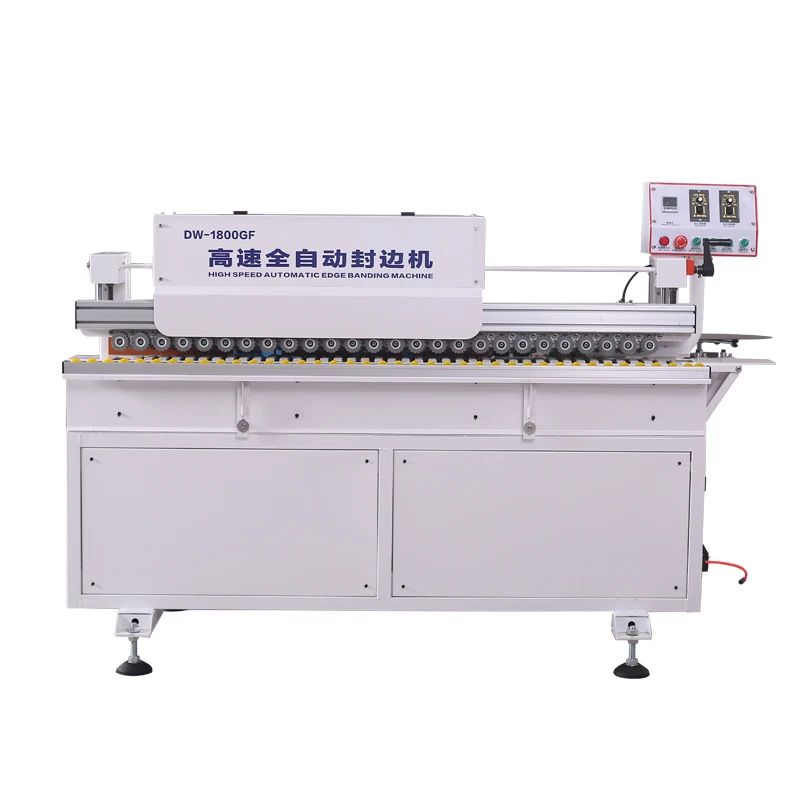
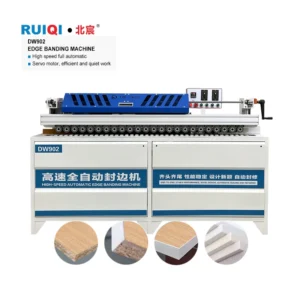
Precision-Built Assembly — Every DW1800 unit is assembled in-house on dedicated lines with a four-stage inspection protocol covering incoming material, in-process checks, finished product verification, and pre-shipment testing before any OEM edge banding machine leaves our facility.
Technical Specifications
| Parameter |
Value |
| Model |
DW1800 |
| Product Type |
Automatic Edge Banding Machine |
| Total Installed Power |
4.9 kW |
| Available Voltage |
380V / 220V / 415V |
| Feed Speed |
0–14 m/min |
| Edge Banding Height |
0–50 mm |
| Edge Banding Thickness |
0.3–3 mm |
| Minimum Sheet Length |
200 mm |
| Minimum Sheet Width |
100 mm |
| Trimming Motor |
800W × 2, 24000 r/min |
| Polishing Motor |
380W × 2 |
| Glue Pot Capacity |
4000 ml |
| Required Air Pressure |
0.4–0.6 MPa |
| Vacuum Power |
550 W |
| Overall Dimensions (L×W×H) |
2200 × 650 × 1250 mm |
| Net Weight |
320 kg |
| Standard Stations |
Double-sided gluing, front/rear alignment, top/bottom trimming, corner rounding, flexible scraping, dust extraction |
| Control Panel Languages |
Chinese, English (other languages configurable) |
| Plug Options |
EU, USA, AU, UK |
| Frame Material |
High-strength extruded aluminum alloy, oxidation treated |
Application Suitability
| Application |
Material or Output |
| Custom cabinet door production |
MDF and particleboard panels with PVC edge banding |
| Kitchen carcass manufacturing |
Melamine-faced chipboard with ABS edging |
| Office furniture components |
Plywood panels with wood veneer strip banding |
| Retail fixture fabrication |
Acrylic and organic glass plates requiring rounded edge profiles |
| Wardrobe and shelving panels |
Solid wood boards with matching veneer edge material |
Why the Voltage Conversation Must Happen Before the Quotation
A machine that cannot run on local power is a crate of expensive steel.
I have watched containers arrive at ports where the three-phase supply runs at 220V while the machine plate reads 380V, and the importing distributor discovers this only after the electrician refuses to sign off on commissioning. The edge banding machine factory that ships without confirming frequency and voltage is creating a problem that no amount of remote troubleshooting will fix. With the DW1800, voltage is a configurable option rather than a fixed default, but that flexibility only works if the buyer states the requirement during specification review. [NEED_CITE: voltage and frequency standards by export market]

Assembly Depth That Distributors Can Verify
When an OEM edge banding machine is sourced through trading channels, the distributor rarely sees the assembly floor where the unit was actually put together. Our facility operates with in-house machining of critical frame components, meaning the extruded aluminum alloy workstations are processed and oxidation-treated under direct supervision rather than subcontracted to an unknown third party. For distributors building a regional brand around consistent equipment quality, this traceability matters.
Corner Rounding as a Differentiator in the Field
The profile tracking station on the DW1800 addresses a finishing problem that lower-tier machines leave to manual labor. When cabinet doors or drawer fronts require smooth, rounded corners rather than sharp ninety-degree edges, this function completes the transition automatically at feed speed. Distributors who serve custom furniture makers quickly learn that corner rounding capability separates a machine that finishes parts completely from one that sends work back to the hand-sanding bench. [NEED_CITE: edge profile finishing standards in custom furniture production]
Reading the Numbers Behind the Six Stations
The DW1800 groups six working stations into a compact footprint, and understanding how they interact explains why certain specifications exist. The trimming motors run at 24000 r/min, a speed necessary for clean cuts on PVC and ABS edging without chipping or tearing the material surface. If the speed were lower, the cutter would drag rather than slice, leaving visible marks on light-colored banding. The 0.3–3 mm thickness range means the machine handles everything from thin melamine strips to thicker solid wood banding, but operators must adjust the gluing roller pressure when switching between these extremes. The 0–14 m/min feed speed range allows slower runs for difficult substrates like plywood, where grain direction can cause banding to lift if pushed too quickly. The 4000 ml glue pot holds enough adhesive for sustained production runs without constant refilling, though glue type and temperature must match the banding material being applied. Air pressure between 0.4 and 0.6 MPa feeds the pneumatic cylinders that control roller pressure and trimming unit positioning, and a drop below this range results in inconsistent banding adhesion.
When a Machine Quoted Without Substrate Testing Arrives
Last year I watched a Middle Eastern customer spend four full days recalibrating glue temperature, roller pressure, and feed speed because the sample panels we ran were standard-density MDF while their actual production used high-density particleboard. The adhesive behaved completely differently on the denser substrate, curing faster and bonding unevenly until every parameter was reset from scratch. Since that job, I insist on receiving actual board samples from every customer before the machine leaves our floor. An edge banding machine factory that tests only on convenient material is shipping a machine tuned for conditions that do not exist at the buyer’s facility. [NEED_CITE: substrate density effects on hot melt adhesive bonding in edge banding]
Why Buyers Source This Machine From Our Line
In-house manufacturing with patented cutting mechanisms means the DW1800 tolerance claims can be physically verified during a factory visit, not just stated on a brochure. The four-stage quality control protocol — incoming material inspection, in-process assembly checks, finished product testing, and pre-shipment verification — ensures that every OEM edge banding machine ships with documented test results rather than assumption-based approval. Voltage customization from 220V to 415V and control panel language options are treated as standard configuration steps, not special requests that delay the order. The full product family, from entry-level units to multi-function lines, lets distributors consolidate their supplier base while covering market segments from small joinery shops to panel processing plants. Engineer-led configuration review produces a formal quotation within 24 hours, including specific recommendations based on the buyer’s stated production volume and material mix.
Documentation & Verification
- CE declaration of conformity referencing applicable machinery directive clauses
- ISO 9001 certificate covering manufacturing and quality management scope
- Electrical schematic matching the confirmed voltage and plug configuration
- Factory test record documenting performance on buyer-supplied panel samples
- Operation and maintenance manual written in the buyer’s specified language
- Packing photographs and dimensional drawings for customs clearance support
Installation, Commissioning & Support
- Requires a level concrete floor with 2200 × 650 mm clear footprint and 1250 mm overhead clearance
- Dedicated circuit matching confirmed voltage (380V/220V/415V) with appropriate breaker rating for 4.9 kW total draw
- Arrives fully assembled; connect power, compressed air at 0.4–0.6 MPa, and dust extraction ducting
- First-run parameter setup includes glue temperature calibration, roller pressure adjustment, and feed speed ramp-up
- Operator training covers station-by-station function, emergency stop locations, and daily lubrication points
- Spare parts list includes trimming blades, polishing wheels, glue roller, and pneumatic seals
Preparing Your Inquiry With the Right Details
Distributors evaluating the DW1800 for regional stock or OEM branding should include the target market’s standard voltage and frequency, the panel materials most common in their territory, and any language requirements for the control interface. If private label branding is needed, specify logo placement preferences and color requirements early so these can be incorporated into the production schedule. Buyers planning a multi-machine order should indicate the full equipment list so line compatibility — particularly feed height and throughput matching between stations — can be confirmed before individual units ship.
Frequently Asked Questions
Q: What is the typical production and dispatch timeline for OEM-branded DW1800 orders?
A: Single units from standard configuration ship within a few weeks of order confirmation. OEM orders requiring custom logo application, non-standard voltage, or alternative control panel languages involve additional setup steps on the assembly line, adding typical multi-week lead times. Large batch orders for distributor stock are scheduled in dedicated production windows, and we confirm the delivery date before the order is finalized.
Q: Which dimensions of the machine can be customized under an OEM agreement?
A: OEM customization covers logo placement on the machine body and control panel, voltage configuration across the available 220V to 415V range, control panel language, plug type selection from EU, USA, AU, and UK standards, and specification adjustments such as optional station additions. Each customization dimension is documented in the formal quotation so both parties agree on the exact build before production begins.
Q: How does the pre-shipment testing process work for international orders?
A: Every DW1800 undergoes a full operational test using panel samples that match the buyer’s intended production material. We document glue adhesion quality, trimming accuracy, corner rounding results, and polishing finish in a factory test record that ships with the machine. If the buyer provides specific board samples, the test is run on those exact panels rather than generic stock material.
Q: What spare parts and technical support are available after the machine is delivered?
A: Each shipment includes a recommended spare parts list covering trimming blades, polishing wheels, glue pot components, and pneumatic seals. Distributors can establish a standing spare parts inventory based on regional service demand. Technical support is provided through remote consultation for parameter adjustment and fault diagnosis, and we supply electrical schematics and assembly drawings to support distributor service teams in the field.
Q: Can we visit the factory to observe DW1800 assembly and run a live sample test?
A: Factory visits are welcome and can be scheduled around your travel plans. During the visit, you can observe the assembly line, inspect the four-stage quality control process in action, and run test panels on a DW1800 using your own material samples. Video-guided factory tours are also available for buyers who cannot travel before placing an initial order.