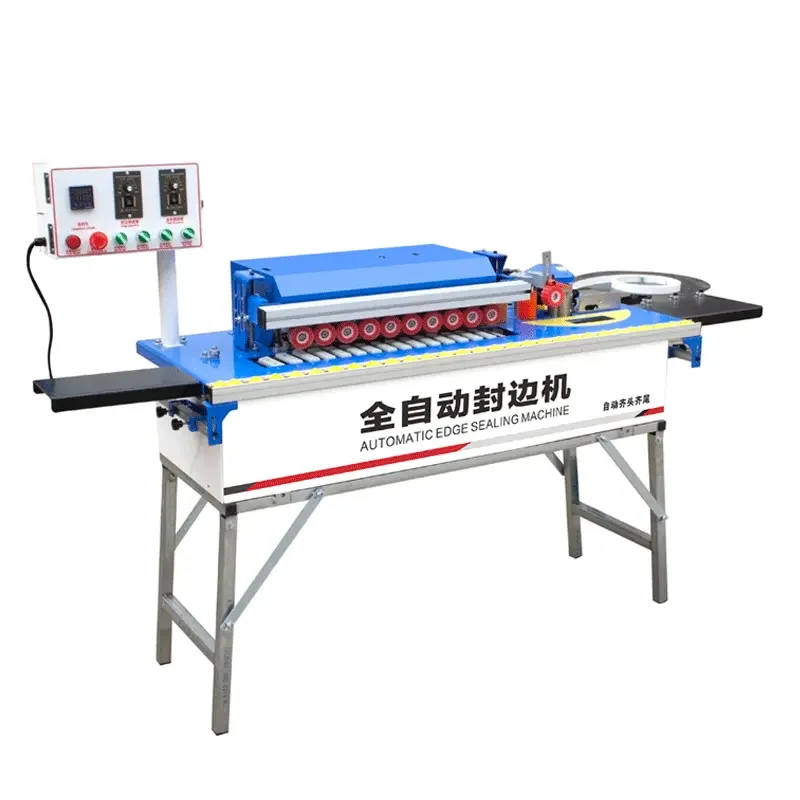
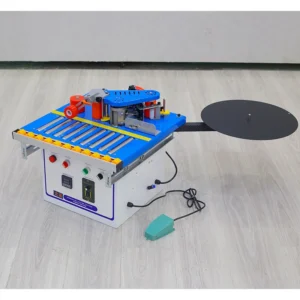
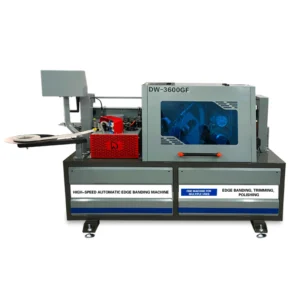
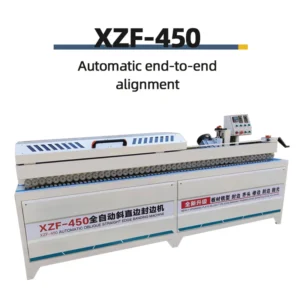
In-House Manufacturing Depth — The DW102 edge banding machine is built entirely within our Shandong facility, from precision-ground trimming spindles to final assembly, giving OEM partners full traceability over every component that goes into their branded equipment.
Technical Specifications
| Parameter |
Value |
| Model |
DW102 |
| Product Type |
Automatic Edge Banding Machine |
| Total Power |
3800W |
| Voltage |
220V / 380V / customization available |
| Edge Banding Thickness Range |
0.3–3mm |
| Edge Banding Height Range |
0–50mm |
| Minimum Sheet Length |
250mm |
| Minimum Sheet Width |
50mm |
| Trimming Power |
650W × 2 |
| Polishing Power |
180W × 2 |
| Vacuum Power |
1200W |
| Transmission Power |
60W |
| Edge Power |
20W |
| Glue Pot Capacity |
1000ml |
| Air Source Pressure |
0.5–0.8MPa |
| Product Dimensions (L×W×H) |
1280 × 470 × 690mm |
| Net Weight |
75kg |
| Key Features |
Curved and straight edge banding, edge trimming, polishing, automatic head and tail cutting, vacuum hold-down |
| Language Options |
Chinese, English, Spanish, or customized |
| Assembly State |
Fully assembled |
| Certification |
CE (basis not stated in source — confirm with manufacturer certificate) |
Application Suitability
| Application |
Material or Output |
| Cabinet door and panel edge banding |
Medium density fiberboard (MDF), particleboard, plywood |
| Custom furniture production runs |
Blockboard, solid wood panels with PVC or veneer banding |
| Curved panel edge finishing |
Polymer doors, shaped MDF components |
| Small-batch joinery workshop output |
Plywood and particleboard shelving, carcass panels |
Why the Voltage Question Must Come Before the Quotation
Confirming local voltage and frequency before production prevents a machine from sitting idle on a factory floor for weeks.
I have watched a fully functional edge banding machine sit unplugged in a Middle East workshop because the 380V motor was incompatible with the facility’s 440V supply. The buyer had to source a step-down transformer while the entire cabinet line stalled, costing the factory weeks of idle labor and delayed shipments. This is not a rare scenario — electrical mismatches remain one of the most common and avoidable reasons for commissioning failures in exported woodworking machinery [NEED_CITE: voltage and frequency standards by export market]. When sourcing an edge banding machine factory direct, the first technical exchange should always be electrical compatibility, not feed speed or trimming stations.

Manufacturing Traceability for OEM Partners
OEM buyers evaluating an edge banding machine factory need visibility into how each sub-assembly reaches the final line. The DW102 begins as raw castings and bar stock that undergo precision grinding at our facility, with dimensional checks recorded at each stage before components move to assembly. This in-house control means an OEM partner can audit the trimming spindle runout, inspect the glue pot welding quality, and review the electrical panel layout before a single unit carries their logo.
Quality Control Stages That Protect Your Brand
A distributor’s reputation depends on the reliability of every machine that leaves the factory under their name. Our four-stage QC process covers incoming material inspection, in-process dimensional verification, finished-product functional testing, and a pre-shipment run under load with the buyer’s specified panel stock. Each DW102 edge banding machine factory order ships with a documented test record, so an OEM partner can show their own customers exactly what tolerance and finish quality were achieved before crating [NEED_CITE: industrial machinery pre-shipment inspection standards].
Reading the Specs That Actually Matter
The dual 650W trimming motors and dual 180W polishing units on the DW102 are sized for continuous trimming and finishing passes on PVC and veneer banding up to 3mm thick. Undersized trimming motors tend to chatter on thicker stock, leaving visible witness lines that force manual rework downstream. The 1000ml glue pot capacity supports sustained runs without frequent refills, which matters when a batch of cabinet doors demands uninterrupted feed. Air source pressure of 0.5–0.8MPa drives the pneumatic feed rollers and trimming actuators; pressure below the minimum threshold causes inconsistent roller grip and panel slippage. The vacuum hold-down system at 1200W keeps lighter panels such as thin MDF stable through the trimming and polishing stations, reducing scrap from workpiece drift.
The Hidden Cost of Skipped Configuration Checks
Ordering a single machine without mapping it to the rest of the line creates bottlenecks that only appear once production starts. A panel saw cutting faster than the bander can process creates a queue of raw edges waiting for finishing, while a slower upstream feed starves the bander and wastes cycle time. Buyers who skip voltage confirmation, skip panel thickness matching, or skip language configuration on the control panel discover these problems at the worst possible moment — after the crate is opened and the installation window has closed [NEED_CITE: common commissioning failures in imported woodworking machinery]. The rework cost in transformer sourcing, rewiring, and operator retraining frequently exceeds the price difference between a properly specified unit and an off-the-shelf default configuration.
Why OEM and Distributor Buyers Source Here
The DW102 is manufactured on a single site where component machining, assembly, and testing all happen under one roof, so an OEM partner never has to chase quality issues across separate subcontractors. Voltage customization from 220V to 380V and beyond is handled at the motor and transformer specification stage, not as a last-minute adapter. Control panel language is configured before the electrical panel is closed, ensuring the operator interface matches the destination market from day one. Our patented cutting mechanisms deliver verified trimming tolerance, documented in the factory test record that accompanies every shipment. The OEM customization scope extends to logo placement, packaging markings, and documentation sets prepared for the distributor’s local compliance requirements.
Documentation & Verification
- CE declaration of conformity for the DW102 edge bander model
- ISO 9001 certificate covering manufacturing processes at our facility
- Factory test record documenting trimming tolerance on buyer’s panel stock
- Electrical schematic reflecting confirmed voltage and frequency for destination market
- Operation and maintenance manual in buyer’s specified language
- Spare parts list with OEM-compatible part numbers for local inventory planning
Installation, Commissioning & Support
- Requires a level concrete floor with clearance around the 1280 × 470mm footprint for panel infeed and outfeed
- Dedicated circuit matching confirmed voltage (220V or 380V) with appropriate breaker rating for 3800W total draw
- Arrives fully assembled; connect compressed air line at 0.5–0.8MPa and power supply before first run
- Initial glue pot heat-up and temperature calibration performed against buyer’s banding material and panel substrate
- Operator training covers curved and straight edge sequences, trimming adjustments, and daily glue pot cleaning routine
- Wear parts list includes trimming blades, polishing wheels, and feed roller covers with stocking recommendations
Preparing Your Engineering Inquiry
To receive a formal quotation with confirmed specifications, share your target panel materials and thickness range, the edge banding materials you plan to run, and your facility’s voltage and frequency. Let us know whether the DW102 will operate as a standalone station or feed into a larger line with existing saws and borers. If you require a sample processing test on your own panel stock before committing to an order, include panel dimensions and banding specifications so we can schedule a trial run.
Frequently Asked Questions
Q: What does the OEM customization scope include for the DW102?
A: OEM partners can specify their own logo on the machine body and control panel faceplate, confirm the voltage and motor winding to match the destination grid, select the operator interface language, and define packaging markings. All custom elements are locked in before production begins, and sample approvals are available for branding layout and documentation sets prior to full-order commitment.
Q: How is edge banding tolerance verified before the machine ships?
A: Each DW102 undergoes a pre-shipment test run using panel stock that matches the buyer’s material specification. Trimming results are measured at multiple points along both straight and curved edges, and the recorded values are included in the factory test document that travels with the shipment. This gives the buyer an auditable record of the precision achieved on their specific substrates.
Q: Can I visit the factory to audit production and quality control?
A: Factory visits are welcomed at any stage — during component machining, mid-assembly, or at final pre-shipment testing. Visiting buyers can observe the precision grinding operations, review four-stage QC checkpoints in real time, and witness a live test run on their chosen panel material. Advance scheduling ensures the relevant engineering staff are available for technical discussion.
Q: How does the DW102 match throughput with upstream and downstream equipment?
A: The machine’s feed system and pneumatic actuator cycle times determine its processing rhythm, which must align with the output rate of your panel saw and the intake capacity of any downstream boring or assembly station. Share your existing equipment models and target batch volumes in your inquiry, and our engineers will recommend feed speed settings and line layout adjustments to balance the flow across all stations.
Q: What is the process for ordering a sample test run before placing a full order?
A: Send panel samples with your typical banding material, and we schedule a test run on a production-specification DW102. You receive the finished panels along with the trimming and polishing measurement data. If you prefer to witness the test in person, coordinate a visit so our technicians can walk through setup parameters and answer questions on the shop floor.