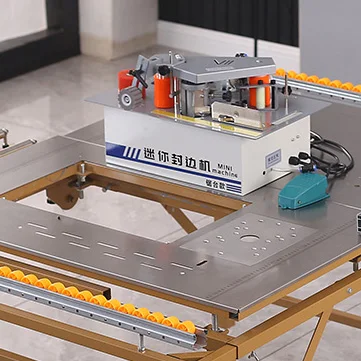
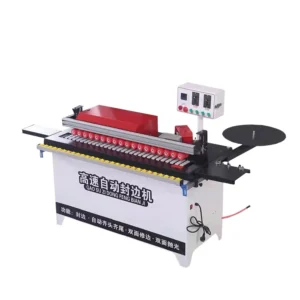
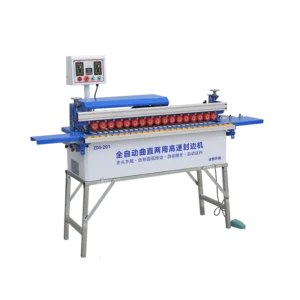
Precision-Ground Components — verified through four-stage QC on every portable edge bander before dispatch, ensuring consistent glue application on curved and straight panel profiles.
Technical Specifications
| Parameter |
Value |
| Product Type |
Manual Edge Bander |
| Voltage |
220V (basis not stated in source — confirm single-phase or three-phase, frequency 50/60Hz) |
| Rated Power |
825W |
| Glue Pot Capacity |
1000 ml |
| Heating Time |
5-10 min |
| Edge Banding Speed |
0-10 m/min |
| Air Pressure Requirement |
0.4-0.6 MPa |
| Edge Pattern Compatibility |
Curves, straight lines, special shaped lines |
| Overall Dimensions |
50×30×27 cm |
| Control System |
Manual operation |
| Trimming Stations |
Manual trimming |
| Assembly State |
Requires assembly |
Application Suitability
| Application |
Material or Output |
| Small workshop custom cabinet edging |
MDF and plywood panels with PVC banding |
| Curved furniture component finishing |
Veneer and melamine edge strips on radiused profiles |
| On-site joinery repair and retrofitting |
Particleboard shelving with standard thickness banding |
| Prototype and short-run production |
Solid wood panels requiring manual contour banding |
Why the Voltage Question Must Come Before the Quote
Sending a 220V machine into a 110V market without transformer planning stops production before it starts.
I have seen importers receive a portable Manual Edge Bander only to discover the heating element could not reach glue activation temperature on their local supply. The glue pot sat lukewarm, the PVC banding peeled off within hours, and the workshop blamed the machine rather than the specification gap. Voltage and frequency confirmation should be the first line in any inquiry, not an afterthought once the crate arrives. [NEED_CITE: voltage and frequency standards by export market]

Component Sourcing and Assembly Depth
Every Manual Edge Bander factory OEM order starts with precision-ground glue roller shafts and matched bearing pairs. The compact 50×30×27 cm footprint demands tight assembly tolerances so the glue film stays uniform across curved profiles. In-house machining of these contact surfaces keeps runout within limits that off-the-shelf bushings cannot guarantee.
Four-Stage Verification Before Dispatch
Incoming material inspection checks the heating element wattage against the rated 825W specification. In-process QC verifies the glue pot seal under 0.4-0.6 MPa air pressure. Finished product testing runs actual PVC and veneer banding through curves at varying feed speeds. Pre-shipment verification includes a voltage confirmation sheet matched to the buyer’s destination market. [NEED_CITE: CE machinery directive requirements for industrial equipment]
What the Specification Sheet Actually Means for Output
The 1000 ml glue pot capacity determines how long you can run before stopping to refill — on a 10 m/min feed rate with standard PVC banding, this translates to sustained operation through a typical small-batch run without interruption. The 5-10 minute heating time reflects the 825W element warming the adhesive to working viscosity; thicker glue formulations or colder workshop environments push this toward the upper end. Air pressure at 0.4-0.6 MPa drives the banding feed roller, and pressure stability directly affects whether the edge strip lays flat on curves or lifts at the tangent points. Manual trimming means the operator controls the cutoff, which suits short runs and one-off curved panels but requires skill to maintain clean corners on production batches.
The Hidden Cost of Skipping Electrical Confirmation
Ordering without matching local voltage leads to underpowered heating elements that never reach adhesive activation temperature. The banding appears to stick during the first test, then delaminates once the panel cools or experiences humidity changes. Workshops spend days troubleshooting glue formulation when the root cause sits inside the electrical cabinet. Replacing the heating element or adding a step-down transformer costs more than confirming specifications before production. [NEED_CITE: common causes of edge banding adhesion failure in woodworking]
Manufacturing Capability Behind the Compact Footprint
In-house precision grinding of the feed roller and glue application surfaces keeps the banding path true, even on the tight curves this unit is designed to handle. The four-stage QC process catches seal leaks and wiring faults before the unit leaves the factory floor. Voltage adaptation from 110V to 440V is configured at the order stage, not patched in the field. Full OEM and private label capability covers custom branding, packaging, and multilingual operation manuals. Engineer-led configuration review ensures the 825W rating and 220V baseline match your market’s electrical infrastructure before production begins.
Documentation & Verification
- Factory test record showing glue adhesion on your specified PVC or veneer thickness
- Electrical schematic confirming voltage and frequency match for your destination market
- Pre-shipment photograph of your unit with serial number and packing condition
- Operation manual translated into your operator’s working language
- Spare parts list with part numbers matching your unit’s bill of materials
Installation, Commissioning & Support
- Requires bench-top assembly; confirm workshop has a stable surface rated for 13.5 kg operating weight
- Dedicated 220V circuit needed to sustain 825W draw without tripping shared breakers
- Compressed air supply at 0.4-0.6 MPa must be clean and dry to protect the feed cylinder
- First run should test heating time with your specific glue brand at workshop ambient temperature
- Manual trimming tools require operator training on curved profiles to avoid chipping the banding edge
- Glue pot cleaning after each use prevents residue buildup that affects heating uniformity
Requesting a Configuration Review
Before quoting, we need your target market voltage and frequency, the banding materials you plan to run (PVC, veneer, melamine), and typical panel thickness range. If you are ordering for OEM distribution, specify branding requirements and documentation language. Sample material can be sent for a factory test run to verify glue adhesion and feed behavior on your exact stock.
Frequently Asked Questions
Q: What OEM customization options are available for this manual edge bander?
A: Logo placement, private label packaging, voltage adaptation from 110V to 440V, and multilingual control documentation are all configurable at order. We provide artwork proofs and packaging mockups for approval before production begins. Minimum order quantities for full OEM branding vary by customization depth.
Q: How does the four-stage QC process work for portable edge banders?
A: Incoming material inspection checks heating elements and pneumatic components against spec. In-process QC tests glue pot seals under working air pressure. Finished product testing runs actual banding material through curves and straight sections. Pre-shipment verification confirms electrical configuration matches the destination market.
Q: What is the typical lead time for a bulk OEM order?
A: Production scheduling depends on order volume and customization scope. Standard voltage configurations with minimal branding changes move through production faster than fully adapted units requiring new electrical components. We provide a confirmed dispatch timeline once the specification sheet is signed off.
Q: Can we visit the factory to inspect manufacturing processes?
A: Factory visits are welcome and can be arranged to observe precision grinding operations, assembly line workflow, and QC checkpoints. We recommend scheduling during production of a comparable order so you can see actual units moving through each verification stage.