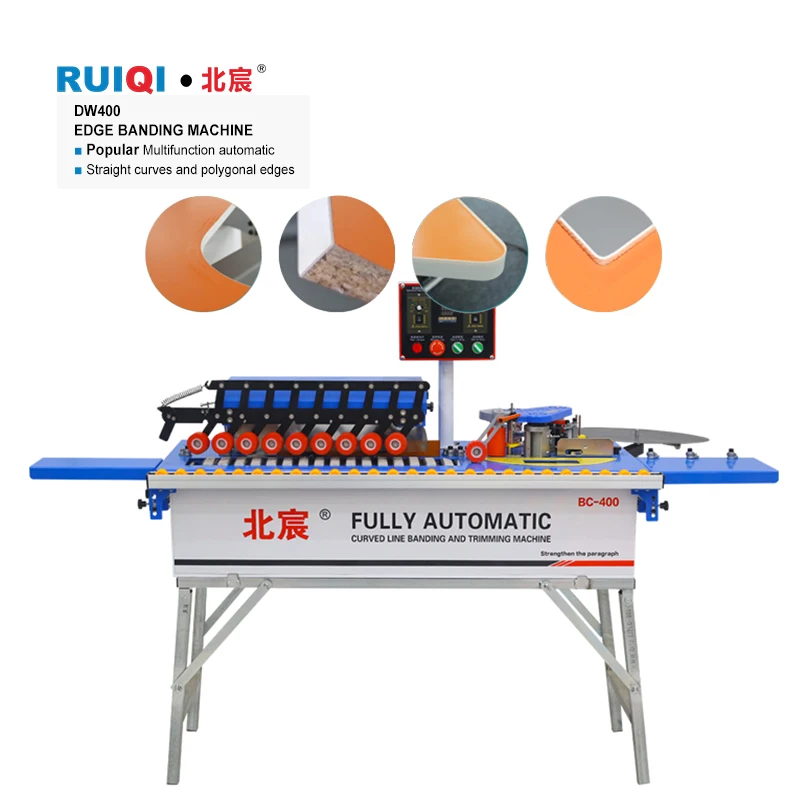
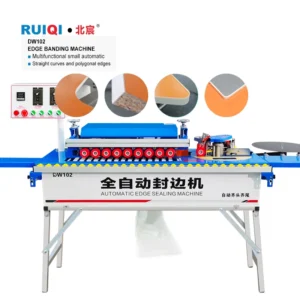
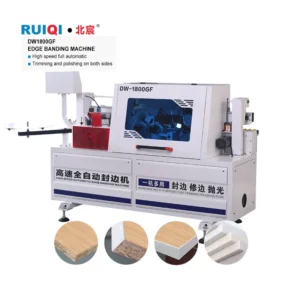
Private-Label Ready — Every DW400 edge bander leaves the factory with your branding, confirmed voltage documentation, and a test record matched to your market’s electrical standards before crating.
Technical Specifications
| Parameter |
Value |
| Model |
DW400 |
| Product Type |
Edge Banding Machine |
| Total Power |
3800W |
| Voltage |
220V / 380V / Custom Configuration |
| Edge Banding Height |
0–50 mm |
| Edge Banding Thickness |
0.3–3 mm |
| Minimum Sheet Length |
250 mm |
| Minimum Sheet Width |
100 mm |
| Trimming Power |
650W × 2 |
| Polishing Power |
180W × 2 |
| Vacuum Power |
1200W |
| Edge Power |
20W |
| Transmission Power |
60W |
| Glue Pot Capacity |
1000 ml |
| Air Source Pressure |
0.5–0.8 MPa |
| Product Size |
116 × 47 × 69 cm |
| Product Weight |
70 kg |
| Assembly State |
Standalone Unit |
| Control Panel Language |
Chinese, English, Customizable (Spanish, French, etc.) |
| Certification |
CE, ISO 9001 |
Application Suitability
| Application |
Material or Output |
| Cabinet carcase edge banding |
MDF, particleboard, plywood |
| Door panel straight edge finishing |
Solid wood panels, blockboard |
| Polymer door profile banding |
Polymer composite sheets |
| Custom furniture trim work |
PVC and veneer edge banding, 0.3–3 mm thickness |
| Mid-volume workshop production |
Panel processing for large and medium-sized furniture manufacturers |
Why Voltage Confirmation Must Happen Before the Order Is Signed
A machine built for the wrong grid does not fail gradually — it fails on day one, and your customer’s entire line stops with it.
An edge banding machine OEM factory conversation often starts with throughput questions and ends with logistics, but the electrical mismatch is the failure mode that causes the most visible damage. I was on a service call in Colombia where a fully automatic edge bander arrived wired for 380V three-phase while the workshop ran 220V three-phase. The main control board burned within minutes of power-on, and the customer’s cabinet line sat idle for two weeks waiting for a replacement board shipped overseas. That kind of incident does not just cost a component — it costs the distributor’s reputation in the local market [NEED_CITE: voltage and frequency standards by export market]. The DW400 ships with a signed voltage confirmation sheet and electrical schematic matched to your destination country before production begins.

OEM Branding and Market-Specific Configuration
Distributors need more than a logo swap to build a defensible product line in their territory. The DW400 supports custom control panel languages — including Spanish, French, and other regional options — so the operator interface matches the market where the machine will actually run. Voltage is configurable across the 110V–440V range, confirmed in writing against the buyer’s local grid specification before any unit enters production. This edge banding machine OEM factory process ensures that every private-label unit is built for a known destination, not pulled from generic stock.
Four-Stage Quality Control Before Crating
Each DW400 passes through incoming material inspection, in-process assembly checks, finished product verification, and a pre-shipment functional test. The glue pot heats to operating temperature, the trimming and polishing stations run under load, and the pneumatic circuits are pressurized to the specified 0.5–0.8 MPa range. A factory test record documents the results and ships with the machine. For OEM partners ordering container loads, this means every unit carries its own traceable verification file rather than a batch-level certificate [NEED_CITE: CE machinery directive requirements for industrial equipment].
Reading the Specification Sheet Against Real Workshop Conditions
The dual 650W trimming motors provide enough torque to cleanly shear PVC and wood veneer banding at the rated thickness range of 0.3–3 mm without chipping the panel edge. Polishing stations at 180W each handle final surface finishing on both straight and slightly contoured edges. The 1000 ml glue pot capacity supports sustained runs without frequent refill interruptions, which matters when a workshop is processing cabinet batches in sequence. The 0–50 mm edge banding height range covers standard 16 mm, 18 mm, and 25 mm panel stock common in furniture production, as well as thicker solid wood door components. Air source pressure at 0.5–0.8 MPa must be available at the point of connection; insufficient pneumatic supply causes intermittent pressure drops that lead to uneven banding adhesion — a fault that operators often misdiagnose as a glue temperature problem.
The Cost of Skipping Pre-Shipment Electrical Verification
When a distributor accepts a machine without reviewing the electrical schematic against local supply conditions, the failure mode is immediate and expensive. Control boards, variable frequency drives, and motor contactors rated for one voltage range will not degrade gracefully on the wrong supply — they fail catastrophically, often taking connected components with them. The workshop loses production days while waiting for international freight on replacement electronics. The distributor absorbs warranty cost, air freight charges, and the reputational damage of delivering a machine that never ran [NEED_CITE: industrial equipment warranty claim patterns by failure category]. The DW400’s pre-production voltage confirmation step exists specifically to eliminate this class of failure.
Why Distributors Source This Model from the Factory
In-house manufacturing with patented cutting mechanisms means the DW400 is not a rebranded unit from a trading company — engineering changes and OEM customization requests go directly to the production floor. The full product family spans entry-level to full-function models, allowing a distributor to offer a tiered range under one brand without managing multiple supplier relationships. Voltage, language, and specification customization are standard line items, not special requests requiring minimum order negotiations. Pre-shipment verification with documented test records protects both the distributor and the end customer from electrical and functional mismatches. Engineer-led configuration recommendations are provided within 24 hours of inquiry, giving distributors the technical backup they need during the quotation stage with their own buyers.
Documentation & Verification
- CE declaration of conformity included with each DW400 shipment
- ISO 9001 certificate covering manufacturing process and QC procedures
- Electrical schematic and voltage confirmation sheet matched to destination market
- Factory test record documenting functional verification before dispatch
- Operation and maintenance manual in the agreed control panel language
- Spare parts list with part numbers for trimming, polishing, and pneumatic components
Installation, Commissioning & Support
- Requires a dedicated circuit matching the confirmed voltage (220V or 380V) with appropriate breaker rating for 3800W total draw
- Pneumatic supply must deliver 0.5–0.8 MPa at the machine inlet; verify compressor capacity before connection
- Standalone unit at 70 kg can be positioned by two people; no foundation bolts required for the 116 × 47 cm footprint
- First startup includes glue pot temperature calibration and trimming station alignment against sample panel stock
- Control panel language set to agreed option before shipment; additional language files available for future reconfiguration
- Glue pot and polishing pads listed as consumables with replacement intervals in the maintenance manual
What We Need to Configure Your DW400 Correctly
To prepare an accurate quotation and configuration proposal, provide your target market’s standard voltage and frequency (e.g., 220V/60Hz or 380V/50Hz), the control panel language your technicians require, and whether the units will carry your own brand logo and packaging. If you are integrating the DW400 into a broader equipment package, share the upstream and downstream machines in the line so we can verify material flow compatibility and feed height alignment.
Frequently Asked Questions
Q: How is voltage and frequency confirmed for my target market before production?
A: Before any DW400 enters production, we request your local voltage and frequency specification and issue a formal voltage confirmation document with a matching electrical schematic. Both are reviewed and signed off by your team. The confirmed values are then locked into the build order, and the factory test is conducted under those exact electrical conditions before the machine is cleared for shipment.
Q: What OEM customization is available for the DW400?
A: The DW400 supports OEM logo placement on the machine body, custom control panel languages including Spanish and French, private-label packaging with your branding and artwork, and voltage configuration from 110V to 440V. Design proofs for logo placement and packaging are sent for your approval before mass production begins, ensuring the finished units match your market positioning.
Q: Can I review the factory test record before the machine ships?
A: Every DW400 undergoes a pre-shipment functional test covering glue pot heating, trimming and polishing station operation under load, and pneumatic circuit pressurization. The test record documents results for each station and is shared with the buyer before crating. For container-load orders, individual test records are provided per unit rather than a single batch-level summary.
Q: What spare parts and training support do you provide to distributor service teams?
A: Each DW400 ships with a spare parts list covering high-wear components including trimming cutters, polishing pads, and pneumatic seals. Distributor service teams can request technical training materials covering electrical troubleshooting, station alignment procedures, and glue system maintenance. Remote support is available for commissioning questions during initial installations in new territories.