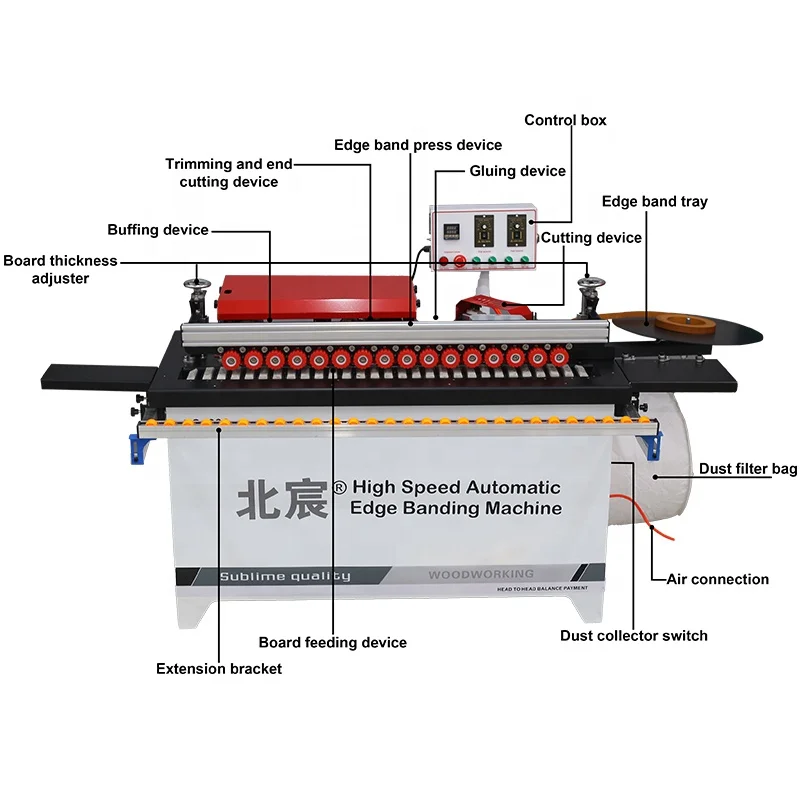
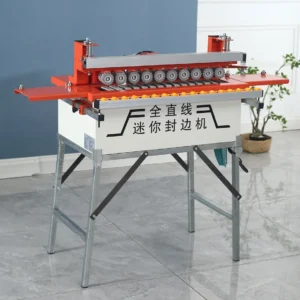
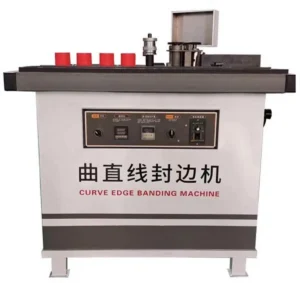
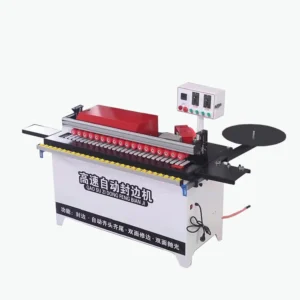
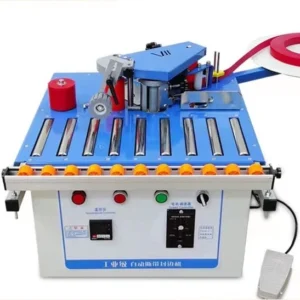
In-house manufacturing control — Every DW802 unit passes four-stage quality checks before leaving the assembly floor, not outsourced or rebranded.
Technical Specifications
| Parameter |
Value |
| Model |
DW802 |
| Product Type |
Automatic Edge Banding Machine |
| Total Power |
4200W |
| Voltage |
220V / 380V / customizable from 110V to 440V |
| Glue Pot Capacity |
4000ml |
| Edge Banding Height |
0–50mm |
| Edge Banding Thickness |
0.3–3mm |
| Minimum Sheet Length |
25cm |
| Minimum Sheet Width |
10cm |
| Edge Feed Power |
140W |
| Transmission Power |
140W |
| Trimming Power |
800W × 2 |
| Polishing Power |
180W × 2 |
| Vacuum Power |
1200W |
| Air Source Pressure |
0.4–0.8 MPa |
| Product Size |
130 × 60 × 95 cm |
| Product Weight |
135 kg |
| Control Panel Language |
Chinese and English (customizable to Spanish or other languages) |
| Plug Options |
EU, USA, AU, UK |
| Assembly State |
Fully assembled |
| OEM Support |
Logo printing available, production to customer drawings |
| Standards |
CE, ISO |
Application Suitability
| Application |
Material or Output |
| Cabinet door edge sealing |
MDF and melamine-faced particleboard |
| Custom furniture panel finishing |
Plywood and ecological board |
| Small-batch joinery production |
Solid wood board up to 50mm thickness |
| Home decoration workshop output |
PVC and veneer edge banding 0.3–3mm |
| Entry-level automated line integration |
Panel components for wardrobe and shelving |
Why Voltage Mismatch Ruins More Orders Than Machine Quality
Confirming local voltage and frequency before production starts is the single most overlooked step in cross-border machinery procurement.
Distributors regularly receive equipment built for a default voltage that does not match the destination market. A 380V/50Hz machine shipped to a 220V/60Hz region will either refuse to start or run motors at incorrect speeds, causing premature bearing wear and inconsistent feed rates. [NEED_CITE: voltage and frequency standards by export market] When this happens after shipment, the cost of rewiring, transformer installation, or motor replacement often exceeds the savings from factory-direct pricing. The DW802 automatic edge banding machine OEM factory build process requires voltage confirmation as a formal step before production begins, not as an afterthought at the packing stage.

Precision Ground Components and Proprietary Mechanisms
The cutting and trimming assemblies in this Automatic Edge Banding Machine OEM factory product line use proprietary mechanisms developed in-house. Dual 800W trimming motors handle head-and-tail cutting with enough torque margin to stay consistent through long production runs without thermal drift. Each component undergoes precision grinding across multiple stages before final assembly, which is how the machine maintains tight edge-to-panel contact across varying board thicknesses.
Four-Stage Quality Control Before Dispatch
Incoming raw materials are inspected first, followed by in-process checks at each assembly station. Finished units then run through operational testing under load conditions that simulate actual production, and a final pre-shipment verification confirms every function matches the specification sheet. This four-stage process is documented and available for review. [NEED_CITE: CE machinery directive requirements for industrial equipment] For OEM partners requesting private label builds, these same QC stages apply with the partner’s branding applied only after mechanical and electrical verification is complete.
How Core Parameters Translate to Edge Quality
The 4000ml glue pot capacity is sized for sustained operation on standard furniture panels without requiring mid-run refills that cause temperature fluctuation and uneven adhesive application. Glue temperature stability directly affects bond strength on porous substrates like particleboard versus sealed surfaces like melamine-faced MDF. The 0.3–3mm edge banding thickness range covers PVC, veneer, and melamine strips, meaning a single machine handles the material mix typical in custom furniture workshops. Vacuum power at 1200W keeps the workpiece stable on smaller panels down to 25cm × 10cm, which matters when processing offcuts and narrow cabinet components that tend to shift under feed pressure. The fully assembled delivery state means the machine arrives ready for power connection and first-run calibration rather than requiring on-site mechanical assembly that could introduce alignment errors.
The Hidden Cost of Skipping Pre-Shipment Verification
Machines that leave a factory without a confirmed test run on the buyer’s actual substrate often reveal problems only after installation. Glue lines become visible on coarse recycled particleboard. Edge banding bubbles appear when moisture content in the board exceeds what the glue temperature profile can accommodate. Feed mechanisms stall on panels that are slightly thicker than nominal because the infeed clearance was never set for that specific material stack. [NEED_CITE: common edge banding defects caused by substrate variability] These are not defects in the machine itself — they are mismatches between default factory settings and real-world production conditions that pre-shipment sample testing would have caught.
Why Sourcing This Automatic Edge Banding Machine from the Factory
In-house manufacturing means the engineering team that designed the DW802 also oversees its assembly, so configuration changes requested by OEM partners are evaluated by the same people who built the machine. Voltage, plug type, and control panel language are confirmed in writing before production, not assumed from a catalog default. Private label builds follow the same four-stage QC protocol as standard units, with the partner’s logo applied after mechanical verification passes. Factory visits are welcomed so distributors can inspect component sourcing, grinding stations, and assembly benches firsthand. Formal quotations are returned within 24 hours with an engineer-led configuration recommendation rather than a generic price list. [NEED_CITE: OEM manufacturing due diligence checklist for industrial machinery]
Documentation & Verification
- CE declaration of conformity covering the DW802 electrical and mechanical safety requirements
- Machine specification sheet confirming agreed voltage, plug type, and control language before build
- Electrical schematic with voltage confirmation signed off by both parties prior to assembly
- Factory test record showing edge banding results on the buyer’s specified panel thickness and material
- Operation and maintenance manual provided in the buyer’s agreed language at shipment
- Spare parts list with part numbers matching the as-built configuration
Installation, Commissioning & Support
- Fully assembled 135kg unit requires level floor space of approximately 130 × 60cm with clearance for infeed and outfeed
- Dedicated circuit required matching the confirmed voltage specification with appropriate breaker rating for 4200W total draw
- Air supply line at 0.4–0.8 MPa must be connected before first run for pneumatic feed and clamping functions
- Initial commissioning includes setting glue temperature profile for the buyer’s edge banding material and substrate combination
- Multilingual control panel in the operator’s language reduces setup errors during first-week production
- Spare parts kit includes high-wear trimming blades and glue pot seals matched to the OEM configuration
Starting Your DW802 OEM Inquiry
Provide your target market voltage and frequency, the panel substrates your customers process most frequently, and the edge banding materials you plan to stock. If you require private label branding, share your logo artwork and any custom color specifications for the machine housing. For buyers evaluating multiple configurations, specify whether the DW802 will operate standalone or integrate into an existing production line so we can confirm feed height and throughput compatibility. Sample processing tests on your actual board stock can be arranged before order confirmation.
Frequently Asked Questions
Q: What customization options are available for OEM and private label builds?
A: Logo printing on the machine housing, custom voltage from 110V to 440V, plug type selection across EU, USA, AU, and UK standards, and control panel language configured to your operator base. Production to customer drawings is also supported for distributors requiring dimensional or functional modifications beyond standard configuration.
Q: Can we arrange a factory visit and sample test before placing an OEM order?
A: Factory visits are welcomed to inspect the assembly floor, QC stations, and component inventory. Sample edge banding tests can be run on your supplied panel material and edge banding stock to verify output quality matches your market expectations before order confirmation.
Q: How are large-volume OEM orders scheduled and delivered?
A: Production slots are confirmed after specification sign-off and deposit receipt. Large batches are scheduled across multiple production cycles with pre-shipment verification on each unit. Dispatch timing is communicated with milestone updates throughout the build cycle.
Q: What spare parts support do OEM partners receive?
A: Each machine ships with a spare parts list matched to the as-built configuration. OEM partners can order branded spare part kits for their own service inventory, and high-wear components like trimming blades and glue pot seals are available for ongoing supply.
Q: What after-sales support is available for overseas distributors?
A: Remote technical guidance is provided for installation and commissioning questions. Distributors can request technical training materials in their local language for their own service teams, and engineering support is available for troubleshooting issues that arise after the machine is in the field.