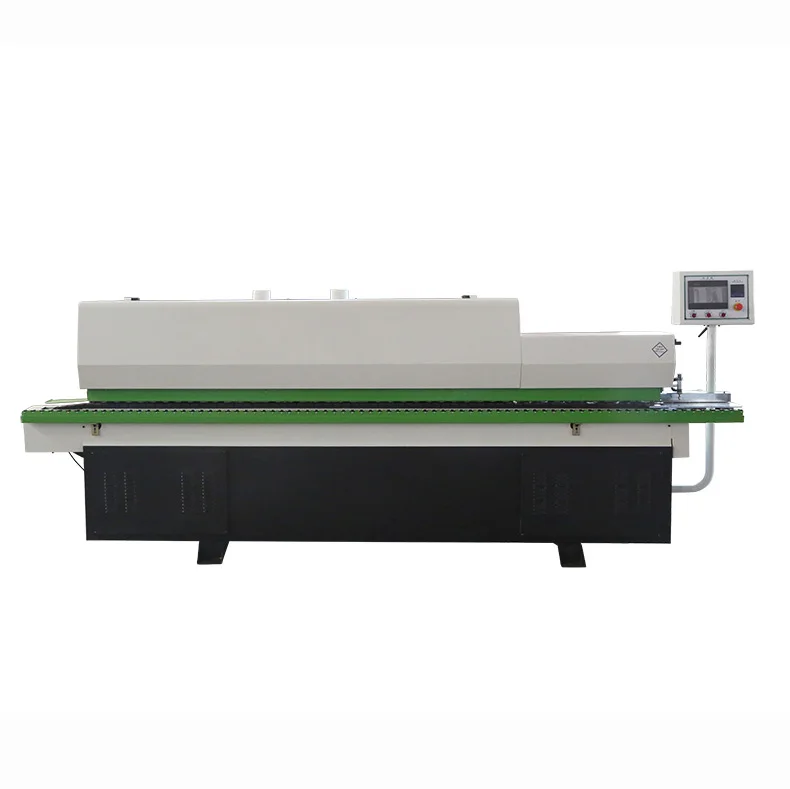
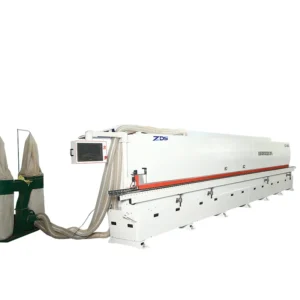
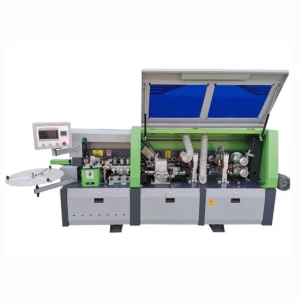
Precision-engineered frame and traceable components — the ZDS368A is manufactured on a 14mm quenched steel chassis with documented sourcing for every pneumatic and electrical subsystem, giving OEM partners verifiable build depth before private-label commitment.
Technical Specifications
| Parameter |
Value |
| Model |
ZDS368A |
| Product Type |
Automatic Edge Banding Machine |
| Main Functions |
Gluing, End Trimming, Rough Trimming, Fine Trimming, Scraping, Buffing |
| Panel Thickness Range |
10–55 mm |
| Edge Thickness Range |
0.3–3.5 mm |
| Min. Panel Width |
40 mm |
| Min. Panel Length |
60 mm |
| Feed Speed (Conveyor Belt) |
18 m/min |
| Rated Power |
8.5 kW |
| Voltage & Frequency |
380V / 3-phase (frequency to confirm: 50 Hz or 60 Hz) |
| Working Pressure |
0.6–0.8 MPa |
| Overall Dimensions (L×W×H) |
4200 × 1000 × 1500 mm |
| Net Weight |
1500 kg |
| Machine Frame |
14 mm national standard high-strength steel plate, frame-type structure, high-temperature quenched |
| Conveyor Guide Rail Material |
HT260 cast iron |
| Conveying Motor |
Taiwan brand with thermal protection |
| Head Guide Rail |
Taiwan brand |
| Pneumatic System |
German Festo or Taiwan AirTAC cylinders and safety valves; AirTAC magnetic switches |
| Electrical Components |
Delixi / Chint air switches and contactors; Japanese Omron travel switches |
| Warranty |
1 year |
Application Suitability
| Application |
Material or Output |
| Custom cabinet door edge finishing |
MDF and plywood with PVC or ABS banding 0.4–2.0 mm |
| Wardrobe and shelving panel edging |
Particleboard with melamine or veneer strips up to 3.5 mm |
| Small-batch furniture production runs |
Solid wood panels requiring scraping and buffing stations |
| OEM-branded machine deployment |
Distributor-specified configurations with private-label panels |
Why the Component List Matters More Than the Price Tag
Every sourcing decision on this Automatic Edge Banding Machine factory OEM build is traceable to a named manufacturer, not a generic label.
Distributors evaluating an Automatic Edge Banding Machine factory OEM partner often discover that quoted specifications tell only half the story. The frame thickness, rail material, and cylinder brand determine whether a machine holds tolerance after six months of continuous operation — or starts producing visible glue lines on the first humid morning of the season. I have seen workshops receive edge banders with unbranded pneumatic valves that drift in pressure within weeks, forcing daily manual recalibration that no manual ever warned them about [NEED_CITE: pneumatic component traceability standards for woodworking machinery].

Sourcing Transparency for Private-Label Partnerships
When a regional distributor commits to branding an Automatic Edge Banding Machine factory OEM unit under their own name, every warranty claim lands on their reputation. The ZDS368A addresses this by specifying German Festo or Taiwan AirTAC cylinders across all trimming and scraping stations, paired with AirTAC magnetic switches that provide consistent positional feedback. This level of component disclosure lets OEM partners audit the bill of materials before the first container ships, rather than discovering substitutions after the machine arrives at their customer’s workshop.
Frame Construction That Survives the Shipping Container
The 14mm high-strength steel frame undergoes high-temperature quenching — a process that relieves internal stresses introduced during welding and cutting. For an OEM partner shipping machines across oceans, this matters: a frame that arrives warped will never hold the ±0.02 mm trimming tolerance the end customer expects. The HT260 cast iron conveyor guide rails add mass and damping where vibration from the trimming motors would otherwise transfer into the panel feed path [NEED_CITE: metallurgical treatment standards for machine tool frames].
Reading the Specs Through a Production Lens
The six-station process sequence — gluing through buffing in a single pass — eliminates the secondary handling that introduces edge damage in two-machine setups. The 10–55 mm panel thickness range covers everything from thin MDF drawer bottoms to thick solid-wood tabletop stock, while the 0.3–3.5 mm edge thickness range accommodates both delicate veneer strips and heavy PVC protection on work surfaces. The 18 m/min conveyor belt speed, driven by a thermally protected Taiwan-brand motor, provides stable feed without the thermal drift that cheaper motors introduce during extended production runs. For workshops processing abrasive particleboard, the combination of rough trimming, fine trimming, and scraping stations means the final buffing pass works on a clean edge profile rather than compensating for leftover material from upstream.
The Hidden Cost of Underspecified Configurations
A distributor who ships an edge bander without confirming the destination market’s voltage and frequency faces a machine that either runs at the wrong speed or trips breakers on startup. I have seen 380V/50Hz machines plugged into 60Hz grids where the conveyor motor runs faster than the glue pot can maintain temperature, producing cold glue joints that peel within days. Similarly, control panels delivered in a language the local operator cannot read turn a straightforward commissioning into a multi-day troubleshooting exercise that erodes the distributor’s credibility [NEED_CITE: voltage and frequency standards by export market].
Why OEM Partners Source From This Production Floor
In-house manufacturing means the frame welding, rail grinding, and final assembly all happen under one roof with four-stage QC oversight — incoming material inspection catches substandard steel plate before it enters the production line. Patented cutting mechanisms in the trimming stations are built and tested on-site, not outsourced to an unnamed subcontractor. Voltage adaptation from 110V to 440V, multilingual control panels, and custom logo application are handled as standard production steps rather than afterthought modifications. Each machine undergoes pre-shipment verification with documented test records, so OEM partners can provide their own customers with proof of performance before the crate is opened.
Documentation & Verification
- CE declaration of conformity aligned with the ZDS368A’s electrical and mechanical safety requirements
- ISO 9001 certificate covering the manufacturing workflow from frame welding to final QC
- Factory test record run on your specified panel thickness and edge material before dispatch
- Electrical schematic confirming voltage, frequency, and circuit protection for your target market
- Component sourcing list identifying motor, pneumatic, and electrical brands installed in your unit
Installation, Commissioning & Support
- Foundation: level concrete floor supporting the 1500 kg frame load across the 4200 mm footprint
- Power supply: dedicated 3-phase circuit matching confirmed voltage and frequency, with appropriate breaker rating for 8.5 kW draw
- Pneumatic connection: clean compressed air supply regulated to 0.6–0.8 MPa with inline filtration
- Commissioning: feed speed, glue temperature, and trimming depth calibrated on your actual panel stock during first startup
- Training: operation and maintenance manual provided in the agreed language for local technicians
- Spare parts: wear items for trimming cutters, scraping blades, and buffing wheels identified in the included parts list
What We Need to Configure Your Machine
To prepare an accurate OEM quotation, please share the target market’s voltage and frequency standard, the control panel language your operators require, and any private-label specifications such as logo placement or custom machine color. Let us also know the primary panel materials and edge banding thicknesses your customers process so we can confirm the ZDS368A’s station configuration matches those requirements.
Frequently Asked Questions
Q: What OEM and private-label options are available for the ZDS368A?
A: Custom logo application, machine color, nameplate design, and documentation branding are all available. Voltage can be configured from 110V to 440V, control panels can be produced in multiple languages, and specification adjustments can be made to match your market’s requirements. Each OEM configuration is documented in the build record.
Q: How do you adapt voltage and frequency for different markets?
A: The motor, transformer, and control circuit components are specified to match your confirmed voltage and frequency before assembly begins. The electrical schematic provided with the machine reflects the exact configuration shipped, so local electricians can service it without guessing at wiring details.
Q: Which component brands are used, and can we specify alternatives?
A: Pneumatic cylinders are sourced from German Festo or Taiwan AirTAC, electrical components from Delixi or Chint with Japanese Omron travel switches. If your market requires different brands for serviceability reasons, substitutions can be discussed during the quotation stage and documented in the component list.
Q: What QC records accompany each shipment?
A: Each ZDS368A passes four-stage quality control covering incoming materials, in-process assembly, finished product testing, and pre-shipment verification. Factory test records documenting performance on specified panel materials are included with the shipping documentation, along with component traceability records.
Q: What is the typical lead time for OEM orders?
A: OEM configurations require additional time beyond standard builds for component sourcing, custom panel production, and extended verification testing. Typical multi-week lead times apply, with the exact schedule confirmed during the quotation stage based on your customization scope and order quantity.