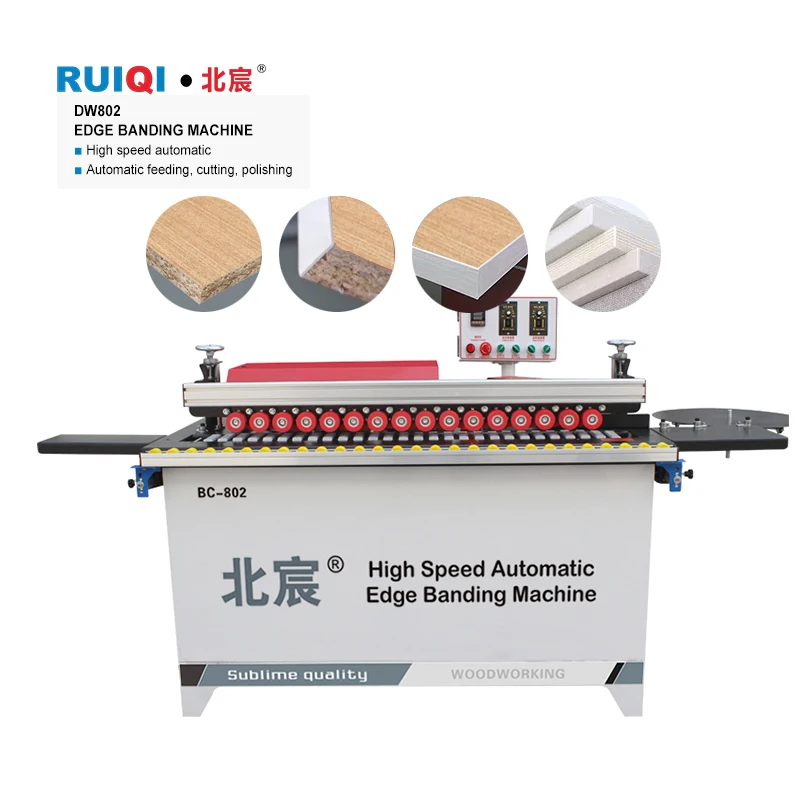
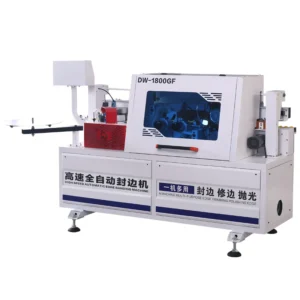
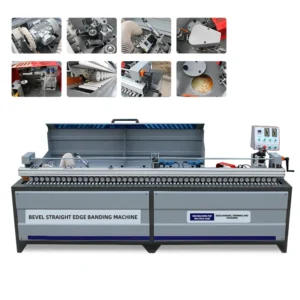
Manufacturing Depth — Every DW802 is built on our floor from raw frame welding to final station calibration, allowing full OEM branding and private-label packaging straight from the source.
Technical Specifications
| Parameter |
Value |
| Model |
DW802 |
| Product Type |
Automatic Edge Banding Machine |
| Total Power |
4200W |
| Voltage & Frequency |
220V/380V/customization (frequency not stated in source) |
| Standard Stations |
Gluing, edge banding, trimming, polishing, automatic head and tail cutting, vacuum |
| Minimum Sheet Length |
25 cm |
| Minimum Sheet Width |
10 cm |
| Edge Banding Height |
0–50 mm |
| Edge Banding Thickness |
0.3–3 mm |
| Edge Feed Power |
140W |
| Transmission Power |
140W |
| Trimming Power |
800W×2 |
| Polishing Power |
180W×2 |
| Vacuum Power |
1200W |
| Air Source Pressure |
0.4–0.8 MPa |
| Glue Pot Capacity |
4000 ml |
| Overall Dimensions (L×W×H) |
130×60×95 cm |
| Net Weight |
135 kg |
| Conveyor Belt Material |
Silica gel (integrated pressure beam design) |
| Control Panel Language Options |
Chinese and English standard; other languages available on request |
| Plug Options |
EU, USA, AU, UK |
Application Suitability
| Application |
Material or Output |
| Home decoration and custom furniture workshops |
MDF, particleboard, ecological board |
| Small-to-medium cabinet making |
Plywood, solid wood board |
| Regional distributor mid-range lines |
PVC and veneer edge banding materials |
Why the Voltage Question Must Precede the Order
Electrical compatibility is locked in before the frame is cut, not after the crate is packed.
A frequent failure point in cross-border machinery procurement is the assumption that standard factory wiring matches the destination grid. When an edge banding machine factory ships a 50Hz motor into a 60Hz market without verification, the immediate result is overheated spindle drives and tripped breakers during the first production run [NEED_CITE: voltage and frequency standards by export market]. The DW802 production workflow requires formal confirmation of local voltage, phase, and plug type before assembly begins, preventing weeks of stalled commissioning.
Component Sourcing and Assembly Control
The DW802 is assembled with a silica-gel conveyor belt and an integrated pressure beam to minimize surface scratching on delicate veneered panels. Sourcing these components directly allows us to adjust the pressure beam tension and conveyor tracking for specific regional material variations. This level of control over the mechanical build is essential for distributors who need consistent edge banding machine factory output across different batches.
OEM Configuration and Private Labeling
Distributors require more than a logo decal to establish a local brand presence. The manufacturing process for this unit accommodates custom color schemes on the machine housing, bespoke control panel overlays in the local operator language, and tailored electrical schematics. Each of these elements is integrated into the production line rather than applied as an afterthought, ensuring the equipment meets the specific branding and compliance requirements of the target market [NEED_CITE: CE machinery directive requirements for industrial equipment].
Interpreting the Glue Pot and Trimming Specs
The 4000 ml glue pot capacity is designed to sustain continuous runs without frequent thermal cycling, which helps maintain consistent adhesive viscosity for MDF and particleboard. The dual 800W trimming motors provide the necessary torque to cleanly shear thicker PVC banding without chipping the substrate edge. Furthermore, the 1200W vacuum system is integrated to extract trimmings and dust at the source, a critical factor for maintaining air quality in compact workshops where this footprint class is typically deployed.

The Hidden Cost of Unverified Factory Tests
When a machine leaves the assembly floor without running the specific substrates the buyer intends to use, the first day of production becomes an unplanned calibration exercise. A distributor importing equipment for a market that primarily processes high-density ecological board will encounter different feed resistance and glue penetration characteristics than those found on standard particleboard. This mismatch leads to visible glue lines and edge lift, damaging the importer’s reputation with local furniture makers who expect immediate plug-and-play reliability [NEED_CITE: typical substrate adhesion challenges in panel processing].
Verified Manufacturing for OEM Partners
Our facility operates under ISO 9001 protocols with a four-stage quality control process that tracks the DW802 from incoming material inspection through pre-shipment verification. We provide full private-label capability, meaning the machine, documentation, and packaging all carry the distributor’s brand identity. The engineering team reviews the target market’s environmental conditions to ensure the electrical cabinets and pneumatic systems are rated appropriately for local humidity and temperature variations, securing long-term reliability for the end user.
Documentation & Verification
- CE declaration of conformity matching the specific DW802 serial number.
- Electrical schematic confirming destination voltage and plug configuration.
- Factory test record using buyer-specified panel thickness and edge material.
- Operation manual translated into the agreed local operator language.
- Itemized spare parts list with OEM component identifiers.
Installation, Commissioning & Support
- Requires a leveled concrete floor to support the 135 kg net weight and trimming vibration.
- Dedicated circuit matching the confirmed 220V/380V custom voltage and 4200W total draw.
- Arrives fully assembled in a wooden crate; requires pneumatic line connection to 0.4–0.8 MPa.
- Initial calibration of the 800W trimming stations for the local PVC thickness range.
- Silica-gel conveyor belt tension adjustment to match the specific board weight.
- Scheduled inspection of the 4000 ml glue pot heating elements to prevent adhesive carbonization.
Production Planning and Order Verification
To initiate a manufacturing run for your market, we require the exact local voltage and frequency, the primary panel materials your customers process, and the preferred control panel language. If you are building a regional inventory, please specify your target batch size and any private-label packaging dimensions required for your warehouse racking.
Frequently Asked Questions
Q: Can the DW802 be produced with my logo, custom color, and private-label packaging?
A: Yes, full OEM branding is integrated into the production process. We apply your custom color scheme to the housing, print your logo on the machine body, and manufacture private-label packaging that meets your warehouse stacking requirements. This ensures the equipment arrives as your proprietary brand rather than a generic import.
Q: How is voltage and plug type confirmed for my destination country before production?
A: Voltage, frequency, and plug type are locked in during the specification review phase before any steel is cut. We generate a custom electrical schematic for your approval to ensure the 4200W total power system, including the trimming and vacuum motors, matches your local grid perfectly without needing third-party transformers.
Q: Can I order a sample unit for pre-testing before placing a bulk distributor order?
A: Sample units are built to your exact specifications, including local voltage and language requirements. We run pre-shipment tests using the specific MDF or particleboard materials your market processes, providing video verification and test records so you can evaluate the edge quality and trimming accuracy before committing to a larger production run.
Q: What spare parts are included, and how are replacements supplied after delivery?
A: Each unit ships with a localized spare parts list and a baseline wear kit. As the manufacturing partner, we maintain the tooling for the DW802’s proprietary silica-gel conveyor and trimming assemblies, allowing us to ship replacement components directly to your regional warehouse or end-user facility as needed.
Q: What is the production lead time for OEM orders with custom specifications?
A: Lead times depend on the complexity of the OEM customization and the current production queue. Once the electrical schematics and branding elements are approved, the unit moves through our four-stage QC process, ensuring that custom voltage configurations and language panels are verified before the machine is crated for export.