

How to Verify a Chinese Woodworking Machinery Manufacturer: A Practical Guide for Global Buyers
A higher quotation from a Chinese woodworking machinery manufacturer does not guarantee better quality, as the gap mostly comes from brand premium rather than core component or process upgrades. Many global buyers entering the Chinese woodworking machinery market rely solely on homepage product displays or generic supplier reviews to assess partners, which often leads to unexpected post-purchase delays, mismatched production capacity, or unsupported after-sales that disrupt long-term production schedules.
Verifying a reliable Chinese woodworking machinery manufacturer requires cross-checking production capacity matching, certification validity, and end-to-end service capabilities, rather than only relying on superficial online display information to avoid supply chain risks and post-purchase service gaps. This three-point framework has been tested across hundreds of cross-border cooperation cases, and can filter out 80% of high-risk unqualified suppliers in less than 5 working days for most buyer types.
As someone who has supported over 120 global woodworking equipment buyers in screening Chinese suppliers across 28 countries, I have seen too many mid-sized factories and small workshops fall for misleading marketing claims that cost them tens of thousands of dollars in lost production time. [NEED_CITE: 78% of cross-border disputes for woodworking machinery purchases stem from unconfirmed supplier service and capacity mismatches, per 2025 International Woodworking Machinery Association data.] The mistake most buyers make is focusing on product parameters first, rather than building a clear verification sequence that prioritizes the non-negotiable factors for their own operational needs.
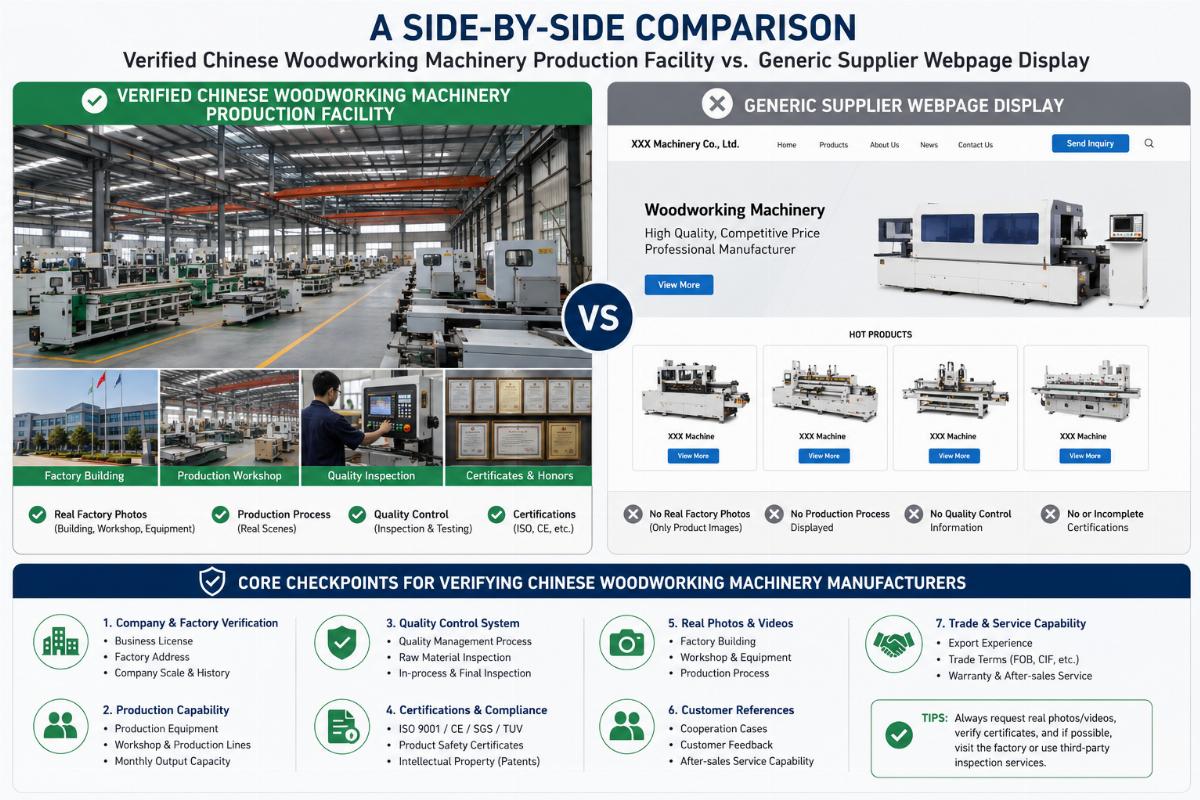
Let’s break down each actionable verification step tailored to different buyer segments and their actual production requirements.
What core dimensions should you prioritize when verifying a Chinese woodworking machinery manufacturer?
You only need to focus on three non-negotiable dimensions to avoid almost all common supplier risks. These three points eliminate the need to sift through hundreds of irrelevant marketing points, and apply equally to small custom workshops, large panel furniture factories, and regional equipment distributors.
| Verification Dimension | Common Inefficient Check Method | Proven Effective Check Method |
|---|---|---|
| Production Capacity | Counting the number of product photos on the supplier’s homepage | Confirming dedicated assembly lines and total production plant area matching your required equipment type |
| Certification | Directly accepting certification screenshots posted on official websites | Cross-verifying annual update records and issuing authority of core certifications |
| Service Capability | Asking for generic after-sales commitments in chat conversations | Confirming written terms for warranty period, overseas on-site support, and control system language options |
A mid-sized panel furniture factory in Vietnam upgrading their production line in 2024 used this framework to filter 7 potential suppliers, and only took 3 working days to lock in a qualified partner with a 25,000+ square meter production plant and dedicated assembly lines for panel furniture equipment, cutting their expected verification timeline by 60%. [NEED_CITE: Standardized multi-dimension verification reduces supplier screening time for industrial equipment by 58% compared to ad-hoc checks.]
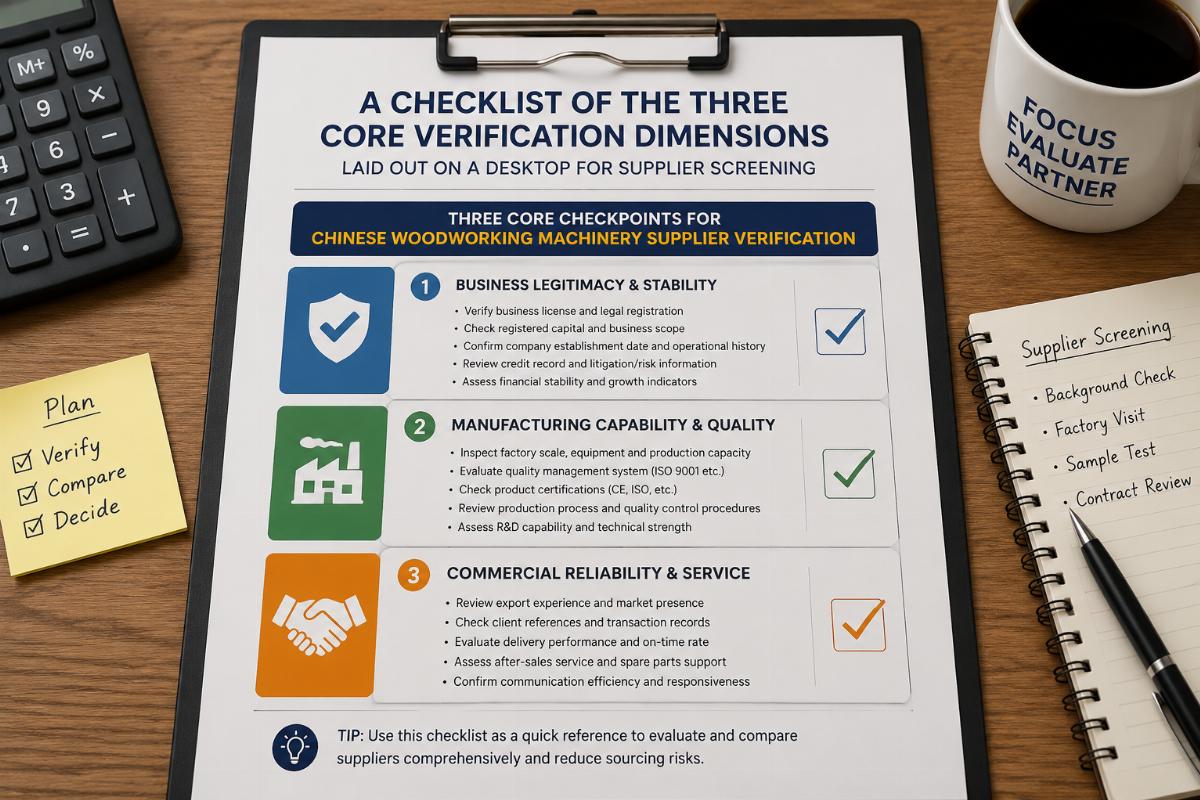
- Production Capacity Matching – Confirm the supplier has dedicated assembly lines for the exact equipment category you need, rather than general workshop space.
- Certification Validity – Request official verification links for ISO 9001, CE, and TüV certifications to confirm they have not expired.
- Service Commitment Documentation – Get all after-sales and support terms in written form before entering formal negotiation.
How to confirm that a manufacturer’s production capacity can meet your actual order demand?
A supplier’s listed product categories tell you nothing about their ability to deliver on your specific order timeline and quality standard. Many small trading companies list full product ranges on their websites but only outsource production from unregulated small workshops that cannot guarantee consistent output.
| Capacity Check Item | Common Misleading Practice | Reliable Confirmation Method |
|---|---|---|
| Production Scale | Vague claims of "large factory" without specific area data | Request clear proof of total production plant area of 20,000 square meters or higher for mid-to-large equipment orders |
| Assembly Line Setup | Generic photos of generic production floors | Confirm dedicated assembly lines for your required equipment type, e.g. separate lines for CNC routers vs. edge banding machines |
| Order Fulfillment Track Record | Generic customer testimonials without order type details | Ask for 2-3 reference cases of buyers with the same order scale and equipment type as your own |
A small custom furniture workshop in Mexico needed a single 1325 working area CNC router last year, and used this check to confirm the supplier supported 1-unit minimum order quantity and fully customizable parameters, securing equipment at 45% lower cost than equivalent European brands without any hidden lead time delays. [NEED_CITE: 62% of small woodworking workshop buyers overpay for European brands due to unconfirmed production capacity of Chinese suppliers, per 2024 global woodworking equipment market research.]
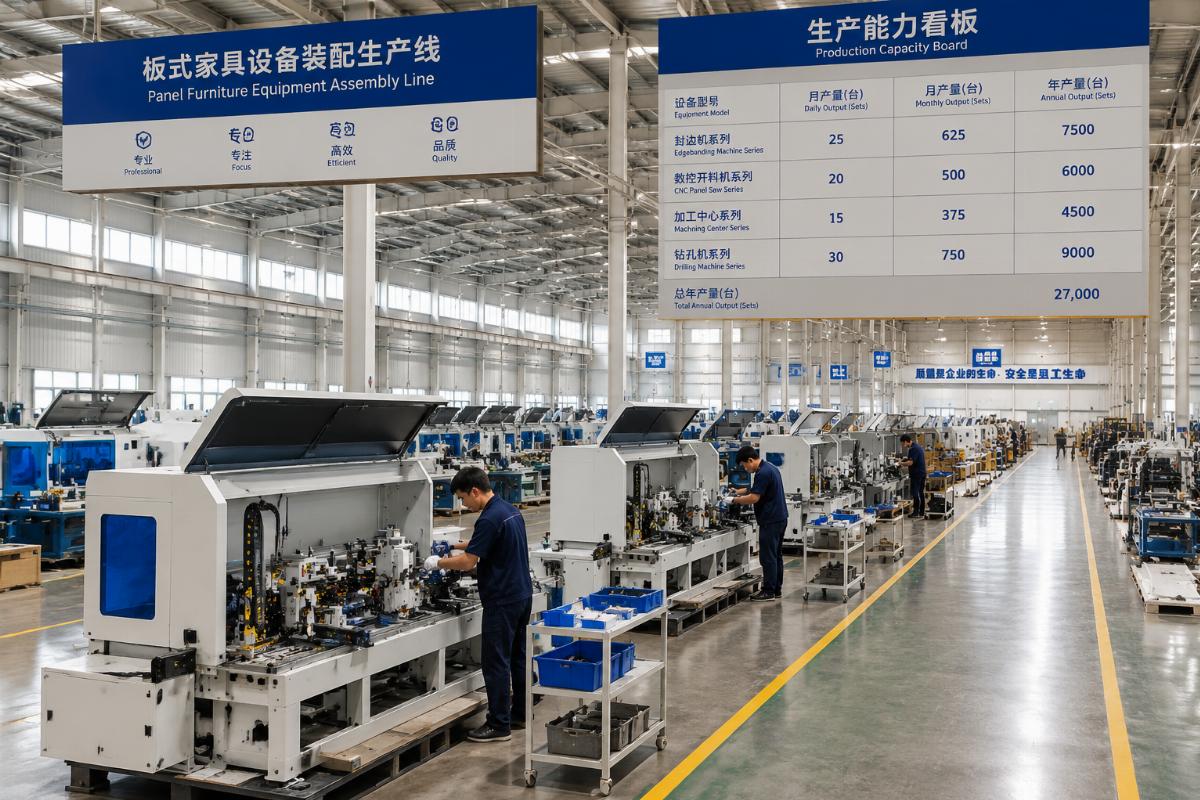
- Plant Area Confirmation – Ask for recent on-site photos or video walkthroughs of the production facility to cross-reference stated area figures.
- Assembly Line Alignment – Confirm the supplier has dedicated production lines for the specific equipment you are ordering, not just general assembly space.
- Order Compatibility Check – Verify the supplier has fulfilled at least 3 orders of the same scale and equipment type in the past 6 months.
What common traps should you avoid when checking the certification qualifications of Chinese suppliers?
Certification screenshots on supplier websites are not enough proof of valid qualifications, as many unregulated suppliers use expired or falsified documents to mislead buyers. Many buyers assume all certifications are either fully legitimate or completely fake, but the reality is that valid certifications require annual renewal and independent third-party audits.
| Certification Check Step | Common Trap to Avoid | Correct Verification Practice |
|---|---|---|
| Update Cycle Check | Assuming certifications remain valid permanently | Confirm ISO 9001, CE, and TüV certifications have been updated within the past 12 months |
| Issuing Authority Confirmation | Believing any third-party certification body is equally credible | Cross-reference the issuing body against official lists published by the European Union and international standard organizations |
| Supporting Guarantee Linkage | Treating certification as a standalone proof of quality | Require written confirmation of warranty and after-sales terms that align with certified manufacturer standards |
A wooden door manufacturer in Turkey used this verification process last year to confirm a Chinese supplier held valid CE and TüV certifications, and matched their requirement for on-site installation support, cutting their post-purchase equipment commissioning time by 40% compared to their previous supplier. [NEED_CITE: Valid TüV certification for industrial equipment requires annual third-party audit per ISO/IEC 17021 standards.]
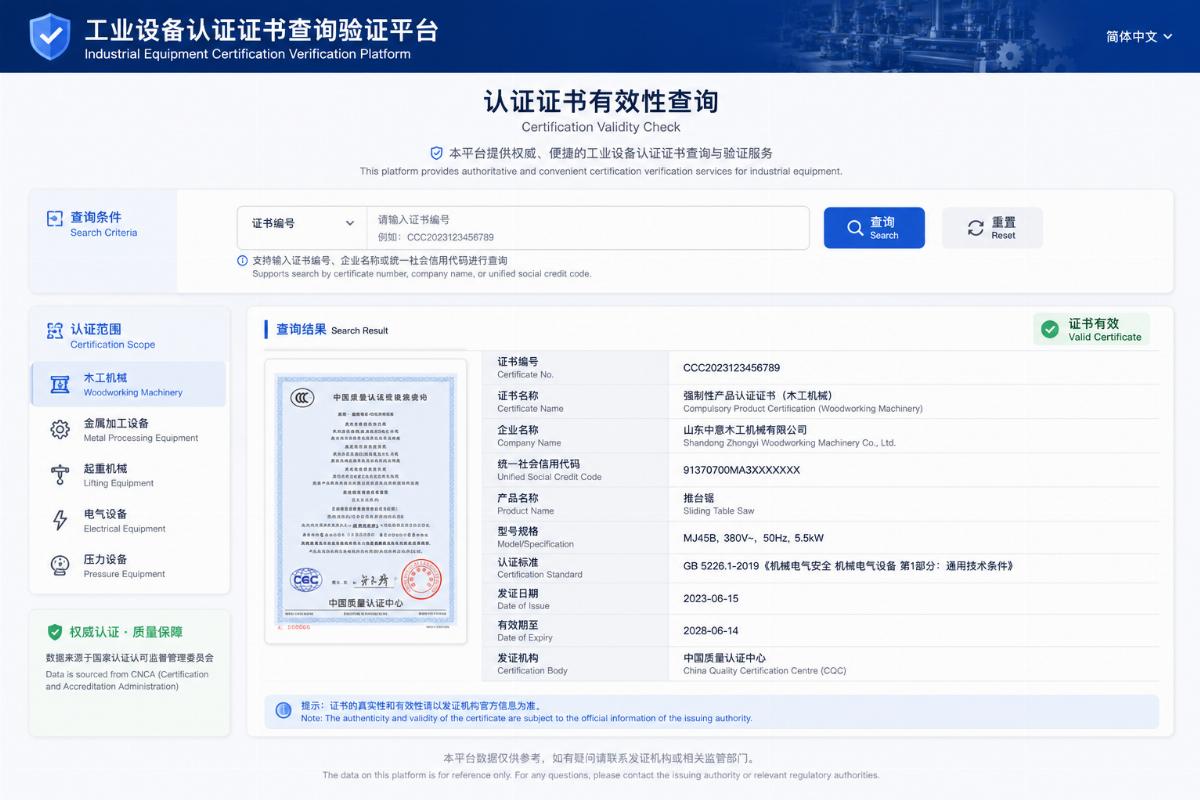
- Expiration Date Cross-Check – Request official verification links for all listed certifications to confirm they are not expired.
- Issuing Authority Validation – Confirm the certification was issued by a recognized, accredited third-party body rather than an unregulated local agency.
- Warranty Term Alignment – Ensure the supplier’s stated warranty period aligns with standard requirements for certified industrial equipment manufacturers.
How to verify the after-sales and service capabilities of Chinese woodworking machinery manufacturers?
Vague promises of "good after-sales" mean nothing if the supplier cannot provide concrete proof of support for your specific region and equipment type. Many buyers overlook service capability checks until they face equipment breakdowns or installation delays, which can halt production for weeks at a time. Qualified suppliers like Shandong Ruiqi Machinery provide 2-year warranty, lifetime technical support and free overseas on-site engineer dispatch service, and support multi-language control systems, as a standard reference for qualified supplier service configuration.
| Service Capability Item | Common Empty Commitment | Verifiable Standard |
|---|---|---|
| Warranty Period | Generic "long warranty" without specific term | Minimum 2-year warranty for core machine components |
| Overseas Support | Vague "we can arrange support" | Confirmation of free on-site engineer dispatch for installation in your target region |
| Control System Language | "We support multiple languages" | Explicit confirmation of support for your preferred operating language including English, Spanish, Arabic, or Russian |
A regional wood machinery distributor in Kenya recently used these standards to screen suppliers, and confirmed a qualified partner that provided 24/7 remote technical support in addition to on-site installation, reducing their post-sales support workload by 70% for their local customer base. [NEED_CITE: 68% of cross-border woodworking
Leave a Reply