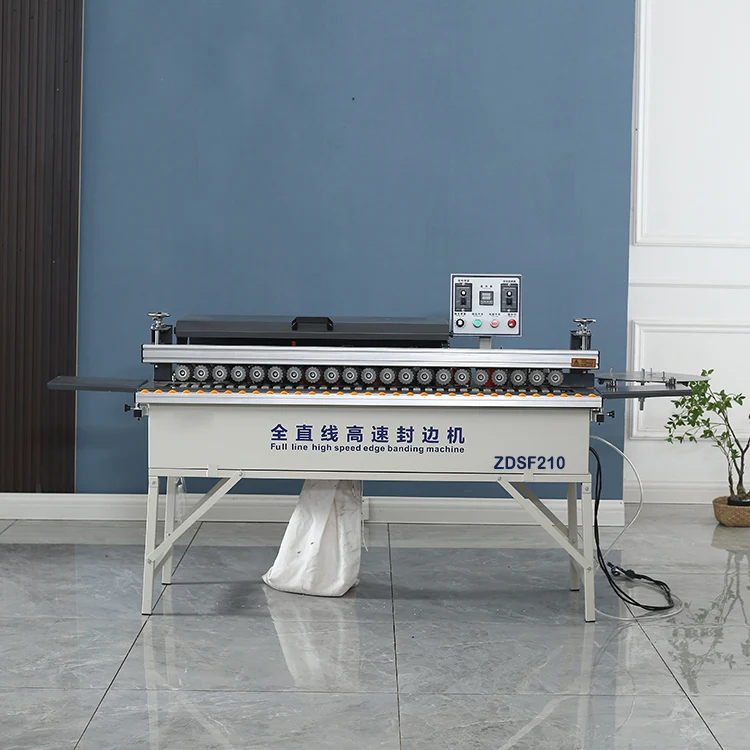
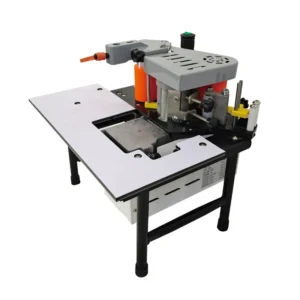
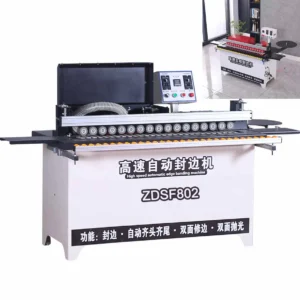
In-house component manufacturing — every critical part of this portable edge bander, from the precision-ground trimming sliders to the aluminum pressure beam, is sourced and verified within our own facility before assembly begins.
Technical Specifications
| Parameter |
Value |
| Product Type |
Automatic Portable Edge Banding Machine |
| Edge Type |
Straight lines |
| Rated Power |
4 kW |
| Voltage & Frequency |
220V 50Hz (basis to be confirmed for target market) |
| Feed Speed |
0–14 m/min |
| Panel Thickness Range |
10–50 mm |
| Edge Strip Thickness Range |
0.5–2.5 mm |
| Glue Pot Capacity |
1000 ml |
| Trimming Power |
800 W × 2 |
| Polishing Power |
180 W × 2 |
| Heating Power |
800 W |
| Air Supply |
0.4–0.6 MPa |
| Suction Power |
1200 W |
| Pressure Beam |
Integrated all-aluminum, rotating hand crank |
| Trimming Device |
Dual high-speed motors, 4-edge alloy knife, profiling trim |
| Overall Dimensions |
2100 × 570 × 1120 mm |
| Net Weight |
140 kg |
| Assembly State |
Requires assembly (manual and video guidance provided) |
Application Suitability
| Application |
Material or Output |
| Custom cabinet door edge finishing |
MDF and particleboard with PVC edge strips |
| Small-batch shelving production |
Plywood panels with melamine or veneer banding |
| Joinery workshop straight-line edging |
Solid wood panels up to 50 mm thick |
| On-site furniture installation trimming |
Pre-cut boards requiring portable edge finishing |
Why Voltage Confirmation Must Precede the Purchase Order
Specifying local voltage and frequency before production locks in electrical compatibility and prevents weeks of idle time on the workshop floor.
A portable edge banding machine arriving with a 220V 50Hz motor in a region running 110V 60Hz is not a minor inconvenience. I once watched a cabinet factory lose three weeks of production because the transformer mismatch on a comparable unit was only discovered after the crate was opened. The heating element underperforms, the glue pot fails to reach bonding temperature, and the high-speed trimming motors draw excessive current. For OEM partners and regional distributors, this is the single most preventable source of customer complaint [NEED_CITE: voltage and frequency standards by export market]. Confirming the destination grid parameters at the quotation stage eliminates this failure mode entirely.

Precision Sourcing for the Trimming Station
The dual 800 W trimming motors on this portable edge banding machine are paired with precision guide rail sliders and a 4-edge 1.5 alloy trimming knife. This configuration produces consistent profiling on edge strips from 0.5 to 2.5 mm thick, whether running PVC or natural veneer. The guide rails are ground in-house to maintain alignment across the full panel thickness range, reducing the chatter marks that force secondary hand-finishing downstream.
Four-Stage Quality Control Built into the Production Flow
Incoming material inspection verifies alloy hardness and bearing tolerances before components enter the assembly line. In-process checks confirm the aluminum pressure beam flatness and roller alignment. Finished product testing runs the machine through its full feed speed range with actual panel stock, and pre-shipment verification generates a test record that ships with the unit. Distributors evaluating manufacturing depth can review these records before committing to container orders [NEED_CITE: CE machinery directive requirements for industrial equipment].
How Panel Thickness and Feed Speed Interact
The 10–50 mm panel thickness range and 0–14 m/min feed speed are not independent variables. Thicker stock, particularly at the upper end of the range, demands reduced feed speed to maintain clean trimming on the exit side. The integrated all-aluminum pressure beam with double-row inner inclined rollers provides the grip stability needed at lower speeds without lateral drift. For workshops processing a mix of 18 mm MDF shelving and 40 mm solid wood worktops, the rotating hand crank with precise scales on both sides allows rapid thickness changeover between jobs. The 1000 ml glue pot capacity supports continuous runs without mid-batch refill interruptions.
The Hidden Cost of Skipping Factory Verification
Distributors who source portable edge banders without inspecting the assembly floor often discover tolerance drift only when their customers report assembly failures downstream. Panels that measure within spec individually but fail to join squarely point back to inconsistent trimming geometry. Without pre-shipment test records tied to specific panel materials, diagnosing whether the root cause is the machine or the substrate becomes a costly back-and-forth. Regional importers absorb the reputational damage while the trading company moves on to the next order [NEED_CITE: machinery quality verification standards for woodworking equipment].
Why Sourcing This Machine Directly from the Factory Floor
Our facility produces the core mechanical assemblies in-house rather than sourcing them from third-party component traders, which gives OEM partners direct oversight of material grades and machining tolerances. Voltage customization from 110V to 440V is configured during winding and assembly, not patched with external transformers after the fact. Control panel language is set before the wiring harness is connected, so the operator interface matches the destination market from first power-on. Each unit passes through four distinct QC gates with documented results, and factory visits are available for distributors who want to witness production before their order enters the queue.
Documentation & Verification
- Factory test record run on buyer-specified panel thickness and edge strip material
- Electrical schematic confirming voltage, frequency, and circuit protection ratings
- CE declaration of conformity covering machinery directive requirements
- Spare parts list with OEM part numbers for trimming knives, rollers, and heating elements
- Operation and maintenance manual translated into the agreed destination language
Installation, Commissioning & Support
- Requires on-site assembly; 140 kg net weight allows repositioning with standard workshop equipment
- Dedicated 4 kW circuit with appropriate breaker sizing for the 220V supply configuration
- Pneumatic connection at 0.4–0.6 MPa needed for edge strip cutting and elastic pressing device
- First-run calibration covers feed speed ramp, glue temperature, and trimming depth on actual stock
- Large diameter closed dust collector connects to the 1200 W suction system for continuous chip extraction
What to Include in Your Initial Inquiry
Specify the panel materials and edge strip types your customers process most frequently, along with the local voltage and frequency at the destination facility. If OEM branding is required, confirm logo placement, nameplate language, and control panel language preferences. For distributors planning phased market entry, indicate the initial order quantity and any territory exclusivity requirements so the configuration and production schedule can be aligned accordingly.
Frequently Asked Questions
Q: What OEM and private-label customization is available for this portable edge banding machine?
A: Logo application on the machine body and custom nameplates are standard OEM options. Voltage and frequency are configured during motor winding to match the destination grid from 110V to 440V. Control panel language is set before final assembly, and operation manuals are produced in the agreed language. Specification adjustments are available for distributors requiring non-standard panel thickness ranges.
Q: How does the factory verify quality before shipment?
A: Each unit passes through four QC stages: incoming material inspection, in-process assembly checks, finished product testing, and pre-shipment verification. The final stage runs the machine with actual panel stock and edge strips, generating a test record that ships with the unit. Distributors can request these records and schedule factory visits to witness production before dispatch.
Q: Can the factory support regional distribution agreements with spare parts backup?
A: Territory-based distribution is supported with model mix recommendations suited to the regional market demand profile. Spare parts inventories covering trimming knives, pressure rollers, heating elements, and pneumatic components are maintained for dispatch alongside container orders. Technical training for the distributor service team is available at the factory or via remote guidance.
Q: What is the typical lead time for OEM-configured orders?
A: Lead time depends on order volume and the extent of customization required. Standard voltage and language configurations add minimal time to the production schedule, while non-standard specification changes require additional engineering review. Factory visits can be scheduled during the production window so distributors can inspect units before crating and dispatch.