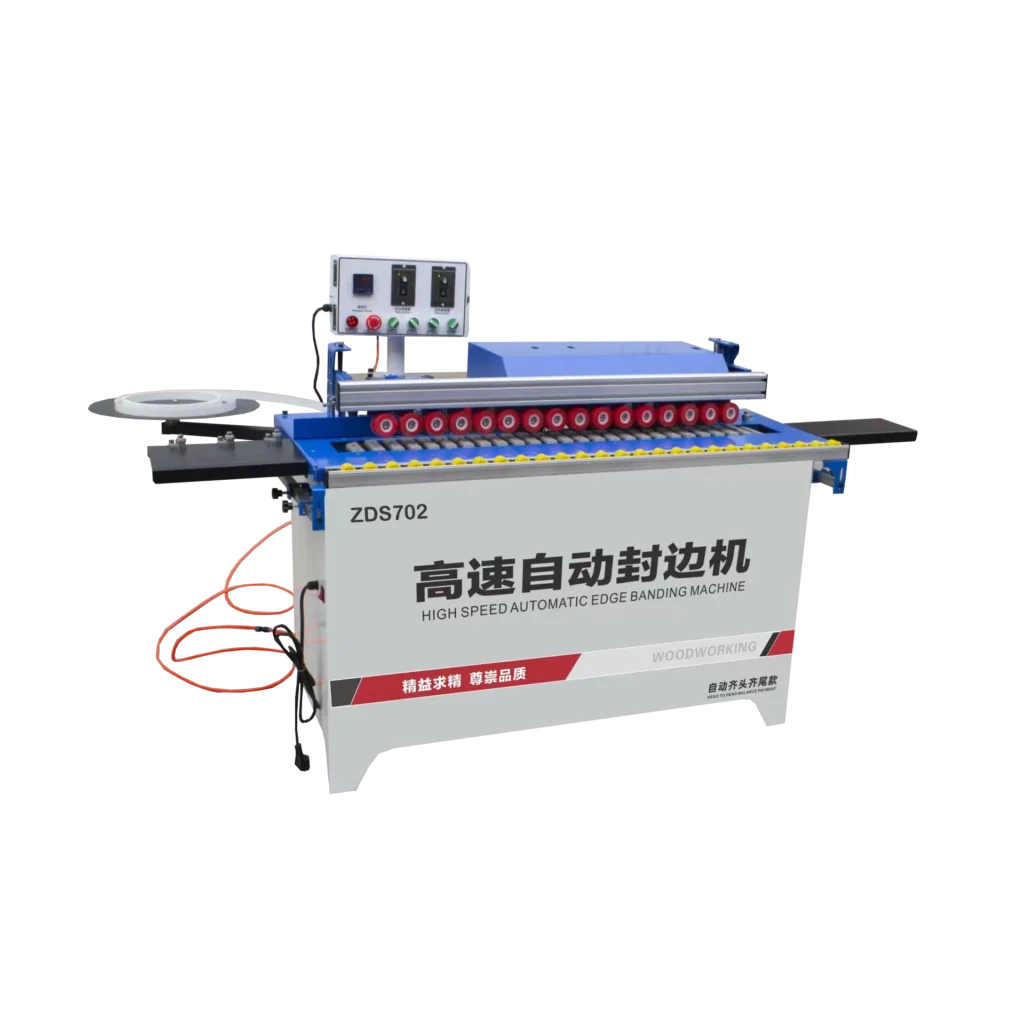
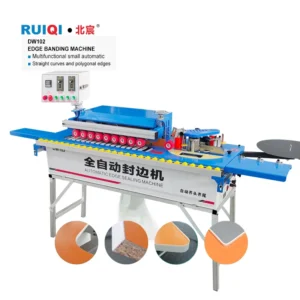
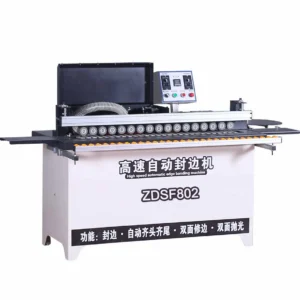
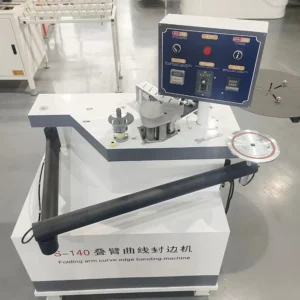
In-house manufacturing depth — every ZDS702 component is precision-ground and assembled under our roof, giving OEM partners full control over private-label specifications from voltage to control panel language.
Technical Specifications
| Parameter |
Value |
| Model |
ZDS702 |
| Product Type |
Automatic Edge Banding Machine |
| Edge Type |
Straight line |
| Trimming Height |
5–50 mm |
| Edge Banding Thickness |
0.3–3 mm |
| Feed Speed |
0–10 m/min |
| Rated Power |
3.8 kW |
| Heating Power |
1000 W (5–10 min warm-up) |
| Glue Pot Capacity |
1000 ml |
| Rated Voltage |
220V / 380V / customization available |
| Rated Air Pressure |
0.4–0.6 MPa |
| Pressure System |
One-piece pressure beam, double-row silicone pressure wheels |
| Dust Extraction |
Integrated vacuum device |
| Adjustment |
Hand crank wheel with precision scale |
| Overall Dimensions |
120 × 55 × 120 cm |
| Machine Weight |
105 kg |
| Key Features |
Automatic plate feeding, end cutting, upper and lower polishing, head and tail trimming, dust collector included |
Application Suitability
| Application |
Material or Output |
| Custom cabinet door edging |
MDF and plywood panels with PVC edge banding |
| Wardrobe and shelving panel finishing |
Particleboard with melamine or veneer banding |
| Small-batch joinery production |
Solid wood panels with thin veneer edge strips |
| Furniture component rework |
Pre-cut boards requiring fresh edge application |
| Regional distributor stock units |
Straight-line edging across common board thicknesses |
Why the Voltage Conversation Must Happen Before Production Starts
A machine wired for the wrong frequency is scrap metal the moment it arrives on your dock.
I have watched containers land at ports with edge banders that were never asked about 50 Hz versus 60 Hz. The motor spins, the feed runs, but the glue pot never reaches stable temperature and the trimming heads chatter across the panel face. The Automatic Edge Banding Machine OEM factory receives the complaint weeks later, after the buyer has already lost production time and customer trust. Confirming voltage and frequency against the destination workshop’s actual supply is not paperwork — it is the single step that keeps the machine functional on day one. [NEED_CITE: voltage and frequency standards by export market]

Private-Label Configuration Beyond a Logo Swap
Distributors sourcing an Automatic Edge Banding Machine OEM factory often receive a sticker and a painted color change. The ZDS702 program goes further into the electrical and interface layers. Voltage winding, control panel language, and safety circuit layout are confirmed before the chassis enters final assembly. This means your branded unit arrives with documentation and operator screens matching the market it will serve, not a generic default.
Component Traceability for Distributor Accountability
When a regional service team opens the cabinet for maintenance, they need to identify every bearing, solenoid, and heating element without guessing. Each ZDS702 ships with an electrical schematic and parts list tied to its serial number. Distributors building after-sales capability around this platform can stock the correct spares from day one and train technicians on verified assemblies rather than reverse-engineering unknown components. [NEED_CITE: CE machinery directive requirements for industrial equipment]
Reading the Specs That Actually Shape Edge Quality
The one-piece pressure beam paired with double-row silicone wheels addresses a problem I see constantly in small workshops: panel slippage during the trimming pass. A segmented beam allows micro-movement that translates into visible waviness on the finished edge. The integrated beam keeps downward force uniform across the 5–50 mm trimming height range, which matters when switching between 5 mm MDF drawer sides and 50 mm solid-wood shelving in the same shift.
Feed speed at 0–10 m/min may look modest compared to high-volume lines, but for the target workshop scale it allows the operator to slow down on difficult substrates like high-moisture particleboard without stopping the machine entirely. The 1000 W glue pot with a 5–10 minute warm-up keeps adhesive at stable viscosity during short runs, avoiding the cold-start glue starvation that causes banding lift-off at the leading edge. Air pressure at 0.4–0.6 MPa feeds the pneumatic end-cutting and trimming cylinders — drop below that range and the cutters hesitate, leaving burrs that require hand cleanup downstream.
The Hidden Cost of Skipping Substrate Questions
I have seen workshops buy a machine rated for MDF and then run high-moisture particleboard through it without adjusting glue temperature or feed rate. The edge banding peels within days because the adhesive never bonded properly to the swollen substrate surface. Nobody checks the board moisture content until the assembled cabinets start returning from installers with failed edges. [NEED_CITE: wood-based panel moisture content standards for edge banding adhesion]
Distributors who place stock orders without matching the machine to the dominant panel type in their territory end up fielding warranty calls that are not actually defects — they are configuration mismatches. Asking two questions before writing the quotation — what board and what banding thickness — eliminates most of these callbacks.
What Manufacturing Depth Means for Your Orders
Precision-ground pressure beams are machined in-house rather than sourced from a third-party catalog, keeping flatness within tolerance across the full trimming height range.
Four-stage quality control covers incoming material inspection, in-process assembly checks, finished product testing, and pre-shipment verification with photographic records for every unit.
Voltage and language customization is handled as a production parameter, not an aftermarket modification — the motor winding and control panel are set before the machine leaves the assembly bench.
Proprietary cutting mechanisms carry verified tolerance documentation that you can share with your own customers during their equipment evaluation.
Factory visits are open to OEM partners who want to audit component sourcing, grinding procedures, and QC checkpoints before committing to volume orders.
Documentation & Verification
- Factory test record on your specified panel thickness and edge material before dispatch
- Electrical schematic matching confirmed voltage and frequency for your market
- Operation and maintenance manual in the language you specify at order
- CE declaration of conformity and ISO 9001 certificate provided per shipment
- Spare parts list cross-referenced to serial number for distributor inventory planning
- Pre-shipment verification photographs of your unit on the test bench
Installation, Commissioning & Support
- Requires a dedicated 3.8 kW circuit with confirmed voltage at the workshop panel before uncrating
- Overall footprint of 120 × 55 × 120 cm fits standard workshop aisles with room for infeed and outfeed tables
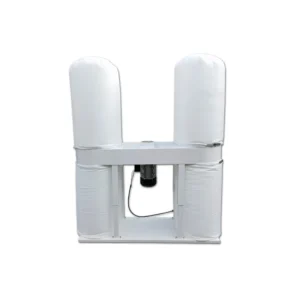
- Integrated dust collector connects to your existing extraction ducting or runs standalone with the included vacuum unit
- Air supply at 0.4–0.6 MPa must be clean and dry to protect pneumatic trimming and end-cutting cylinders
- Hand crank pressure adjustment calibrated on-site during first run using your actual panel stock
- Glue pot warm-up verified at 5–10 minutes before feeding the first test panel through the line
What We Need to Build Your Sample Unit
Before we issue a formal quotation, share the panel materials and edge banding types your customers run most often, along with the dominant board thickness range. Confirm the local voltage and frequency at the destination workshop, and let us know the control panel language your operators require. If you are evaluating this platform for a private-label program, tell us the branding and color specifications so we can include them in the production drawing rather than applying them after assembly.
Frequently Asked Questions
Q: What OEM customization is available beyond logo placement on the ZDS702?
A: Logo application, machine color, control panel language, and full electrical specification including voltage and frequency are all configurable during production. We do not apply branding after assembly — the private-label specification is built into the unit from the chassis stage, ensuring documentation and operator interfaces match your market requirements.
Q: How do you confirm voltage and frequency before production begins?
A: Every order includes a specification confirmation step where the buyer signs off on the exact voltage, frequency, and plug type for the destination workshop. The motor winding and transformer are then matched to that standard during assembly, and the electrical schematic included with the shipment reflects the confirmed configuration.
Q: Can I review the pre-shipment test record for my specific unit?
A: Each ZDS702 is tested on the factory floor using panel material matching your specified thickness range and edge banding type. The test record includes photographs of the trimmed edge, measured glue line appearance, and verification of all pneumatic functions. This documentation ships with the unit and is available digitally before dispatch.
Q: Is it possible to visit the factory to evaluate manufacturing capability?
A: Factory visits are welcome at any stage of the evaluation process. You can inspect precision-ground components on the machining floor, observe the four-stage QC checkpoints during assembly, and run test panels on a production unit. We recommend scheduling at least one week in advance to align with your preferred test material.
Q: What technical documentation supports distributor-level after-sales service?
A: Every unit ships with an electrical schematic, spare parts list tied to the serial number, and a maintenance manual in the agreed language. Distributors can use these documents to stock correct replacement components, train local service technicians, and diagnose faults without waiting for factory support on routine maintenance tasks.