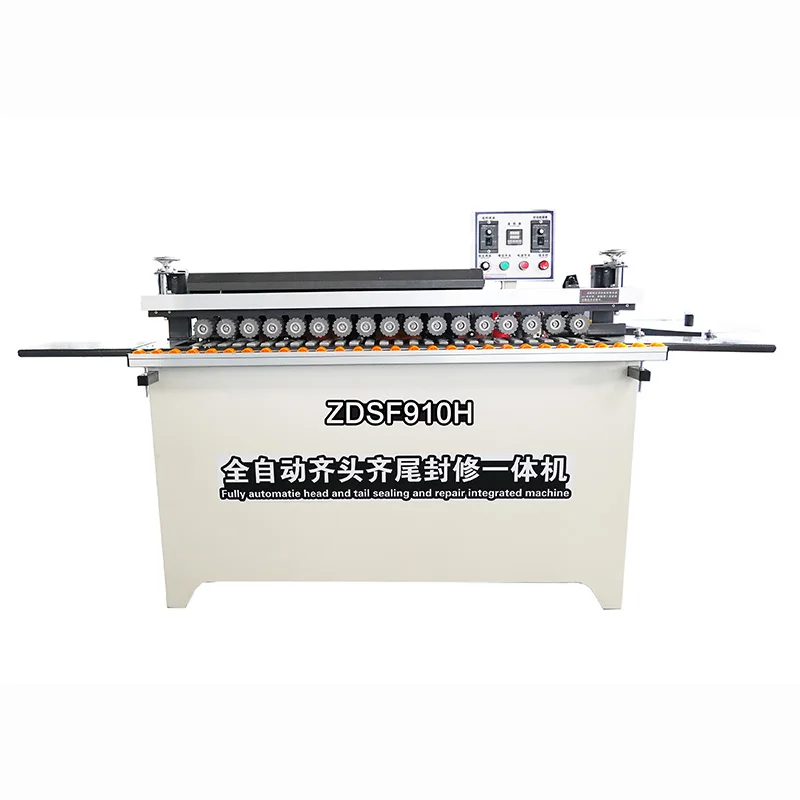
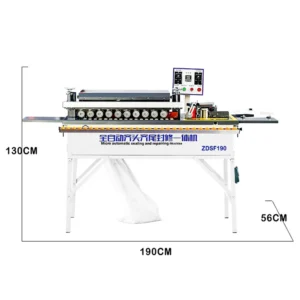
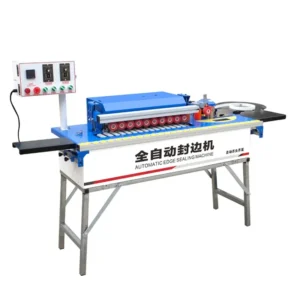
Manufacturing Depth — The 910H miniature curved-and-straight edge bander is built on our assembly floor with precision-ground components and a patented 4-blade alloy arc knife, not relabeled from a third-party trading catalog.
Technical Specifications
| Parameter |
Value |
| Model |
910H |
| Product Type |
Miniature Automatic Curved and Straight Edge Banding Machine |
| Function |
Automatic plate feeding, double-sided gluing, upper and lower polishing, automatic head and tail trimming |
| Edge Type |
Both curved and straight lines |
| Voltage & Frequency |
220V 50Hz |
| Rated Power |
4 kW |
| Rated Air Pressure |
0.4–0.6 MPa |
| Suction Power |
1200 W |
| Heating Power |
800 W |
| Polishing Power |
180 W × 2 |
| Trimming Power |
800 W × 2 |
| Sheet Thickness Range |
10–50 mm |
| Strip Thickness Range |
0.5–2.5 mm |
| Glue Capacity |
1000 ml |
| Feed Mechanism |
Crawler transmission with steel rod slide rails |
| Pressure Beam |
Adjustable aluminum alloy |
| Trimming Cutter |
4-blade alloy arc knife |
| Control System |
Multi-function button operation panel |
| Dust Collection |
Two large-diameter dust collectors |
| Overall Dimensions (L×W×H) |
1300 × 560 × 1090 mm |
| Net Weight |
140 kg |
Application Suitability
| Application |
Material or Output |
| Custom cabinet door edging |
MDF and particleboard with PVC or melamine strips |
| Small-batch curved furniture components |
Plywood and solid wood panels with veneer banding |
| Joinery workshop dual-purpose operations |
Straight and shaped panel edges in a single machine footprint |
| Compact production cell prototyping |
Panel thicknesses from 10 mm to 50 mm |
Why Voltage Confirmation Must Precede Every Edge Banding Machine Factory OEM Order
A machine wired for the wrong grid is scrap metal until an electrician rewires the entire shop.
I spent weeks troubleshooting a 440V unit that arrived at a customer site where only single-phase 220V was available. The distributor had assumed the factory would default to a common export voltage. With an edge banding machine factory OEM arrangement, voltage and frequency must be locked at the quotation stage — not discovered on the dock. Regional resellers stocking inventory for a specific market need every unit configured before crating [NEED_CITE: voltage and frequency standards by export market].
Component Sourcing and Assembly Transparency
Distributors evaluating an edge banding machine factory OEM partner need to see exactly where the value is added. On the 910H, the 4-blade alloy arc knife and the steel rod slide rails are machined and ground in-house, giving us direct control over the trimming finish and feed stability. The crawler transmission, adjustable aluminum alloy pressure beam, and multi-function button panel are assembled and tested as a complete system before any private-label branding is applied.
Private-Label Scope Beyond a Logo Badge
OEM customization on this model extends across the entire user interface and compliance surface. Control panel language, nameplate ratings, electrical schematics, operation manuals, and packing artwork are all configurable per territory requirement. A distributor serving Spanish-speaking workshops receives documentation and panel labeling in that language, while a partner targeting 110V markets gets the heating circuit and motor rewound and retested accordingly. The 220V 50Hz baseline configuration ships from stock; other voltages are built against confirmed orders [NEED_CITE: CE machinery directive requirements for industrial equipment].
How Core Parameters Translate on the Shop Floor
The 10–50 mm sheet thickness range covers most MDF, plywood, and particleboard panels encountered in custom furniture work, while the 0.5–2.5 mm strip range accommodates thin PVC through thicker veneer and melamine edging. The 800 W heating element must reach a stable melt temperature before the glue roller engages; on a 4 kW total power budget, that thermal recovery time directly affects how quickly the first panel of the day can run. The dual 180 W polishing motors and dual 800 W trimming motors operate independently, so a dull trimming knife does not drag down polishing speed. Two large-diameter dust collectors manage chip and dust extraction at the trimming and polishing stations, keeping the slide rails and crawler track clear during extended curved-edge runs.
The Cost of Skipping the Factory Audit
Resellers who commit to a stocking order without visiting the production floor inherit every tolerance stack the factory has not caught. A slightly off-center trimming cutter produces a visible glue line on curved panels that straight-edge samples hide. Inconsistent pressure beam adjustment means the first panel and the fiftieth panel leave the machine with different edge profiles. These issues surface as warranty claims the distributor must absorb locally [NEED_CITE: common edge banding defects traced to machine alignment].
What This Factory Brings to a Distributor Partnership
In-house machining of the patented cutting mechanism means replacement arc knives are available without third-party lead times. Four-stage QC — incoming material, in-process, finished product, and pre-shipment verification — produces a factory test record for every serial number. Voltage, language, and specification customization is standard procedure, not a special request. Engineer-led configuration ensures the model mix matches the distributor’s regional demand rather than clearing excess stock. Factory visits are open for component inspection and assembly line walkthrough before any purchase commitment.
Documentation & Verification
- CE declaration of conformity matched to the 910H configuration shipped
- ISO 9001 certificate covering the machining and assembly processes
- Factory test record on your specified panel thickness and edge strip material
- Electrical schematic confirming voltage and frequency for the destination market
- Operation and maintenance manual in the language your technicians read
- Spare parts list with part numbers cross-referenced to the 4-blade arc knife assembly
Installation, Commissioning & Support
- Dedicated 220V circuit rated for the full 4 kW draw with appropriate breaker sizing
- 1300 × 560 mm footprint fits through standard workshop doors without disassembly
- Crawler track and steel rod slide rails inspected for alignment after transit
- Glue pot heated to operating temperature and flow-tested before first panel feed
- Trimming and polishing parameters set on the multi-function button panel for your strip thickness
- Dust collector ducting sized to the two large-diameter ports for effective chip extraction
What We Need to Configure Your Stocking Order
Share the voltage and frequency standard for your target market, the control panel language your technicians require, and the edge strip materials your customers run most often. If you are evaluating this model against an existing product line, tell us which machines it must complement in throughput and panel size. Sample processing tests on your actual panel stock can be arranged before you commit to an initial order quantity.
Frequently Asked Questions
Q: What elements of the 910H can be customized under an OEM agreement?
A: Logo placement, machine color, voltage from 110V to 440V, control panel language, nameplate ratings, packaging artwork, and documentation language are all configurable. Each OEM order is confirmed with an electrical schematic and specification sheet before production begins.
Q: Which components are machined in-house versus sourced externally?
A: The 4-blade alloy arc knife cutting mechanism and the steel rod slide rails are machined and precision-ground on our floor. Motors, electrical components, and pneumatic parts are sourced from established suppliers and verified through incoming material inspection before assembly.
Q: How do you support a new distributor building a regional model mix?
A: We review your market’s typical panel sizes, edge materials, and workshop power availability to recommend which configurations to stock. Spare parts packages are assembled to match the models shipped, and technical documentation is prepared in your local language.
Q: What does the spare parts supply chain look like after the first shipment?
A: Replacement arc knives, polishing wheels, glue rollers, and crawler track components are produced in-house or held in inventory. Orders are typically dispatched within a standard lead time, and we provide exploded diagrams with part numbers for your service team.
Q: How do we schedule a factory visit before placing a stocking order?
A: Contact our engineering team with your preferred dates and the specific configurations you want to inspect. We arrange walkthroughs of the machining, assembly, and QC stations, and can run sample panels on your specified materials during the visit.