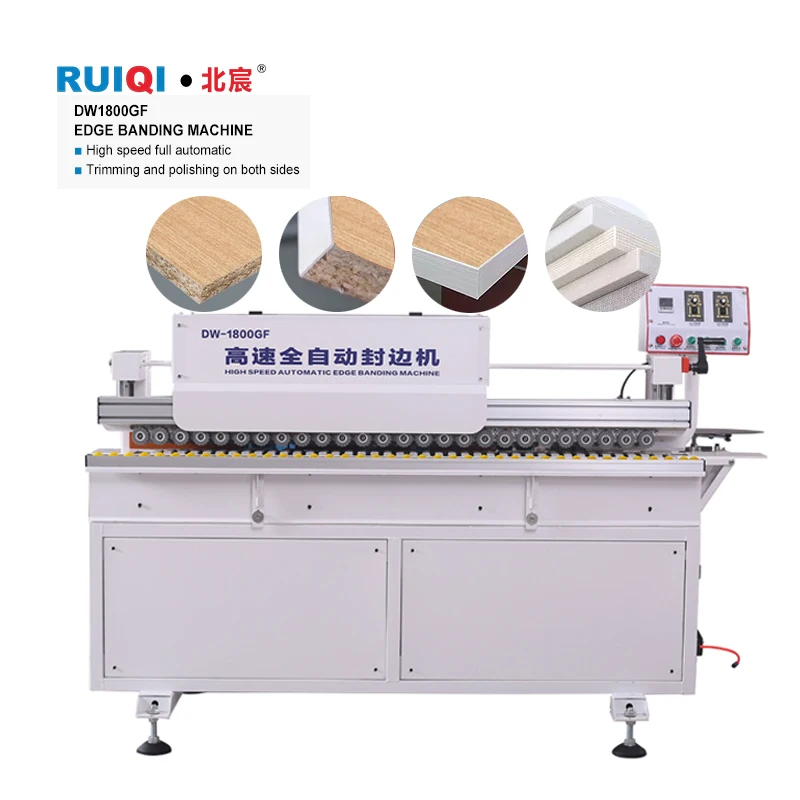
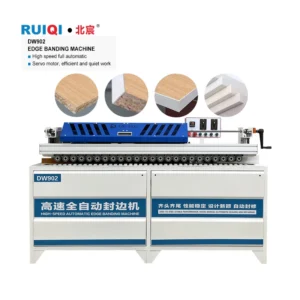
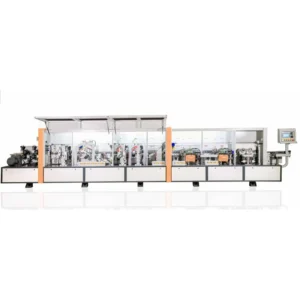
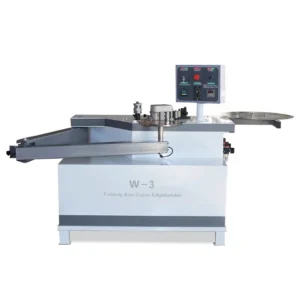
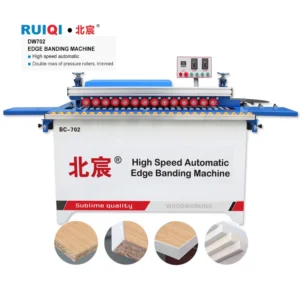
OEM Manufacturing Depth — Every DW1800 Automatic Edge Banding Machine is built in-house with precision-ground components, patented cutting mechanisms, and full voltage customization verified against the buyer’s local grid before production begins.
Technical Specifications
| Parameter |
Value |
| Model |
DW1800 |
| Product Type |
Automatic Edge Banding Machine |
| Total Power |
4.9 kW |
| Voltage Options |
380V / 220V / 415V (configurable from 110V to 440V) |
| Frequency |
50Hz / 60Hz (to be confirmed per destination market) |
| Feed Speed |
0–14 m/min |
| Edge Banding Thickness Range |
0.3–3 mm |
| Edge Banding Height Range |
0–50 mm |
| Minimum Sheet Length |
200 mm |
| Minimum Sheet Width |
100 mm |
| Trimming Motor Power |
800 W × 2, 24000 r/min |
| Polishing Motor Power |
380 W × 2 |
| Vacuum Motor Power |
550 W |
| Glue Pot Capacity |
4000 ml |
| Air Supply Pressure |
0.4–0.6 MPa |
| Mobile Table Guide |
Roll-ball differential structure |
| Mobile Workstation Frame |
High-strength extruded aluminum alloy |
| Overall Dimensions (L×W×H) |
2200 × 650 × 1250 mm |
| Net Weight |
320 kg |
| Control System |
PLC |
| Language Options |
Chinese, English (additional languages on request) |
| Plug Options |
EU, USA, AU, UK |
Application Suitability
| Application |
Material or Output |
| Custom furniture panel edge banding |
MDF, particleboard, plywood |
| Cabinet door and carcass finishing |
PVC and ABS edge banding on substrate panels |
| Solid wood panel edge treatment |
Solid wood panels with veneer or PVC banding |
| Decorative panel processing |
Organic glass plates, ABS boards |
| Small to mid-volume workshop production |
Batch runs of flat-panel components for furniture assembly |
Why the Voltage Question Must Precede the Quotation for Every Automatic Edge Banding Machine OEM Order
A machine that cannot run on the local grid is a stranded asset, no matter how accurate its trimming stations.
Over years of commissioning edge banders across Southeast Asian factories, I have watched production lines stall for weeks because the voltage and frequency on the nameplate did not match the facility supply. In one Vietnamese plant, a 380V machine connected to a 220V/60Hz industrial circuit tripped the main breaker on startup, and the PLC registered overvoltage faults across every I/O module. The factory waited three weeks for a variable-frequency drive retrofit while panels sat unprocessed [NEED_CITE: voltage and frequency standards by export market]. For regional distributors and OEM partners sourcing an Automatic Edge Banding Machine OEM solution, confirming the destination grid parameters before the purchase order is the single most effective way to avoid commissioning failures.

How OEM Partners Evaluate Manufacturing Depth
When a distributor decides to place their own brand on an edge bander, they need to verify more than logo placement. The DW1800 is manufactured entirely in-house, from the precision-ground feed components to the patented cutting mechanisms that hold trimming tolerance within ±0.02 mm. An Automatic Edge Banding Machine OEM engagement here starts with component traceability — buyers can review material certificates for the aluminum alloy frame and the hardened steel trimming cutters before production begins. The four-stage quality control process covers incoming raw material, in-process machining, finished assembly, and pre-shipment verification, so an OEM partner evaluating manufacturing depth sees documented checkpoints rather than marketing claims.
Private-Label Customization Beyond the Nameplate
Regional importers need machines that feel native to their market. The DW1800 supports custom control panel branding, color-matched body panels, and language localization for the HMI beyond the default Chinese and English options. Voltage is configured per order — a distributor covering the Philippine market can specify 220V/60Hz with a NEMA plug, while a partner selling into Thailand can request 380V/50Hz with IEC industrial connectors. The plug options available from stock include EU, USA, AU, and UK types, and additional configurations are produced per order [NEED_CITE: CE machinery directive requirements for industrial equipment]. Each unit ships with an electrical schematic and a voltage confirmation document matched to the buyer’s declared grid specification, eliminating the guesswork that causes field failures.
Reading the Spec Sheet: What the Numbers Mean on the Shop Floor
The DW1800 runs trimming motors at 24000 r/min with 800 W each, which determines how cleanly the edge banding is trimmed flush with the panel surface on materials ranging from 0.3 mm PVC to 3 mm solid wood veneer. At higher feed speeds approaching 14 m/min, the trimming cutters must maintain surface finish quality, and the motor speed directly governs that outcome. The 4000 ml glue pot provides enough adhesive volume for sustained production runs without frequent refills, and its temperature stability affects glue line visibility on porous substrates like MDF and particleboard — a lower-capacity pot would introduce thermal fluctuation as fresh cold glue enters the reservoir. The roll-ball differential feed structure maintains panel alignment across the full 0–50 mm edge height range, preventing the lateral drift that causes uneven trimming on narrow workpieces. Air supply at 0.4–0.6 MPa drives the pneumatic actuators for front/rear alignment and flexible edge scraping; insufficient pressure at the lower bound can cause incomplete scraping passes, leaving visible burrs on the finished edge.
The Hidden Cost of Skipping Grid Verification
When an importer takes delivery of an edge bander without confirming voltage compatibility, the consequences cascade through the entire dealership operation. The machine sits idle while the buyer sources transformers or frequency converters, warranty disputes arise over whether the fault is a manufacturing defect or an installation error, and the distributor’s service team spends billable hours diagnosing a problem that was preventable at the quotation stage [NEED_CITE: common causes of industrial motor failure from voltage mismatch]. For an OEM partner, a single grid-mismatch incident can damage brand credibility across a territory, as word travels quickly among furniture manufacturers who share workshop space and service contacts. The DW1800 addresses this by requiring voltage and frequency confirmation as a mandatory step in the order process, with a signed electrical specification document returned before the machine enters production.
Why Distributors Source the DW1800 Here
In-house manufacturing with patented cutting mechanisms means OEM partners negotiate directly with the factory floor, not a trading company adding margin layers. Full voltage customization from 110V to 440V is offered as standard, so a single distributor covering multiple territories can consolidate orders under one supplier with different electrical configurations per destination. The product family spans entry-level to full-function models, allowing a distributor to offer a tiered range under their own brand without qualifying a second manufacturer. Four-stage quality control with pre-shipment verification includes factory test records run on the buyer’s specified panel material, providing documented evidence the machine meets tolerance before it leaves the facility. Engineer-led configuration recommendations are delivered as formal quotations within 24 hours, giving distributors the technical documentation they need to close deals with their own customers.
Documentation & Verification
- CE declaration of conformity covering the DW1800 edge bander for EU market import
- ISO 9001 certificate available for distributor quality system alignment
- Factory test record on buyer-supplied panel material before dispatch
- Electrical schematic with confirmed voltage and frequency for the destination grid
- Operation and maintenance manual in the agreed language with illustrated spare parts list
- Packing photographs and customs documentation support for international freight forwarding
Installation, Commissioning & Support
- Requires a dedicated circuit matching the confirmed voltage, with the 4.9 kW total load and compressor draw calculated separately
- Overall footprint of 2200 × 650 mm fits standard workshop bays with clearance for panel infeed and offfeed
- Roll-ball feed table arrives assembled; workstation frame bolts to the base with alignment verified on site
- First-run commissioning includes PLC parameter setup for the specific edge banding thickness and material type
- Operator training covers glue pot temperature management for PVC versus wood veneer banding at the 4000 ml capacity
- Spare parts list includes trimming cutters, polishing wheels, and feed rollers with reorder part numbers
What to Include in Your Inquiry
To receive an accurate configuration proposal, provide the target market’s standard voltage and frequency, the panel materials and edge banding types your customers most commonly process, and the control panel language required by local operators. If you are building a territory-specific model mix, share the production volume range your end users operate in so the engineering team can confirm whether the DW1800’s feed speed and glue pot capacity align with daily throughput expectations.
Frequently Asked Questions
Q: What OEM and private-label customization is available for the DW1800?
A: Custom logo application on the machine body and control panel, color-matched exterior panels, and localized HMI language are all configurable per order. The electrical specification — voltage, frequency, and plug type — is set to match your target market. Each OEM unit carries your branding on the documentation package as well.
Q: How is voltage and frequency confirmed before production starts?
A: Every order requires a signed electrical specification document declaring the destination grid parameters. The engineering team cross-references this against the motor, PLC, and heater ratings, then produces a matched electrical schematic that ships with the machine. No unit enters assembly without this confirmation step completed.
Q: What does the four-stage quality control process cover?
A: Incoming raw materials are inspected before machining begins. In-process checks verify dimensional accuracy of ground components. Finished assembly is tested under power with all stations running. Pre-shipment verification includes a test run on the buyer’s specified panel material, with results documented in the factory test record.
Q: Can distributors request sample processing with their own panel material?
A: Yes. Buyers can ship representative panel samples to the factory for a processing test on the DW1800. The test verifies trimming quality, glue line appearance, and edge finish on the actual substrates the distributor’s customers will run, and the results are included with the quotation.
Q: What spare part and technical training support do distributors receive?
A: Each shipment includes a detailed spare parts list with reorder codes for trimming cutters, polishing wheels, and pneumatic components. Distributors can arrange technical training for their service teams covering PLC diagnostics, trimming station adjustment, and glue pot maintenance procedures specific to this model.