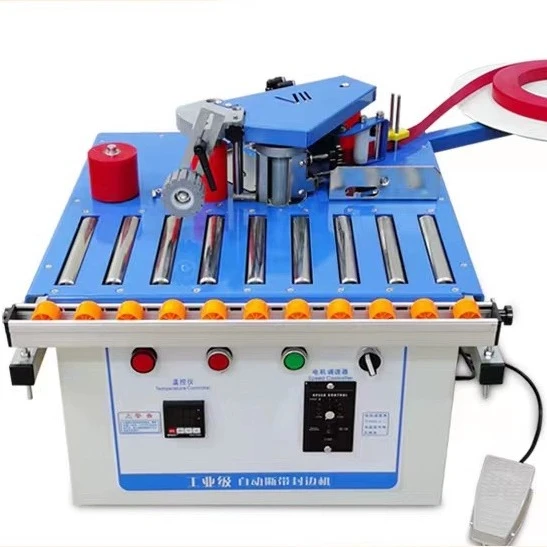
Precision Manufacturing — Verified through four-stage quality control with pre-shipment testing records photographed and archived before dispatch.
Technical Specifications
| Parameter |
Value |
| Product Type |
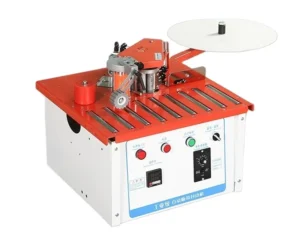
Portable Edge Banding Machine |
| Function |
Double Side Gluing for Straight, Curved and Shaped Edges |
| Rated Voltage |
220V (configurable from 110V to 440V) |
| Rated Power |
1.2 kW |
| Rated Air Pressure |
0.4–0.6 MPa |
| Strip Thickness Range |
0.5–1.5 mm |
| Sheet Thickness Range |
10–60 mm |
| Glue Pot Capacity |
1000 ml |
| Heating Time |
5–10 min |
| Edge Banding Speed |
0–6 m/min |
| Glue Heating System |
4 heating tubes |
| Glue Application |
Glue-coated rollers, double-sided |
| Pressure Rollers |
Adjustable, rubber material |
| Edge Strip Transport |
Adjustable bayonet according to strip height |
| Belt Breaking Control |
Pneumatic with foot switch (curved); travel switch (straight) |
| Overall Dimensions |
54 × 54 × 56 cm |
| Net Weight |
26 kg |
Application Suitability
| Application |
Material or Output |
| Custom furniture panel edge finishing |
MDF and particleboard with PVC edge banding |
| Curved cabinet door and radius panel sealing |
Plywood panels with veneer strips (0.5–1.5 mm) |
| Small joinery workshop production |
Solid wood panels requiring shaped edge profiles |
| On-site installation and mobile repair tasks |
Pre-cut boards where full-size machinery is impractical |
| Entry-level furniture making |
Laminate and melamine-faced boards with straight edges |
Why Voltage Confirmation Must Happen Before the Order Ships
A portable edge banding machine that arrives with the wrong voltage is a 26 kg paperweight sitting on your workshop floor.
I have watched importers receive woodworking equipment only to discover the motor hums but never reaches operating speed because the factory wound it for 380V three-phase while the destination country runs single-phase 220V at 50 Hz. The glue pot never reaches temperature, the pressure rollers stall mid-pass, and the entire first batch of panels comes back with delaminated edges. For a compact unit like this portable edge banding machine, the electrical specification is not a detail — it is the single factor that determines whether you can plug it in and run it on day one [NEED_CITE: voltage and frequency standards by export market].

How In-House Manufacturing Controls Glue Line Consistency
The double-sided gluing system on this portable edge banding machine uses a 1000 ml pot with four independent heating tubes. Uniform heat distribution across the pot prevents cold spots where adhesive viscosity rises and hot spots where it degrades. When a distributor sources from a trading company rather than the factory, there is no way to verify whether the heating elements were matched to the pot geometry or simply dropped in as commodity parts. Building these units in our own facility means the glue-coated rollers are tested against actual PVC and veneer strips before the machine leaves the assembly bench.
Engineering Pressure Rollers for Curved and Straight Profiles
Curved edge banding demands different pressure dynamics than straight runs. The adjustable rubber pressure rollers on this unit compensate for radius changes without leaving compression marks on softer veneer materials. The pneumatic belt-breaking system pairs a foot switch for curved work with a travel switch for straight edges, letting the operator transition between profile types without reconfiguring the machine. This level of control is something we validate during in-process QC rather than leaving to field discovery [NEED_CITE: CE machinery directive requirements for portable woodworking equipment].
Reading the Specs That Actually Matter for Panel Assembly
The 10–60 mm sheet thickness range covers standard furniture board stock, from 12 mm shelving material up to thick worktop panels. What matters is how the adjustable bayonet transport mechanism handles strip height variation within that range — if the bayonet does not align with the strip edge, the banding feeds at an angle and produces a visible overhang that has to be trimmed by hand. The 0–6 m/min speed range is intentionally slow because manual feed rate depends on operator skill and edge complexity, not motor capability. Running curved profiles at higher speeds causes the strip to lift before the adhesive sets, which is why the speed ceiling stays conservative. The 0.4–0.6 MPa air pressure requirement is standard for workshop compressors and does not demand dedicated pneumatic infrastructure.
The Cost of Buying Without Confirming Material Compatibility
One of the most common failures I have seen in the field involves operators running veneer strips through a machine calibrated for PVC. Veneer absorbs moisture from the adhesive differently, requires lower glue temperature, and needs gentler roller pressure to avoid cracking along the grain. When a buyer does not specify the strip material during the inquiry stage, the factory ships with default settings optimized for the most common material — and the first production run reveals the mismatch as curled edges, blistered surfaces, or adhesive bleed-through that ruins finished panels [NEED_CITE: woodworking adhesive behavior across veneer and PVC substrates].
What Manufacturing Depth Means for Your Supply Chain
Sourcing this portable edge banding machine directly from the production floor means every unit goes through incoming material inspection, in-process assembly checks, finished product testing, and pre-shipment verification with photographic records. The precision-ground pressure roller shafts are measured for runout before installation, not assumed to be within tolerance because the supplier said so. OEM partners receive the same component traceability whether the order is one unit or a container load. Voltage and control panel language customization happens during assembly rather than as a post-production modification that voids the electrical certification.
Documentation & Verification
- CE declaration of conformity matched to the specific portable unit serial number
- ISO 9001 certificate covering the manufacturing process for this product family
- Electrical schematic confirming your ordered voltage and frequency configuration
- Factory test record showing edge banding results on your specified strip material
- Packing photographs documenting the unit condition before crate closure
- Operation manual translated into your operator’s working language
Installation, Commissioning & Support
- Requires a dedicated 220V circuit capable of sustaining 1.2 kW continuous draw without voltage drop
- Compact 54 × 54 × 56 cm footprint fits on a standard workshop bench without floor anchoring
- Arrives fully assembled — connect air supply at 0.4–0.6 MPa and power on for first heat cycle
- Allow 5–10 minutes for the four-tube glue pot to reach stable operating temperature before first run
- Spare parts list includes replacement rubber pressure rollers and heating tubes for long-term maintenance
- Pneumatic foot switch and travel switch calibrated at the factory for immediate straight and curved operation
What We Need to Quote Your Configuration Accurately
Tell us the edge banding strip materials you plan to run — PVC, ABS, melamine, or natural veneer — because each requires different glue temperature and roller pressure settings. Confirm your local voltage and frequency so the motor and heating elements are wound correctly before assembly begins. If you are evaluating this unit as an OEM product line, specify your branding requirements, manual language, and target order volume so we can map production scheduling to your market timeline.
Frequently Asked Questions
Q: What OEM and private-label customization options are available for this portable edge bander?
A: We offer custom logo placement on the machine housing, branded operation manuals, and private-label packaging. Voltage, control panel language, and plug type are configured to your target market during assembly. Minimum order quantities depend on the customization scope and are confirmed after reviewing your branding and specification requirements.
Q: How does your four-stage QC process verify edge banding quality before shipment?
A: Incoming materials are inspected for dimensional accuracy, then assembly is checked at critical torque and alignment points. The finished unit runs a banding test on actual strip material to verify glue distribution and roller pressure. Pre-shipment verification includes photographic documentation of the test results and the packed unit before it leaves the factory floor.
Q: Can the machine be configured for different regional voltages and control panel languages?
A: Yes. The standard rating is 220V, but the motor and heating system can be configured for voltages from 110V to 440V depending on your local supply. Control panel labeling and the operation manual are produced in the language your operators will use, confirmed during the specification stage before production begins.
Q: What is the typical manufacturing lead time for OEM orders?
A: Lead time depends on order volume and customization complexity. Standard configurations with voltage and language changes typically move through production and QC within a multi-week window. Fully branded OEM orders with custom housing and packaging require additional scheduling, which we confirm in the formal quotation after reviewing your complete specification sheet.