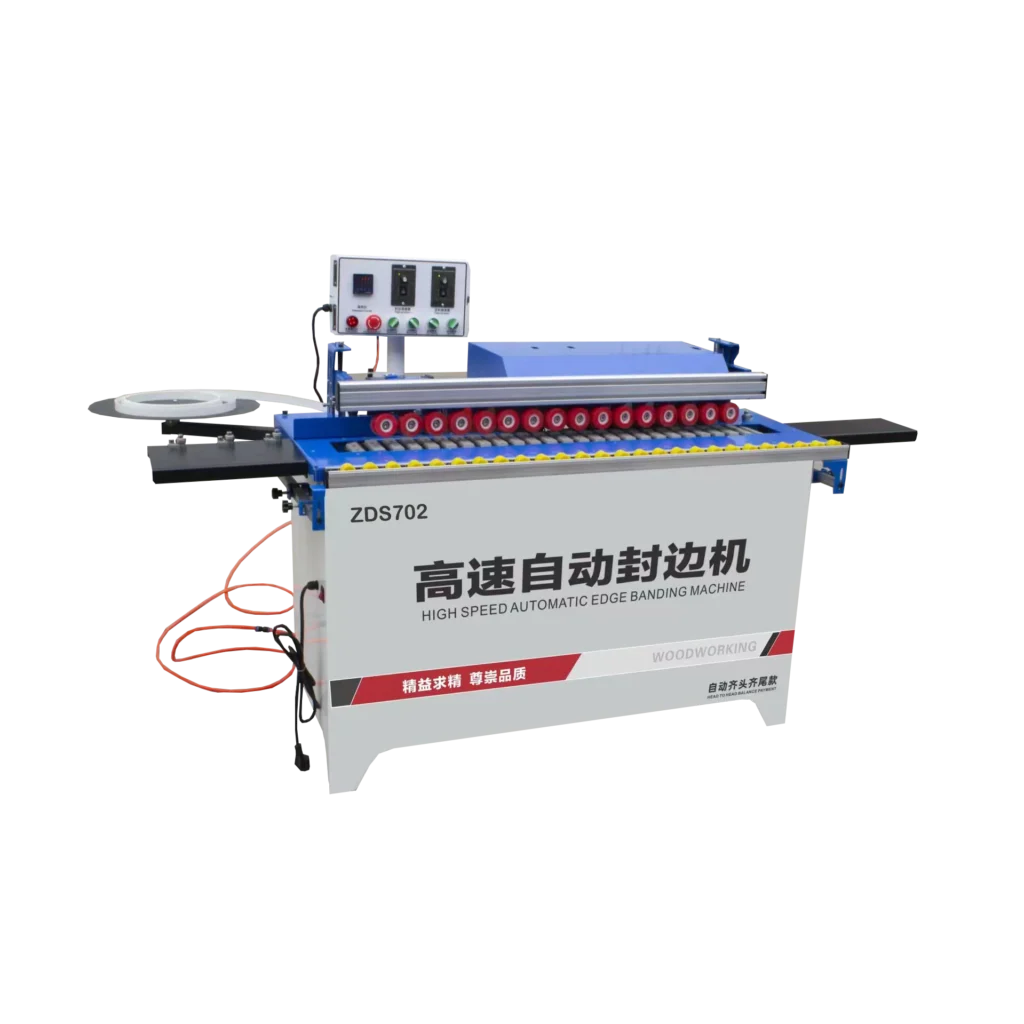
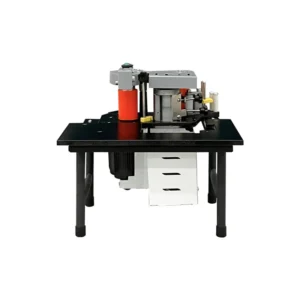
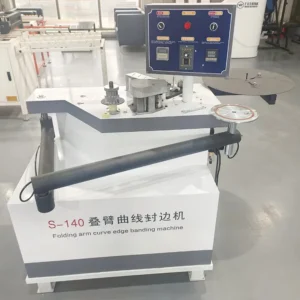
Voltage-Flexible Assembly — Every ZDS702 semi automatic edge banding machine leaves our Ningjin workshop only after its motor winding, control transformer, and heating element are verified against the buyer’s confirmed local grid frequency and voltage.
Technical Specifications
| Parameter |
Value |
| Model |
ZDS702 |
| Product Type |
Semi Automatic Edge Banding Machine |
| Edge Type |
Straight line |
| Trimming Height (Panel Thickness) |
5-50mm |
| Edge Banding Thickness |
0.3-3mm |
| Feed Speed |
0-10m/min |
| Rated Power |
3.8kW |
| Heating Power |
1000W (5-10min heat-up) |
| Glue Capacity |
1000ml |
| Rated Voltage |
220V / 380V / Custom |
| Rated Air Pressure |
0.4-0.6MPa |
| Pressure System |
Double row pressure roller, integrated pressure beam, silicone conveyor belt |
| Adjustment |
Hand crank wheel integrated pressure adjustment |
| Overall Dimensions |
120 x 55 x 120cm |
| Net Weight |
105kg |
| Assembly State |
Requires assembly (manual and video provided) |
| Functions |
Auto plate feeding, end cutting, head/tail trimming, upper/lower polishing, dust collector |
| Certification |
CE, ISO 9001 |
Application Suitability
| Application |
Material or Output |
| Custom cabinet door production |
MDF and plywood panels with PVC edge banding |
| Small-batch wardrobe side panel processing |
Particleboard with melamine or veneer strips |
| Workshop furniture prototyping |
Solid wood panels up to 50mm thickness |
| Joinery startup straight-line edging |
Laminated boards requiring end trimming and polishing |
Why the Voltage Question Must Precede the Price on a Semi Automatic Edge Banding Machine
Matching the electrical supply before production starts prevents the most common commissioning failure we see on export shipments.
I have stood in workshops where a brand-new machine sat dead under a tarp because the factory ordered a 380V/50Hz unit for a facility running on a 415V/60Hz local grid. The control board fried within minutes, and the heating element ran hot enough to scorch the glue. With the ZDS702 semi automatic edge banding machine, we require a signed voltage and frequency confirmation sheet before the first component is cut [NEED_CITE: voltage and frequency standards by export market]. This step adds days to the paperwork but eliminates weeks of downtime waiting for a replacement transformer.

Component Sourcing and Assembly Integrity
The pressure beam on this unit uses a double row pressure roller layout paired with a silicone material conveyor belt. These components are sourced against our internal tolerance sheet, and each batch undergoes incoming material inspection before release to the assembly floor. The hand crank wheel mechanism for integrated pressure adjustment is ground and fitted by the same team that builds the heavier fully automatic models, maintaining part commonality across the product family.
Four-Stage QC Built Around Real Panel Samples
We do not ship a Semi Automatic Edge Banding Machine manufacturer standard test and call it done. Our four-stage QC protocol requires incoming material check, in-process dimensional verification, finished product functional run, and a pre-shipment test using the actual board thickness and edge banding material the buyer intends to run. If a customer in West Africa sends us a sample of locally sourced 18mm particleboard and 0.6mm PVC strip, we lock the feed speed, glue temperature, and pressure roller gap against that exact combination before crating [NEED_CITE: CE machinery directive requirements for industrial equipment]. The test record travels with the machine.
What 0-10m/min Feed Speed and 5-50mm Trimming Height Mean on the Floor
A 5-50mm panel thickness range lets a small workshop run thin 5mm MDF back panels and thick 50mm solid wood tabletop edges on the same machine without a tooling changeover. The variable 0-10m/min feed speed matters because running PVC banding on particleboard at maximum speed can cause the glue to cool before full adhesion; operators dial back to 4-6m/min for porous substrates and push toward 8-10m/min on sealed melamine surfaces. The 1000W heating element reaches working temperature in roughly 5-10 minutes, and the 1000ml glue pot holds enough adhesive for continuous runs without frequent refills. The 3.8kW total rated power keeps the machine within the capacity of a standard single-phase or small three-phase workshop supply, avoiding the cost of an electrical infrastructure upgrade.
The Hidden Cost of Skipping the Voltage and Sample Test Step
Workshops that skip the sample test often discover on day one that locally purchased edge banding shrinks or expands differently from the supplier’s test material, causing the head and tail trimming station to leave visible overhangs or cut into the panel face. The operator then spends hours adjusting the double row pressure roller gap by feel, risking damage to the integrated pressure beam. We have seen this exact scenario stall a production line for an entire week while waiting for remote guidance [NEED_CITE: common edge banding commissioning faults in export markets]. Running the buyer’s actual material at the factory eliminates this variable entirely.
Why Source This Machine Through Our Manufacturing Channel
Our in-house manufacturing means the patented cutting mechanism and precision-ground components in the ZDS702 are built on the same floor as our full-function automatic lines, so parts and service knowledge remain unified. Voltage customization from 110V to 440V is a standard option, not a special request, documented with an electrical schematic before production begins. An engineer-led configuration review matches your panel range and daily volume to the correct pressure roller setup and feed speed bracket, with a formal quotation typically returned within 24 hours. Pre-shipment verification against your sample material is included, and factory visits for live demonstration are welcomed at our Ningjin facility.
Documentation & Verification
- CE declaration of conformity covering the ZDS702 electrical and mechanical safety envelope
- ISO 9001 certificate tied to our four-stage QC protocol
- Electrical schematic confirming your specified voltage and frequency before assembly
- Factory test record run on your submitted panel and edge banding samples
- Operation and maintenance manual delivered in your agreed language
- Spare parts list with OEM part numbers for reorder
Installation, Commissioning & Support
- Requires assembly on arrival; 120x55x120cm footprint fits standard workshop doorways
- Dedicated 3.8kW circuit with correct voltage breaker sizing per the supplied schematic
- 0.4-0.6MPa clean air supply needed for pneumatic pressure roller engagement
- Video-guided assembly and first-startup sequence included with shipment
- Glue pot heat-up and feed speed calibration walkthrough on your panel stock
- Silicone conveyor belt and pressure roller wear items listed with reorder part numbers
Before You Request a Quote
Send us the panel substrates you intend to process, the edge banding thickness range you stock, and your local voltage and frequency so we can configure the ZDS702 correctly from the start. If you are evaluating multiple semi automatic edge banding machines for a new workshop line, share your available floor space and compressed air capacity so we can confirm this unit integrates with your existing equipment. We can arrange a sample processing test at the factory using your material before you commit to an order.
Frequently Asked Questions
Q: How do I confirm the correct voltage and frequency for my country?
A: We supply a voltage confirmation form during the quotation stage. You provide your facility supply specs, and we configure the ZDS702 motor, control transformer, and 1000W heating element accordingly, from 110V to 440V. An electrical schematic is issued for your electrician to verify before production begins, preventing commissioning failures caused by grid mismatch.
Q: What panel thickness and edge banding materials does the ZDS702 handle?
A: The machine processes panels from 5-50mm thick and edge banding from 0.3-3mm, covering MDF, plywood, particleboard, and solid wood with PVC or veneer strips. We recommend submitting a sample of your exact material so we can lock the feed speed and glue temperature at the factory before shipping.
Q: What assembly and commissioning support is provided?
A: The ZDS702 ships partially disassembled at 105kg net weight. We include a step-by-step manual and video guides covering reassembly, pressure roller gap setting via the hand crank wheel, and first-run calibration. The double row pressure roller and silicone belt alignment are demonstrated in detail to minimize on-floor setup time.
Q: Can I visit the factory for a sample processing test before ordering?
A: Yes. We welcome buyers to our facility to run their own panel and edge banding samples on the ZDS702. The pre-shipment test covers auto plate feeding, end cutting, head and tail trimming, and upper/lower polishing, so you can verify edge quality and trimming accuracy against your assembly tolerances before the machine is crated.