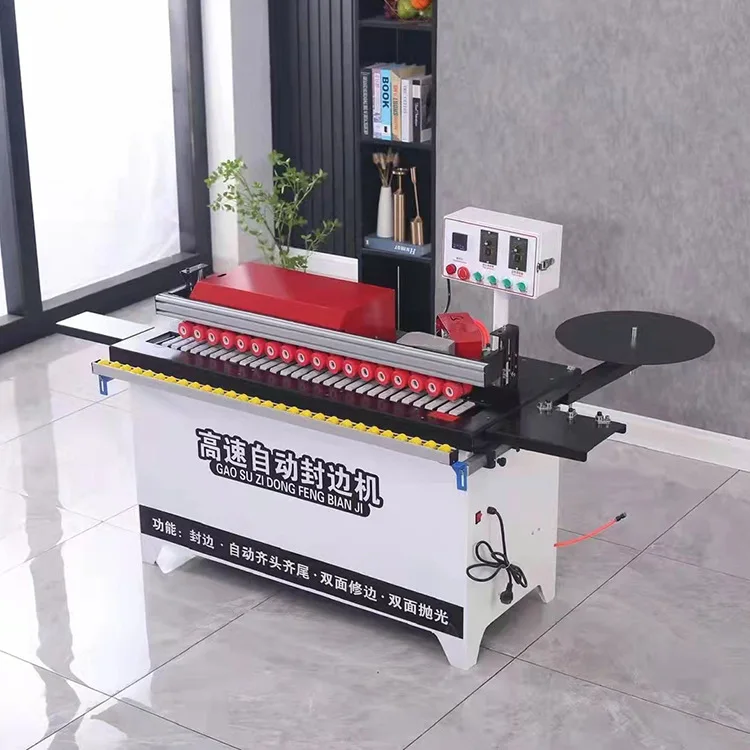
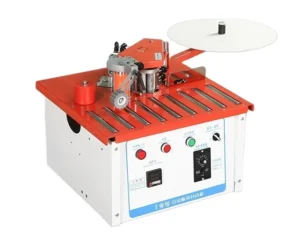
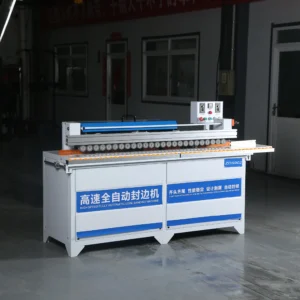
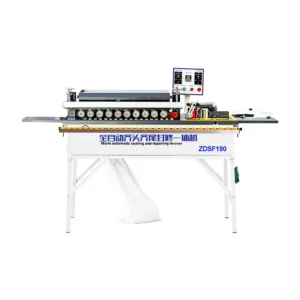
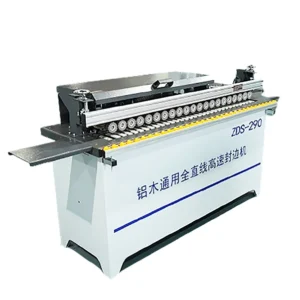
In-House Precision Manufacturing — every edge bander leaving our Ningjin floor is built on patented cutting mechanisms, four-stage QC, and pre-shipment verification using your own substrates before the crate is sealed.
Technical Specifications
| Parameter |
Value |
| Product Type |
Automatic Edge Banding Machine |
| Function |
Automatic plate feeding, end cutting, upper and lower polishing, head and tail trimming, dust collection |
| Edge Type |
Straight line |
| Rated Voltage |
220V (frequency and phase to be confirmed with buyer’s market) |
| Strip Thickness |
0.5–2.5 mm |
| Sheet Thickness |
10–50 mm |
| Trimming Power |
800W × 2 |
| Polishing Power |
180W × 2 |
| Suction Power |
1200W |
| Rated Power |
4 kW |
| Rated Air Pressure |
0.4–0.6 MPa |
| Feed Speed |
0–10 m/min |
| Glue Pot Capacity |
4000 ml |
| Heating Power |
1000W (5–10 min warm-up) |
| Overall Dimensions |
1300 × 650 × 750 mm |
| Machine Weight |
150 kg (basis not stated in source — verify against manufacturer catalog) |
| Control Panel |
Digital display of glue pot temperature, independent switch |
| Pressure Beam |
One-piece beam, double rows of pressure wheels |
| Conveyor Belt Material |
Silicone |
| Belt Breaking Method |
Pneumatically controlled |
| Extendable Support |
Fluent strips for large plate stability |
Application Suitability
| Application |
Material or Output |
| Custom furniture panel edge banding |
MDF, particleboard, plywood with PVC or melamine strips |
| Cabinet door and carcass production |
Laminated panels with veneer edge banding 0.5–2.5 mm |
| Small to mid-size workshop automation |
Transitioning from manual edge banding to semi-automatic feed |
| Shelving and storage unit fabrication |
Standard sheet stock 10–50 mm thickness |
What "Tolerance Claimed" Actually Means When the Crate Arrives
A tolerance is only real when it is documented against your specific panel and edge strip before the machine ships.
Many distributors quote edge banders with impressive precision numbers, but those figures are rarely tested on the exact MDF or particleboard the buyer will run in their own workshop. I have seen automatic edge banding machine OEM factory orders arrive at a distributor’s warehouse only for the end user to discover that the ±0.02 mm tolerance was measured on a completely different substrate. The result is visible glue lines, trimming chatter, and a service call that could have been prevented. [NEED_CITE: common substrate-related edge banding defects in panel processing]

How This Edge Bander Is Assembled on the Floor
The pressure beam is machined as a single piece rather than bolted in sections, which keeps deflection uniform across the full 50 mm sheet thickness range. Double rows of pressure wheels press the panel against the silicone conveyor belt without leaving surface marks on finished melamine faces. This matters for OEM partners who need their private-label equipment to deliver consistent results regardless of whether the operator is running 10 mm shelving stock or 50 mm worktop blanks. The automatic edge banding machine OEM factory build process includes precision grinding of the trimming carriage rails, a step that directly determines whether the head-and-tail cut lands clean or leaves a witness mark.
Component Sourcing and the Four-Stage QC Protocol
Every critical component — from the 800W trimming motors to the pneumatic belt-breaking cylinder — is logged at incoming inspection before assembly begins. In-process checks verify alignment of the double high-speed trimming heads and the 4000 ml glue pot seating. Once assembly is complete, the machine runs a continuous cycle using sample panels and edge strips, and those results are recorded. Pre-shipment verification then repeats the test with the buyer’s own material if samples have been provided. [NEED_CITE: ISO 9001 quality management requirements for machinery assembly]
Reading the Specs That Actually Affect Your Edge Finish
The 0–10 m/min feed speed range is variable, and the right setting depends on strip thickness and glue open time. Running 2.5 mm PVC at the top of that speed range may starve the glue bond, while 0.5 mm veneer at the lower end can overheat the adhesive. The digital temperature display on the glue pot lets operators dial in the correct curve for each material, but that curve must be established during commissioning — not guessed on the first production morning. The 1000W heating element reaches working temperature within 5–10 minutes, which is adequate for a workshop doing batch runs with material changeovers. The extendable fluent strips keep large-format panels stable as they enter and exit the pressure zone, preventing the tail-end dip that causes uneven trimming on oversized boards.
The Cost of Skipping Voltage Confirmation Before Production
A distributor once ordered a batch of edge banders for a market running 380V three-phase, but the units were wired for 220V single-phase based on a generic quotation. The machines arrived unusable until rewinding was completed locally at the distributor’s expense. Electrical mismatches are among the most common reasons for delayed commissioning in cross-border machinery trade, and they are entirely preventable. When the voltage and frequency are not locked in writing before the order enters production, the automatic edge banding machine OEM factory has no basis to configure the motor windings, contactors, and heating elements correctly. [NEED_CITE: voltage and frequency standards by export market]
What the Build Process Covers for Distributors
The patented cutting mechanisms used in the trimming stations are developed and manufactured in-house, which means replacement parts do not depend on third-party supplier lead times. Voltage is configurable from 110V to 440V, so a single product family can serve multiple territories without maintaining separate model lines. Multilingual control panels are standard, eliminating the situation where an operator in South America or Southeast Asia cannot read the temperature readout. The four-stage QC protocol — incoming material, in-process, finished product, and pre-shipment — ensures that every unit carries a factory test record before crating. Private-label branding, including custom logo placement and color, is integrated into the production run rather than applied as an afterthought.
Documentation & Verification
- CE declaration of conformity covering the specific edge bander model shipped
- Factory test record with measured trimming tolerance on buyer’s panel samples
- Electrical schematic confirming voltage and frequency for the target market grid
- Operation and maintenance manual in the buyer’s agreed language
- Spare parts list with part numbers matching the as-built configuration
Installation, Commissioning & Support
- 4 kW rated power requires a dedicated circuit with appropriate breaker sizing
- 1300 × 650 mm footprint fits standard workshop aisles without foundation work
- Pneumatic belt-breaking system needs 0.4–0.6 MPa clean air supply at the connection point
- Digital glue pot calibration performed on-site using the buyer’s PVC or veneer strips
- Silicone conveyor belt inspection and tensioning covered in first-day operator training
- Extendable fluent strips adjusted to match the buyer’s most common panel dimensions
What We Need to Configure the Right Machine for Your Market
Send us the panel materials and edge strip types your customers run most often, along with the local voltage and frequency standard. If you are planning a phased rollout across several territories with different grid specifications, let us know the sequence so we can stage production accordingly. We also welcome sample material shipped to our Ningjin facility so that the pre-shipment test reflects real conditions rather than generic test stock.
Frequently Asked Questions
Q: What OEM and private-label options are available for this edge bander?
A: Custom logo placement, machine color, voltage from 110V to 440V, and multilingual control panel text are all configurable during production. Distributors can specify branding on the machine body, packaging, and documentation. Each configuration is documented in the order specification sheet so repeat orders stay consistent.
Q: How is trimming tolerance verified before the machine leaves the factory?
A: We run sample panels and edge strips provided by the buyer through the full trimming and polishing cycle, then measure and record the results. The factory test record ships with the machine. This covers head-and-tail trimming accuracy and polishing finish on the specific substrate the buyer will use.
Q: Can the glue pot settings handle different edge banding materials?
A: The 4000 ml glue pot has a digital temperature display and 1000W heating element. Operators can adjust the temperature curve for PVC, melamine, and veneer strips within the 0.5–2.5 mm range. We recommend sending your most common strip and board combination so we establish the baseline settings before dispatch.
Q: What spare parts and training support do distributors receive?
A: Each machine ships with a matched spare parts list based on the as-built configuration. We provide technical documentation and can arrange training sessions for the distributor’s service team, covering trimming motor replacement, belt maintenance, and glue pot servicing procedures.