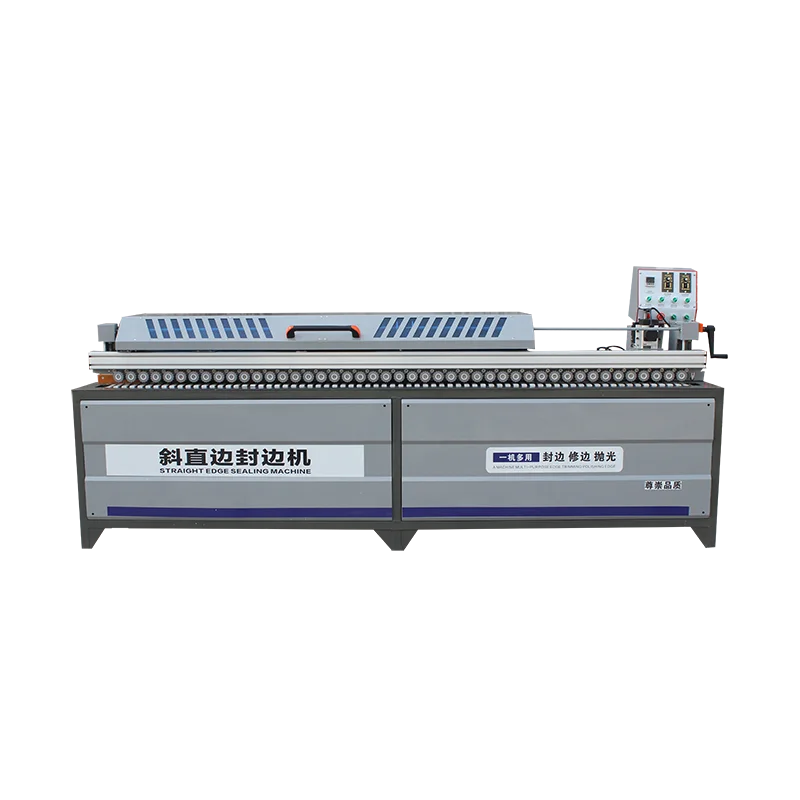
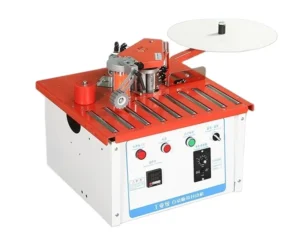
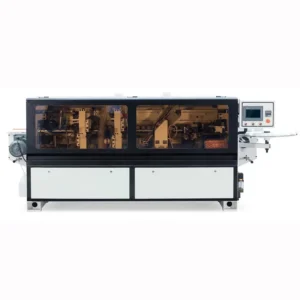
Precision-Built Edge Bander — manufactured in-house with patented cutting mechanisms, verified tolerance, and full OEM customization from voltage to control panel language.
Technical Specifications
| Parameter |
Value |
| Model |
ZDSDW3000 |
| Product Type |
Oblique Straight Edge Banding Machine |
| Function Stations |
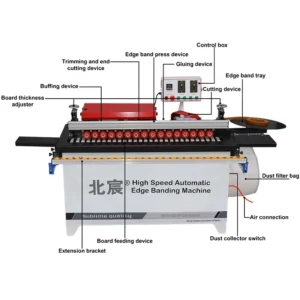
Gluing, Fine Trimming, Rough Trimming, End Trimming, Scraping, Buffing |
| Pre-milling |
Pre-milling motor included for smoother panel edges and stable gluing |
| Bevel Pressing |
8 groups, angle adjustable from 30° to 90° |
| Pressure Beam Adjustment |
Digital display, accommodates varying plate thicknesses |
| Gluing Device |
Tight contact mechanism between edge belt and boards |
| Buffing System |
Dual motors, up and down configuration |
| Dust Extraction |
Large-diameter suction tube |
| Overall Dimensions (L×W×H) |
2990×650×1300 mm |
| Panel Thickness Range |
(basis to be confirmed) |
| Feed Speed |
(basis to be confirmed) |
| Rated Power |
(basis to be confirmed) |
| Voltage & Frequency |
Configurable from 110V to 440V |
| Control System |
(basis to be confirmed) |
Application Suitability
| Application |
Material or Output |
| Furniture panel edge banding |
MDF, particleboard, plywood panels with PVC edge banding |
| Cabinet door and carcass finishing |
Melamine-faced boards with straight and beveled profiles |
| Custom furniture production |
Wood-based panels requiring oblique or straight edge treatment |
| Joinery workshop output |
Solid wood panels and veneer-banded components |
Why Voltage Verification Must Happen Before the Oblique Straight Edge Banding Machine Factory Ships
Every electrical specification must be confirmed against the buyer’s actual site supply, not assumed from a regional standard.
I once watched a Spanish cabinet factory lose two full weeks of production because an edge bander arrived wired for 400V/50Hz while the workshop ran 480V/60Hz. The inverter tripped on overvoltage within seconds of power-on. A transformer had to be shipped by sea, and the entire line sat idle. That incident changed how I handle every subsequent order: I now ask buyers to photograph the nameplate on their main distribution board before any Oblique Straight Edge Banding Machine factory begins assembly [NEED_CITE: voltage and frequency standards by export market]. The cost of getting this wrong extends far beyond the machine itself.

How OEM Buyers Evaluate Build Depth
Distributors and importers do not buy machines the way end-users do. They need to understand what happens inside the frame before the cover panels go on. For this oblique straight edge banding machine, the evaluation starts with component sourcing traceability and the precision grinding standards applied to critical tolerance parts. OEM partners also require confidence that private-label branding, from logo placement to multilingual control panel overlays, can be integrated without altering the machine’s structural integrity or voiding performance guarantees.
The Four-Stage QC Protocol That Protects Your Brand
When you place your logo on a machine, its performance reflects on your reputation in the local market. The manufacturing process for the ZDSDW3000 covers incoming material inspection, in-process verification during assembly, finished-product testing, and pre-shipment validation. Each stage generates documentation that travels with the machine [NEED_CITE: ISO 9001 quality management requirements for machinery manufacturing]. For an OEM distributor, this means you can show your own customers the test records that prove the machine met specification before it left the factory floor, rather than asking them to trust a claim.
Reading the Specifications That Actually Matter on the Shop Floor
The 8-group bevel pressing system with adjustment from 30° to 90° determines which edge profiles the machine can handle without tooling changes. A workshop producing both straight-edged cabinet carcasses and beveled decorative panels benefits from this range because changeover time drops and small batches remain economically viable. The pre-milling motor addresses a common problem: panel edges that arrive slightly uneven from the saw, which leads to visible glue lines and poor adhesion. By removing a thin layer before gluing, the edge belt bonds more consistently to MDF and particleboard. Digital display pressure beam height adjustment means operators set the exact gap for each plate thickness rather than relying on manual estimation, reducing scrap during the first few panels of a new batch. The dual-motor buffing system finishes the edge from both directions, which matters when PVC banding must blend smoothly with the panel surface on both the top and bottom arrises.
What Happens When Configuration Is Skipped
Buying an edge bander on specification sheets alone, without confirming how it connects to your existing line, creates problems that surface only after installation. Feed height mismatches between the bander and upstream panel saws force operators to manually lift boards, which introduces positioning errors and slows throughput. A machine configured without considering local dust extraction standards may have a port diameter that does not match your central collection system, leaving fine PVC dust on finished panels [NEED_CITE: industrial dust extraction standards for woodworking facilities]. These issues are not defects in the machine itself; they are consequences of incomplete communication during the ordering stage, and they cost far more to resolve on-site than to prevent before shipment.
Manufacturing Accountability You Can Audit
The ZDSDW3000 is produced within a 10,000-square-meter facility by a team that includes 60 engineers and over 800 skilled workers, and the factory welcomes on-site visits where buyers can inspect precision-ground components and observe the assembly process directly. In-house manufacturing with patented cutting mechanisms means tolerance claims can be verified against physical test pieces rather than brochure figures. Voltage, language, and specification customization are handled as standard line items rather than special engineering requests. Engineer-led configuration recommendations are delivered with a formal quotation, ensuring that every parameter from bevel angle range to motor count is documented before production begins. The four-stage quality control process with pre-shipment verification means each machine is tested under load before crating.
Documentation & Verification
- Factory test record showing edge banding adhesion and trim quality on your specified panel material
- Electrical schematic with confirmed voltage and frequency matching your facility supply
- Operation and maintenance manual written in your operator’s working language
- Spare parts list with part numbers for all consumable and wear components
- CE declaration of conformity and ISO 9001 certificate supplied with formal quotation
- Packing photographs and customs documentation support for your import clearance
Installation, Commissioning & Support
- Floor space planning based on the 2990×650 mm footprint with clearance for panel infeed and outfeed
- Dedicated circuit matching the confirmed voltage configuration and rated power draw
- Machine arrives with bevel pressing groups and buffing stations pre-assembled; pressure beam calibrated on-site
- First-run commissioning includes digital display pressure beam setting across your actual plate thickness range
- Operator training covers 8-group bevel angle adjustment and pre-milling depth setting for your edge material
- Wear parts inventory recommendation based on your daily panel volume and PVC banding thickness
What to Include in Your Inquiry
To receive an accurate configuration proposal, provide the panel materials and thickness range you process most frequently, along with the edge banding materials in use such as PVC or veneer. Share a photograph of your workshop’s main distribution board nameplate so that voltage and frequency can be confirmed before quotation. If you are integrating this oblique straight edge banding machine into an existing line, list your upstream and downstream equipment models so that feed height and throughput can be matched.
Frequently Asked Questions
Q: What OEM customization options are available for the ZDSDW3000?
A: Private-label scope includes custom logo placement on the machine body, voltage configuration from 110V to 440V to match your market’s electrical standards, multilingual control panel overlays, and specification adjustments such as bevel pressing group count or buffing motor arrangement. All customizations are documented in the formal quotation and reflected in the pre-shipment test record.
Q: How does the factory verify quality before shipment?
A: The four-stage QC process covers incoming material inspection, in-process assembly checks, finished-product functional testing, and a pre-shipment verification run using panel samples. Test records documenting edge adhesion quality, trim accuracy, and bevel pressing consistency are generated and provided to the buyer before the machine is crated for dispatch.
Q: Can I visit the factory to inspect components and assembly?
A: Factory visits are welcomed at any stage of the ordering process. Buyers can inspect precision-ground components, observe the assembly line, review the four-stage QC documentation, and witness a live test run on the ZDSDW3000 using their own panel samples if arranged in advance.
Q: What technical support is provided for distributor service teams?
A: Distributor partners receive electrical schematics, spare parts documentation, and maintenance procedures specific to the ZDSDW3000. Technical training can be arranged at the factory or at the distributor’s location, covering bevel pressing calibration, pre-milling adjustment, and common fault diagnosis so that local service teams can respond independently.