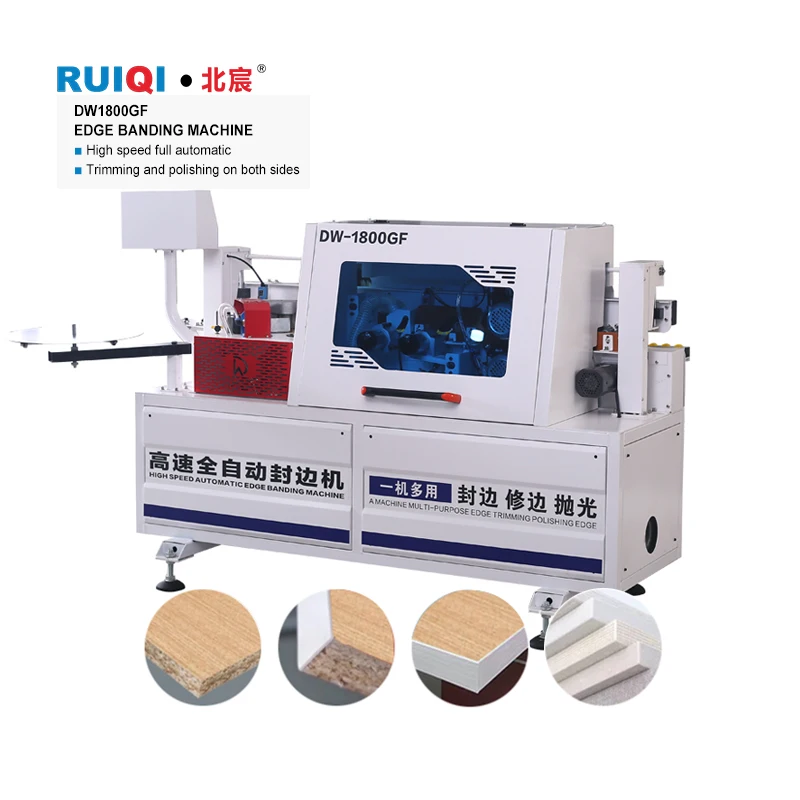
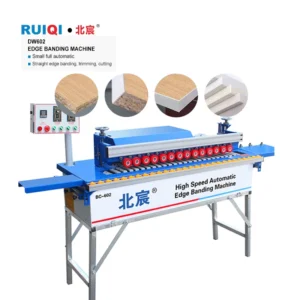
OEM-ready build platform — Every DW1800 Automatic Edge Banding Machine leaves the assembly floor with electrical schematics confirmed against your destination grid before the first motor spins.
Technical Specifications
| Parameter |
Value |
| Product Type |
Automatic Edge Banding Machine |
| Model |
DW1800 |
| Total Power |
4.9 kW |
| Voltage Options |
380V / 220V / 415V |
| Edge Banding Thickness Range |
0.3–3 mm |
| Edge Banding Height Range |
0–50 mm |
| Minimum Sheet Length |
20 cm |
| Minimum Sheet Width |
10 cm |
| Trimming Motor Speed |
24,000 r/min (×2 units, 800 W each) |
| Polishing Motor Power |
380 W × 2 |
| Edge Feed Power / Speed |
160 W / 0–14 m/min |
| Transmission Power / Speed |
180 W / 0–14 m/min |
| Glue Pot Capacity |
4,000 ml |
| Vacuum Power |
550 W |
| Air Source Pressure |
0.4–0.6 MPa |
| Machine Dimensions |
220 × 65 × 125 cm |
| Machine Weight |
320 kg |
| Control Panel Language |
Chinese and English (customizable) |
| Plug Options |
EU, USA, AU, UK |
| Assembly State |
Fully assembled |
| Certifications |
CE, ISO 9001 |
Application Suitability
| Application |
Material or Output |
| Custom furniture panel edge banding |
MDF, particleboard, plywood |
| Cabinet door and carcass production |
PVC panels, ABB boards |
| Joinery workshop batch processing |
Solid wood panels, organic glass plates |
| OEM-branded equipment lines |
Wood-based panels with PVC or veneer edge banding |
Why the Voltage Question Must Precede the Machine Order
A machine wired for the wrong grid is dead weight on your factory floor until an electrician rewinds every transformer.
I once watched a 440V edge bander sit silent for three weeks in a Middle Eastern workshop because the local supply ran at 380V. The distributor had assumed voltage compatibility without verifying frequency and phase. That delay cost the end user an entire production window. Since then, every DW1800 Automatic Edge Banding Machine order I handle starts with a confirmed electrical schematic matched to the buyer’s local grid — not a generic quote [NEED_CITE: voltage and frequency standards by export market]. Regional distributors and OEM partners specifying equipment for multiple markets need this discipline built into the procurement process, not added as an afterthought.

Engineering for Private-Label Equipment Programs
Distributors building a branded machine portfolio need an Automatic Edge Banding Machine factory that treats OEM configuration as standard procedure, not a special request. The DW1800 supports custom logo placement, control panel language selection, and region-specific plug configurations from the first unit off the line. This means your brand identity reaches the end user intact without post-delivery modification.
Four-Stage Verification Before the Crate Closes
Incoming material inspection, in-process checks, finished-product testing, and pre-shipment verification form the quality backbone of every unit we build. For OEM partners, this means the factory test record you receive reflects your specified substrate, edge material, and voltage — not a generic run on whichever panel happened to be on the floor [NEED_CITE: ISO 9001 quality management system requirements for manufacturing]. Distributors evaluating manufacturing depth can request witness testing or arrange a factory visit before committing to container-load orders.
What Trim Speed and Glue Capacity Mean for Panel Quality
The 24,000 r/min trimming motors cut PVC and veneer edge banding cleanly at feed speeds up to 14 m/min, reducing visible scoring on the panel face that would otherwise require manual touch-up downstream. A 4,000 ml glue pot sustains continuous double-sided gluing through long production runs without mid-batch refill pauses that leave cold spots on the glue line. The 0.3–3 mm edge thickness range covers the full spectrum from thin PVC foil to solid-wood lipping, giving furniture makers flexibility without switching machines. Adjustable edge feed at 160 W ensures the banding presses firmly against the panel edge regardless of material density, while the 550 W vacuum system pulls trim waste away before it contaminates the polishing stage.
The Hidden Cost of Skipping Pre-Shipment Electrical Confirmation
A machine that arrives with mismatched voltage forces the buyer into an unplanned electrical retrofit — hiring a local contractor, sourcing step-up transformers, and retesting every safety circuit. Production schedules slip, customer delivery dates move, and the distributor absorbs blame for a problem that was preventable at the quotation stage. When control panels arrive in a language the operator cannot read, commissioning stalls until a translator interprets every menu tree [NEED_CITE: machinery directive operator interface language requirements]. These are not warranty claims; they are configuration failures that erode trust between distributor and end user.
What Manufacturing Depth Means for Your Supply Chain
Our in-house precision grinding ensures that trimming and polishing assemblies hold alignment across extended production runs, not just the first week after installation. Patented cutting mechanisms deliver consistent edge finishing that your end users can verify on every panel, not just sample pieces. Voltage, language, and specification customization are treated as standard order parameters — there is no "custom surcharge" conversation mid-production. Every DW1800 ships with a complete documentation package matched to your destination market, reducing customs delays and giving your service team the schematics they need for field support.
Documentation & Verification
- CE declaration of conformity referencing the DW1800 build configuration
- ISO 9001 certificate covering our manufacturing and quality processes
- Electrical schematic confirming your ordered voltage and plug type
- Factory test record with processing samples on your specified panel material
- Operation manual in the control panel language you selected
- Spare parts list with OEM part numbers for distributor inventory planning
Installation, Commissioning & Support
- Fully assembled delivery — the 220 × 65 × 125 cm footprint requires only positioning and power connection
- 4.9 kW total load demands a dedicated circuit rated above the machine’s draw at your confirmed voltage
- 0.4–0.6 MPa air source must be connected before the glue pot and cylinder systems activate
- First-run calibration covers trimming depth, polishing pressure, and edge feed alignment on your panel stock
- Custom-language control panel lets operators navigate menus without translation delays during commissioning
- Spare parts list provided at shipment supports distributor-level service without factory callbacks
What We Need to Configure Your Order
Tell us the destination market so we can confirm voltage, frequency, and plug type before quoting. Share the panel materials and edge banding types your customers process most often so we set the glue system and trim stations accordingly. If you are building a private-label line, send your logo files and packaging specifications early to avoid production-stage changes.
Frequently Asked Questions
Q: How do you verify manufacturing tolerance and precision claims before shipment?
A: Every DW1800 undergoes pre-shipment testing using the buyer’s specified panel material and edge banding type. We record trim quality, glue line consistency, and polishing finish, then ship the factory test record with the machine. Distributors can request witness testing or visit the assembly floor to observe the four-stage QC process firsthand.
Q: What is the OEM customization range for voltage, language, and branding?
A: Voltage is configurable across 220V, 380V, and 415V with confirmed frequency matching for your market. Control panel language is customizable beyond the standard Chinese and English options. Custom logo placement, plug configuration, and packaging specifications are treated as standard order parameters, not special requests.
Q: Can I visit the factory to inspect production quality control processes?
A: Factory visits are welcomed at any stage — from initial evaluation through witness testing of your specific order. You can observe incoming material inspection, in-process assembly checks, and pre-shipment verification on the DW1800 line. We coordinate visit schedules around your production timeline and export shipping windows.
Q: What documentation is provided for customs clearance in my destination country?
A: Each shipment includes the CE declaration of conformity, ISO 9001 certificate, electrical schematic with confirmed voltage, packing photographs, and commercial documentation matched to your import requirements. Customs documentation support is provided to ensure smooth clearance at your port of entry.
Q: How do you ensure component sourcing quality across the supply chain?
A: Incoming materials undergo first-stage inspection before entering assembly. Precision-ground components are verified against tolerance specifications at the in-process stage. We maintain supplier qualification records and trace component batches through the four-stage QC system, giving distributors confidence in long-term parts availability and consistency.