Precision Manufacturing Depth — Every portable double table saw leaves this facility with a factory test record verifying cutting accuracy on your specified panel materials before it reaches the dock.
Technical Specifications
| Parameter |
Value |
| Product Type |
Portable Double Table Saw |
| Total Power |
6200W |
| Main Saw Power |
3000W |
| Main Saw Speed |
3800 r/min |
| Main Saw Diameter |
20CM |
| Sub Saw Power |
2000W |
| Sub Saw Speed |
13000 r/min |
| Vacuum Cleaner Power |
1200W |
| Maximum Plank Cutting Length |
2.44M |
| Maximum Plank Cutting Thickness |
4CM |
| Product Weight |
22KG |
| Product Size |
50×30×38CM |
| Voltage & Frequency |
Configurable from 110V to 440V |
| Plug Options |
EU, USA, AU, UK |
| Language Options |
Chinese, English, and customizable multilingual control panels |
Application Suitability
| Application |
Material or Output |
| On-site joinery and cabinet sizing |
MDF, particleboard, and plywood sheets up to 2.44m |
| Small workshop panel breakdown |
Solid wood planks up to 4cm thickness |
| Portable cutting for installation contractors |
Veneered panels and melamine-faced boards |
| Regional distributor stock for resale |
Branded portable saws for local carpentry markets |
Why Voltage Confirmation Must Precede the Bill of Lading
A portable double table saw factory ships equipment that must run on arrival, not after a transformer hunt.
I spent years across the Yangtze Delta manufacturing belt crawling under machines that sat dead on arrival because someone skipped the voltage conversation. One distributor ordered a batch of double table saws without confirming local frequency — those units sat on a dock for weeks while transformers were sourced locally at three times the cost. The problem compounds when control panels arrive in a language the operator cannot read, stalling commissioning entirely. Voltage and language are not afterthoughts for export equipment; they are the baseline. [NEED_CITE: voltage and frequency standards by export market]

OEM Scope for Branded Portable Saw Lines
When distributors approach a portable double table saw factory, the conversation extends beyond the machine itself. Logo placement, private label packaging, and customized documentation all fall within the OEM scope available here. This unit can be configured with your brand identity, regional plug standards, and control panel language before it enters the container.
Manufacturing Verification Before the Container Seals
The four-stage quality control process covers incoming material inspection, in-process verification during assembly, finished product testing, and pre-shipment validation. Each stage produces documented records. For distributors committing to container orders, factory visits allow direct observation of precision grinding stations and assembly workflows. [NEED_CITE: CE machinery directive requirements for industrial equipment]
Spec Sheet to Shop Floor: What the Numbers Mean
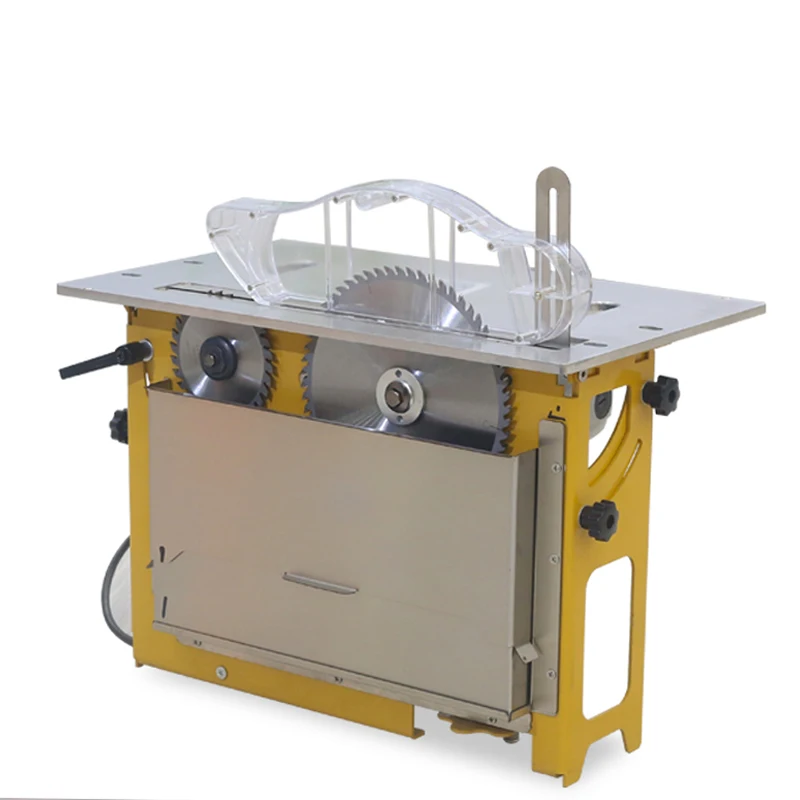
The dual-saw configuration pairs a 3000W main blade running at 3800 r/min with a 2000W scoring sub saw spinning at 13000 r/min. The sub saw scores the panel surface before the main blade cuts through, preventing tear-out on melamine and veneer faces — a common failure point on single-blade machines. The 2.44M maximum cutting length accommodates full standard sheets, while the 4CM thickness capacity handles solid wood stock beyond typical panel materials. The integrated 1200W vacuum extraction connects directly at the cutting zone, reducing airborne particulate during continuous operation. For workshops without centralized dust collection, this self-contained extraction keeps the immediate work area functional without additional infrastructure investment.
The Hidden Cost of Skipping the Test Record
Machines quoted without verified cutting tolerance create problems that surface only during assembly. Panels cut slightly oversize accumulate error across a full cabinet run, and by the time the installer discovers the drift, the machine has already produced a batch of unusable components. Without a factory test record showing measured accuracy on your actual panel materials, you are accepting risk that belongs to the manufacturer. Distributors reselling this equipment face warranty claims rooted in tolerance issues that should have been caught at the source. [NEED_CITE: typical tolerance verification practices for panel saws]
Why Source This Portable Double Table Saw Here
In-house manufacturing with patented cutting mechanisms means the factory controls the tolerance, not a subcontractor. The product family allows distributors to stock entry-level and full-function models from one supplier, simplifying spare parts inventory and technician training. Voltage, plug type, and control language customization is built into the standard ordering process rather than treated as a special request. Pre-shipment test records ship with every unit, providing documented proof that the machine performed to specification before packing.
Documentation & Verification
- Factory test record on your panel thickness and material type before dispatch
- CE declaration of conformity matching the specific machine category
- ISO 9001 certificate covering the manufacturing facility
- Electrical schematic confirming your voltage and frequency configuration
- Operation and maintenance manual in your agreed language
Installation, Commissioning & Support
- Power requirement of 6200W total demands a dedicated circuit rated above the combined draw
- Product weight of 22KG allows single-person relocation without lifting equipment
- Integrated 1200W vacuum system requires no external ductwork connection at setup
- Plug options (EU, USA, AU, UK) arrive factory-fitted to match your regional standard
- Multilingual control panel configured before shipment eliminates on-site translation delays
What We Need to Move Forward
Provide your target market voltage and frequency so the electrical system is built correctly from the start. Specify the panel materials and typical thickness range you will cut so the test record reflects real conditions. Confirm your preferred control panel language and plug type to avoid commissioning delays on arrival.
Frequently Asked Questions
Q: What OEM customization scope is available for this portable double table saw?
A: Logo application, private label packaging, voltage from 110V to 440V, regional plug fitting, and multilingual control panels are all configurable. Distributors can request custom color schemes and branded documentation to match their market identity. Each OEM specification is confirmed in writing before production begins.
Q: How is cutting accuracy verified before shipment?
A: Every unit undergoes a pre-shipment test cutting your specified panel materials at defined thicknesses. Measured results are recorded and included with the shipment documentation. This test record provides the baseline for any tolerance discussion after the machine arrives at its destination.
Q: What documentation accompanies each portable double table saw shipment?
A: Each machine ships with a CE declaration, ISO 9001 certificate copy, electrical schematic matching your voltage, factory test record, operation manual in your language, and a spare parts list. Customs documentation support is provided to streamline clearance in your destination market.
Q: Can the factory produce to modified specifications or buyer-supplied drawings?
A: Modified specifications are reviewed by the engineering team for feasibility before quotation. If your market requires adjustments to cutting capacity, power configuration, or physical dimensions beyond the standard range, the factory evaluates production viability and provides a formal response within the standard quotation window.
Q: What does the factory quality inspection process look like?
A: Four stages cover incoming material verification, in-process assembly checks, finished product testing, and pre-shipment validation. Each stage generates records. Components undergo precision grinding with multi-stage inspection before assembly, and the completed unit runs under load before packing.