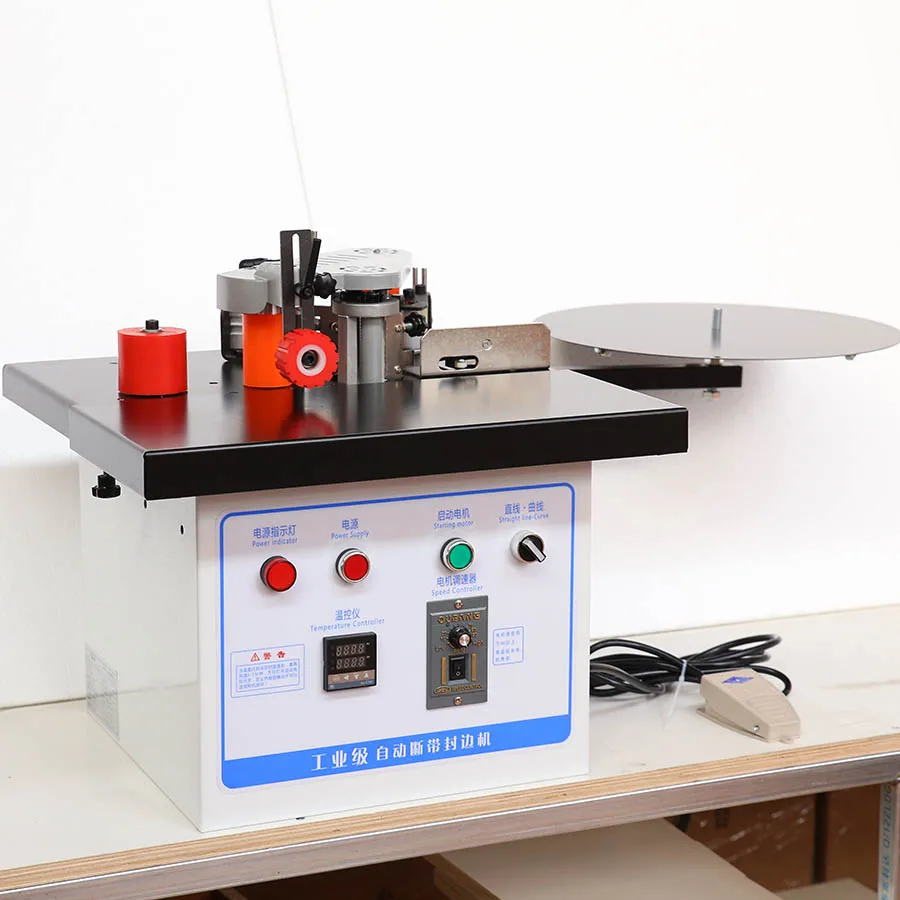
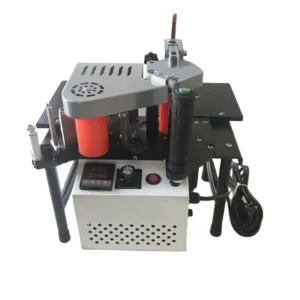
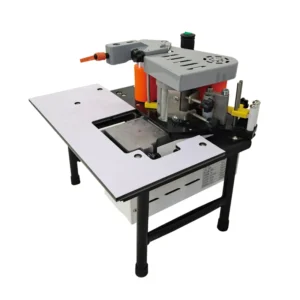
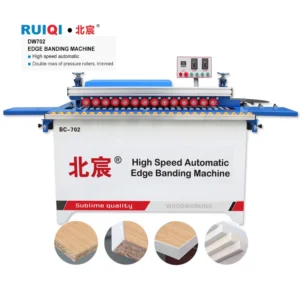
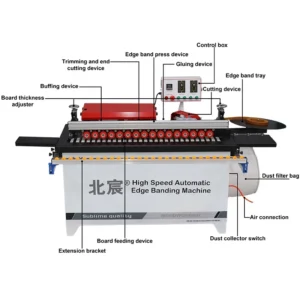
Precision-Ground Manufacturing — every ZDSF-60 mini edge banding machine leaving our Ningjin facility carries OEM branding, verified voltage configuration, and a four-stage QC record that distributors can present to their own customers.
Technical Specifications
| Parameter |
Value |
| Model |
ZDSF-60 |
| Product Type |
Mini Edge Banding Machine |
| Rated Voltage |
220V (configurable 110V–440V for OEM orders) |
| Heating Power |
800W |
| Glue Pot Capacity |
1000 ml with 4 heating tubes |
| Heat-Up Time |
5–8 min |
| Edge Banding Speed |
0–6 m/min |
| Rated Air Pressure |
0.4–0.6 MPa |
| Strip Thickness Range |
0.5–2 mm |
| Max Sheet Thickness |
50 mm |
| Edge Shape Capability |
Straight, curved, and shaped edges |
| Glue Application |
Double-sided via glue-coated rollers |
| Belt Breaking |
Pneumatic with foot switch and travel switch |
| Pressure Rollers |
Adjustable, rubber material |
| Overall Dimensions |
54 × 54 × 56 cm |
| Machine Weight |
26 kg |
Application Suitability
| Application |
Material or Output |
| Small workshop custom furniture production |
MDF, particleboard, plywood panels with PVC or veneer edge banding |
| On-site joinery and fit-out work |
Solid wood panels requiring portable edge finishing |
| Cabinet door and drawer front edging |
Curved and shaped profiles on sheet stock up to 50 mm thick |
| Sample and prototype fabrication |
Short-run edge banding where full-size machinery is unavailable |
| Distributor demo and training units |
Compact edge bander for showroom or customer trial purposes |
Why the Voltage Question Must Come Before the Quotation
A mini edge banding machine OEM factory that skips voltage confirmation is handing your customer a 26 kg paperweight.
I once shipped a small manual edge bander to a Middle Eastern workshop. The voltage was assumed, not confirmed. When the operator plugged it in on site, the breaker tripped immediately. The customer waited nearly three weeks for a replacement transformer before the machine could run. Since that job, I check the destination grid on every single order — even for a compact unit like the ZDSF-60. A portable machine drawing 800W on heating alone will not forgive a voltage mismatch [NEED_CITE: voltage and frequency standards by export market]. For OEM partners reselling under their own brand, a field failure caused by incorrect electrical specification damages the label on the machine, not the name on the factory gate.

OEM Branding Built Into the Production Flow
Private-label orders require more than a sticker. The ZDSF-60 mini edge banding machine OEM factory process covers logo placement on the machine housing, custom color options for the frame, and branded packaging — all integrated at the assembly stage rather than applied as an afterthought. Control panel labels, operation manuals, and spare parts documentation are produced in the destination language before dispatch. This means a distributor in Southeast Asia and a reseller in South America each receive a machine that looks and reads as if it were manufactured locally.
Four-Stage Quality Control Before Any Unit Ships
Incoming raw materials, in-process assembly, finished-product functional testing, and pre-shipment verification form the QC sequence [NEED_CITE: CE machinery directive requirements for industrial equipment]. For the ZDSF-60, this includes verifying the four-tube glue pot reaches stable melt temperature within the specified heat-up window, confirming the pneumatic belt-breaking cycle on both straight and curved edges, and checking that adjustable pressure rollers maintain even contact across the full 0.5–2 mm strip thickness range. Every test result is logged in the factory test record that accompanies the shipment.
What the Spec Sheet Numbers Actually Mean on the Shop Floor
The 800W heating system with four tubes distributed around the 1000 ml glue pot keeps the adhesive at a consistent melt temperature — a single-tube design creates hot and cold zones that lead to uneven glue application and visible seam lines on lighter PVC banding. The double-sided gluing via coated rollers ensures adhesive reaches both the panel edge and the back of the strip, which is the difference between a bond that holds through seasonal humidity swings and one that peels after a few weeks. The pneumatic belt-breaking device deserves particular attention: the foot switch gives the operator manual control for curved and shaped edges, while the travel switch automates straight-line cutting. This dual-mode arrangement means a small workshop can handle radiused cabinet doors and standard rectangular shelving on the same machine without changing tooling. The 26 kg weight and 54 × 54 × 56 cm footprint put the ZDSF-60 on a standard workbench, but the 0.4–0.6 MPa air pressure requirement still demands a dedicated compressor line — a detail that catches out workshops running only hand tools.
The Cost of Skipping Configuration Checks
A portable edge bander ordered without confirming the panel thickness range against actual production stock leads to pressure rollers that cannot close the gap on 50 mm boards or crush thinner strip material on 12 mm shelving. A machine arriving with a 220V motor into a 110V market will run, but at reduced heating output and slower feed — the operator compensates by forcing the feed, which damages the drive mechanism [NEED_CITE: common causes of premature failure in portable edge banding equipment]. Distributors who skip the OEM configuration review end up processing warranty claims instead of processing reorders.
Why Distributors Source This Machine From Our Facility
The ZDSF-60 is built on the same production line as our full-size edge banding range, giving OEM partners a single supplier for both entry-level and production-grade equipment. Voltage customization from 110V to 440V is confirmed in writing before production release — not guessed from a regional lookup table. The patented cutting mechanism technology used across our edge bander family informs the belt-breaking precision on this compact model. Engineer-led configuration review ensures that each OEM order is matched to the distributor’s actual market requirements, and the formal quotation is delivered within 24 hours. Factory visits are welcomed so that importers can audit the assembly floor before committing to a container load.
Documentation & Verification
- Factory test record covering glue pot temperature stability and pneumatic cycle timing before dispatch
- Electrical schematic with voltage and plug type confirmed for the destination market
- Operation and maintenance manual produced in the agreed language for the end user
- CE declaration of conformity and ISO 9001 certificate available for the specific model ordered
- Spare parts list with part numbers matching the unit’s serial number
Installation, Commissioning & Support
- Requires a stable 220V single-phase circuit (or confirmed custom voltage) with dedicated breaker for the 800W heating load
- Air supply at 0.4–0.6 MPa from a compressor with moisture trap to protect the pneumatic belt-breaking valve
- Bench-top placement on a level surface within the 54 × 54 cm footprint, with clearance for strip feed on both sides
- First-run glue temperature calibration and pressure roller adjustment included in the commissioning guide
- Spare glue-coated rollers and replacement heating tubes identified in the included parts list for distributor stock planning
Start the OEM Conversation
Send us your target market’s voltage and frequency, the edge banding materials your customers use most frequently, and your preferred branding specifications including logo files and packaging requirements. If you plan to stock multiple configurations for different regional markets, share the voltage variants and manual languages needed so that we can structure the production run accordingly. Sample processing tests on your actual panel stock can be arranged before order confirmation.
Frequently Asked Questions
Q: What OEM customization options are available for the ZDSF-60?
A: Logo placement on the machine housing, custom frame color, branded packaging, voltage configuration from 110V to 440V, and operation manuals in the destination language are all available. Control panel labeling is also customized to match the target market. Each OEM specification is confirmed in writing before production begins.
Q: What is the minimum order quantity for private-label orders?
A: The facility accommodates single-unit orders through to large production runs for OEM partners. Minimum quantity depends on the level of customization required — standard logo and manual language changes can be applied to smaller batches, while custom color and packaging tooling may require a higher threshold. The exact MOQ is confirmed during the quotation stage.
Q: How is voltage confirmed before production starts?
A: Every order requires written confirmation of the destination market’s voltage, frequency, and plug type before the production release is authorized. The electrical schematic is prepared to match the confirmed specification, and the pre-shipment test verifies the machine operates correctly at the specified voltage. This eliminates the field failures caused by assumed or incorrect electrical configuration.
Q: What does the four-stage QC process cover for this machine?
A: Incoming material inspection, in-process assembly checks, finished-product functional testing, and pre-shipment verification are all documented. For the ZDSF-60, this includes glue pot temperature stability, pneumatic cycle timing, pressure roller alignment, and electrical safety checks. Buyers and their third-party inspectors are welcome to witness pre-shipment testing at the factory.
Q: How is the spare parts supply managed for distributors?
A: Each machine ships with a spare parts list matched to the unit’s serial number, identifying wear items such as glue-coated rollers and heating tubes. Distributors can order spare parts in bulk alongside machine shipments to reduce freight costs. The parts list is included in the documentation package so that resellers can plan their inventory before the machines reach end customers.