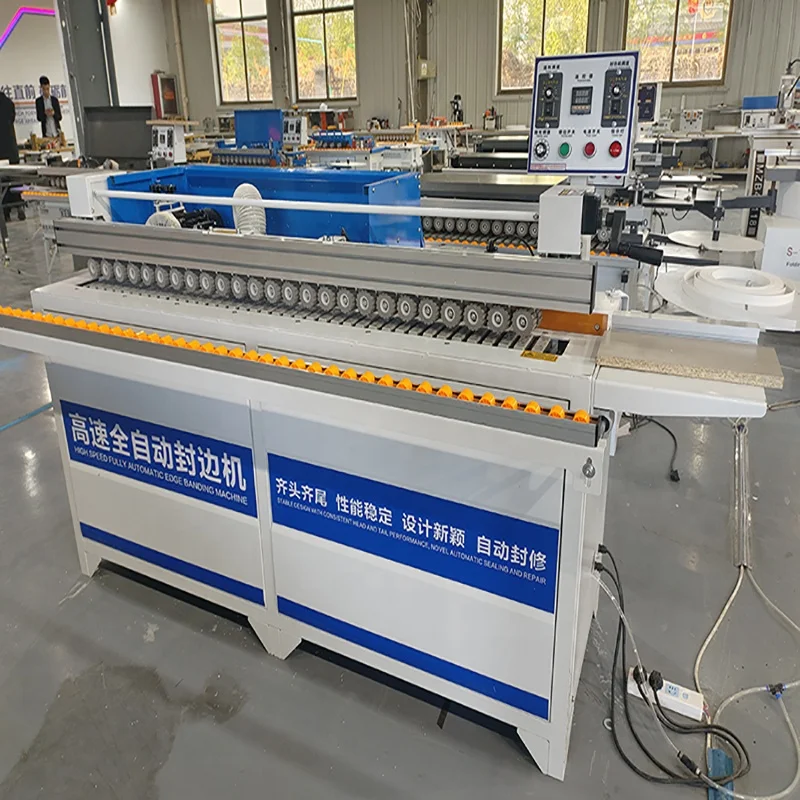
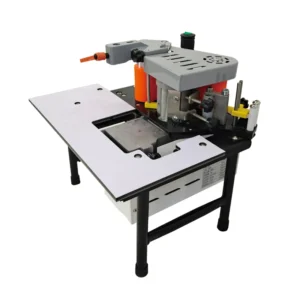
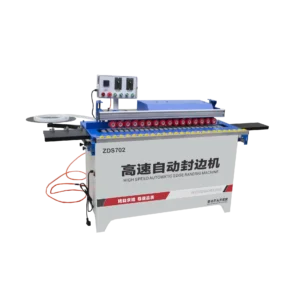
In-House Manufacturing Depth — every precision-ground component and patented cutting mechanism is machined, assembled, and verified on our own factory floor before it reaches your production line.
Technical Specifications
| Parameter |
Value |
| Product Type |
Automatic Edge Banding Machine |
| Voltage |
220V (frequency to be confirmed: 50Hz or 60Hz) |
| Total Power |
4200W |
| Equipment Size |
207 × 60 × 122 cm |
| Weight |
245 kg |
| Edge Banding Type |
Linear Edge Banding Machine |
| Edge Band Height Range |
0–35 mm |
| Edge Band Thickness Range |
0.5–2.5 mm |
| Glue Pot Capacity |
4000 ml |
| Pressure Beam |
Integrated with adjustable handle |
| Conveyor Belt |
Silicone material, double rows of pressure wheels |
| Edge Strip Cutting |
Pneumatically controlled |
| Trimming System |
Double high-speed motors, up and down |
| Polishing System |
Dual motors, up and down |
| Key Features |
Double-sided gluing, intelligent temperature control, independent operating platform |
| Warranty |
1 year |
Application Suitability
| Application |
Material or Output |
| Panel furniture edge banding |
MDF, particleboard, plywood with PVC or ABS edge bands |
| Cabinet door and carcass production |
Melamine-faced boards with 0.5–2.5 mm PVC or ABS strips |
| Custom woodworking workshops |
Solid wood panels requiring linear edge sealing and trimming |
| OEM private-label equipment lines |
Distributors specifying branded machinery for regional resale |
Why Voltage Confirmation Must Happen Before the Order Ships
A machine wired for the wrong frequency will burn out its motors within the first production shift — no amount of post-delivery troubleshooting fixes a fundamental electrical mismatch.
I once flew to a furniture factory in Vietnam because their new Automatic Edge Banding Machine factory OEM kept tripping its thermal overload relay mid-cycle. The local grid was running closer to 55 Hz on a 60 Hz motor spec, and the torque curve had shifted just enough to stall the feed drive under load. The machine itself was fine; the specification handshake before production was not. [NEED_CITE: voltage and frequency standards by export market]
This is why we treat electrical schematic review as a hard gate in the sales process, not a formality. Every order goes through voltage and frequency confirmation against your facility’s actual supply before the control panel is wired and the motor windings are specified.

How In-House Machining Protects Your Tolerance Claims
When we say an automatic edge banding machine holds tight tolerances on trim and polish, that claim rests entirely on how the trimming spindles and polishing shafts are ground and seated. Our component sourcing stays within our own machining workshops, where precision grinding stations finish the bearing seats and motor mounts to the same specification every time. This means the trimming motors and polishing motors you receive have not passed through three layers of subcontractors, each adding stack-up error.
The integrated pressure beam and silicone conveyor belt work as a single feed system. The adjustable handle sets the beam height for your panel thickness, and the double rows of pressure wheels maintain consistent downward force across the entire board length. For OEM partners evaluating manufacturing depth, this level of component control is what separates a factory that builds machines from one that assembles purchased sub-assemblies.
The Four-Stage QC Process Behind Every Shipment
Our quality protocol runs through incoming material inspection, in-process assembly checks, finished product functional testing, and a pre-shipment verification that records actual machine output against your specified panel range. [NEED_CITE: CE machinery directive requirements for industrial equipment] Each stage generates documentation that travels with the machine — not filed away in a cabinet back in Shandong, but included in your shipment package.
For an automatic edge banding machine destined for a distributor’s warehouse or an OEM partner’s private label, this traceability matters. You receive a factory test record showing the glue pot temperature stability, the pneumatic edge strip cutting cycle times, and the trim finish quality on your specified edge band thickness range. If something drifts after installation, you and our service team are looking at the same baseline data.
What the Spec Sheet Actually Means on the Shop Floor
The 4000 ml glue pot capacity is not just a volume figure — it determines how long the machine can run before the operator needs to refill, which directly affects uninterrupted production runs on long cabinet orders. Combined with intelligent temperature control, the pot maintains adhesive viscosity within a narrow band, preventing the thin glue lines that cause edge band lifting on MDF substrates weeks after delivery.
The edge band height range of 0–35 mm and thickness range of 0.5–2.5 mm define which panel profiles this machine can handle without tooling changes. If your product mix includes thick solid-wood edges alongside thin PVC on particleboard, staying within these boundaries means fewer changeover stops. The pneumatically controlled cutting device and double high-speed trimming motors work together: the cutter severs the strip flush, and the up-and-down trim motors clean the top and bottom edges in a single pass, which is where the visible glue-line problem either gets solved or gets passed to your customer.
The Real Cost of Skipping Upstream-Downstream Verification
A furniture factory in Southeast Asia once paired a new edge bander with an older sliding table saw that fed panels at a different height than the bander’s conveyor entry point. The result was a micro-stall at every panel handoff, invisible during the single-machine test but devastating across a full shift. [NEED_CITE: material flow and feed height compatibility in panel processing lines] When machines are sourced piecemeal without verifying infeed height, throughput rhythm, and dust extraction port alignment, the bottleneck simply migrates rather than disappears.
Choosing an automatic edge banding machine without confirming your local compressed air supply specification is another common gap. The pneumatic edge strip cutting device requires clean, dry air at a specific pressure; undersized compressors cause intermittent cut failures that operators blame on the machine rather than the air line.
Why Sourcing This Machine Directly From the Factory Floor
Our manufacturing facility produces the core mechanisms — cutting assemblies, trimming spindles, pressure beam components — rather than sourcing them externally. This gives OEM partners a single point of accountability for tolerance documentation and a single factory visit to verify the entire build process.
Voltage customization from 110V to 440V is executed at the winding and wiring stage, not through external transformers bolted on afterward. Multilingual control panels are programmed before assembly, so your operators see their own language from the first power-on. The four-stage QC process with pre-shipment verification means every automatic edge banding machine ships with a test record matching your material specification, not a generic pass stamp. Private label partners receive machines with their own logo and documentation branding, supported by the same ISO 9001 and CE framework we apply to our own-brand equipment.
Documentation & Verification
- CE declaration of conformity matched to your import market’s machinery directive
- ISO 9001 certificate covering the manufacturing process of this edge banding machine
- Factory test record documenting trim quality on your specified PVC or ABS thickness
- Electrical schematic confirming voltage, frequency, and circuit protection before wiring begins
- Operation manual in your operator’s language with pneumatic system maintenance schedules
Installation, Commissioning & Support
- Confirm floor space for the 207 × 60 × 122 cm footprint with clearance for the pressure beam handle
- Provide a dedicated circuit matching the confirmed 220V specification and 4200W total power draw
- Machine ships requiring assembly; our technician guides alignment of the conveyor belt and pressure beam
- First-run commissioning includes glue pot temperature calibration and pneumatic cutting device pressure setting
- Operator training covers edge band thickness changeover between 0.5 mm and 2.5 mm materials
- Spare parts list identifies trimming motor brushes and polishing wheel consumables for your first reorder
What We Need to Configure Your Machine Correctly
Before we quote, share your primary panel materials, the edge band thickness and height range you run most often, and your facility’s actual voltage and frequency at the panel board. If this edge bander will sit in a line with existing saws or boring machines, send us their infeed heights and cycle times so we can verify throughput compatibility and material flow before production starts.
Frequently Asked Questions
Q: What can be customized under an OEM or private-label agreement?
A: Logo placement on the machine body, control panel language, voltage configuration from 110V to 440V, and specific functional specifications within the product family range. Custom branding extends to operation manuals, packaging markings, and documentation. Single-unit sample orders through to large production runs are supported with the same QC framework applied at every volume.
Q: How does the four-stage QC process work in practice?
A: Incoming materials are inspected before assembly begins. In-process checks verify component seating and alignment during build. Finished product testing runs the machine through functional cycles on representative materials. Pre-shipment verification records performance against your ordered specification, generating a factory test report that ships with the machine.
Q: Can I visit the factory to inspect manufacturing capability?
A: Factory visits are welcomed at any production stage. You can inspect precision grinding stations, component sourcing inventory, assembly lines, and the QC documentation workflow. Visits are particularly valuable for distributors evaluating whether to commit to a regional supply agreement or for OEM partners verifying private-label production depth.
Q: What spare parts support is available for distributor service teams?
A: A full spare parts list ships with every machine, identifying consumables like trimming motor components and polishing wheels. Technical training can be arranged for your regional service team, covering common fault diagnosis, pneumatic system maintenance, and glue pot servicing. Parts supply continuity is maintained across the product family.
Q: What documentation ships with the machine for customs and compliance?
A: CE declaration of conformity, ISO 9001 certificate, machine specification sheet, electrical schematic with voltage confirmation, factory test record, operation and maintenance manual in the agreed language, spare parts list, and packing photographs. Customs documentation support is provided to match your import market’s requirements.