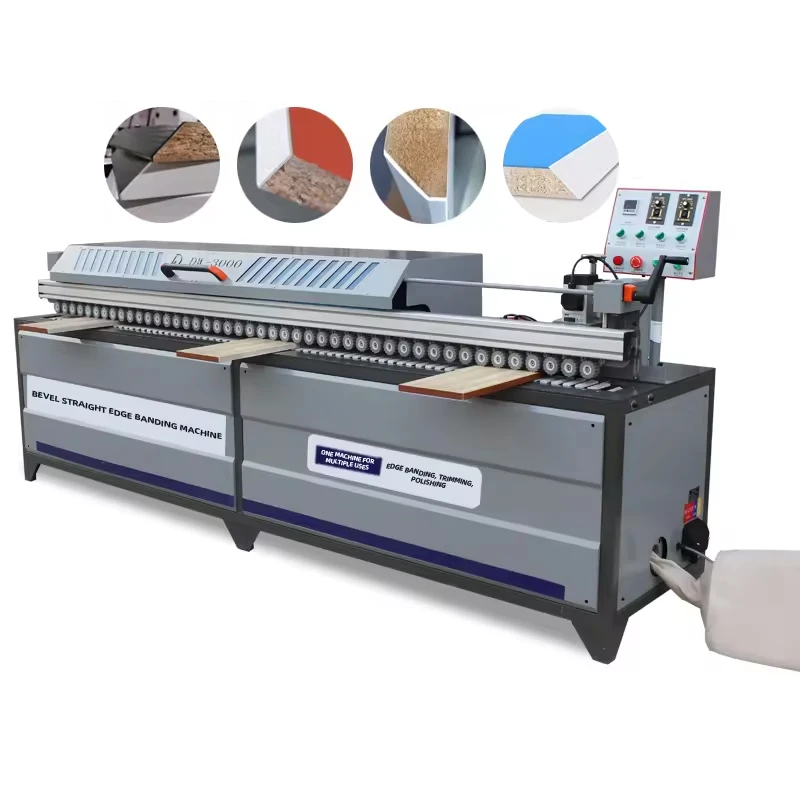
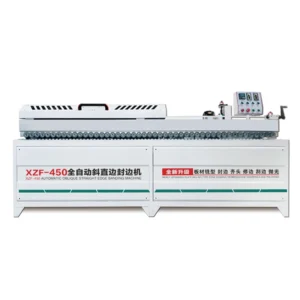
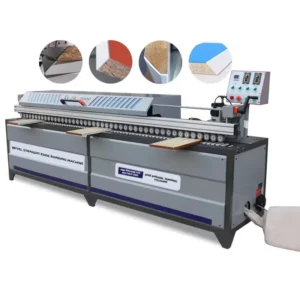
In-house manufacturing with patented cutting mechanisms — every DW3000 edge bander undergoes four-stage QC verification from raw material inspection to pre-shipment tolerance validation, ensuring OEM partners receive machines built to documented specifications rather than catalog promises.
Technical Specifications
| Parameter |
Value |
| Model |
DW3000 |
| Product Type |
Automatic 45 Degree Bevel and Straight Edge Banding Machine |
| Total Power |
11 kW |
| Voltage |
380V / 415V (configurable from 110V to 440V) |
| Feed Speed |
0–12 m/min |
| Minimum Sheet Length |
300 mm |
| Minimum Sheet Width |
150 mm |
| Edge Banding Height |
0–50 mm |
| Edge Banding Thickness |
0.3–3 mm |
| Pre-milling Motor |
2.2 kW |
| Heating Power |
2.2 kW × 2 (double heat gun design) |
| Trimming Motor |
2.2 kW × 2 (spindle trimming, 3 spindle motors total) |
| Polishing Motor |
0.4 kW × 2 |
| Vacuum Motor |
550 W |
| Glue Pot Capacity |
4000 ml |
| Air Source Pressure |
0.5–0.7 MPa |
| Transmission Power |
180 W |
| Edge Feeding Power |
160 W |
| Overall Dimensions |
2990 × 650 × 1300 mm |
| Net Weight |
430 kg |
| Feeding System |
Double cylinder feeding belt |
| Pressure Wheel Configuration |
8 groups, adjustable 30–90 degrees |
| Hot Air System |
Double heat gun design |
| Flexible Edge Scraper |
Included |
| Control Panel Language |
Chinese / English (customizable to Spanish or other languages) |
| Plug Options |
EU, USA, AU, UK |
Application Suitability
| Application |
Material or Output |
| Custom cabinet production |
MDF and particleboard panels with PVC edge banding |
| Panel furniture manufacturing |
Plywood and melamine-faced boards with ABS edging |
| Joinery workshop bevel processing |
Solid wood panels and veneer banding at 30–90 degree angles |
| Straight edge furniture components |
MDF, plywood, and particleboard with 0.3–3 mm banding |
| Mixed-angle production runs |
Switching between straight and bevel profiles without retooling |
Why Voltage Confirmation Matters Before Production Starts
Machines quoted without confirming local voltage and frequency arrive unusable at the dock, costing importers weeks of rework.
I have watched containers land in South America with 380V/50Hz machines destined for 220V/60Hz grids. The distributor absorbs the return freight, the factory re-winds motors, and the end customer waits two extra months before a single panel gets edged. For OEM partners and regional importers, an edge banding machine factory that treats electrical confirmation as an afterthought becomes a recurring liability. The DW3000 addresses this at the quotation stage — voltage, frequency, and plug type are locked into the specification sheet before metal is cut [NEED_CITE: voltage and frequency standards by export market].

Component Sourcing and Precision Grinding Standards
Every spindle motor and pressure wheel assembly entering our Ningjin production line passes incoming material inspection before it reaches the assembly bench. The DW3000 uses three dedicated spindle trimming motors rather than a single shared drive, which means each trimming stage maintains independent torque throughout long production runs. When an OEM edge banding machine leaves the factory with motors sourced from verified suppliers and ground to documented tolerances, the distributor’s service team spends less time on warranty calls and more time selling the next unit.
Four-Stage Quality Control Across the Build Cycle
Incoming material inspection checks motor windings and bearing tolerances before assembly begins. In-process verification confirms pressure wheel alignment across all eight groups at their full 30–90 degree adjustment range. Finished product testing runs actual MDF and PVC samples through the complete milling, banding, trimming, scraping, and polishing sequence. Pre-shipment verification records the ±0.02 mm tolerance measurement and photographs every critical station [NEED_CITE: CE machinery directive requirements for industrial equipment]. This four-stage process is how an edge banding machine factory protects its OEM partners from field failures that damage brand reputation.
How Feed Speed, Pressure Wheels, and Glue Temperature Interact
The DW3000’s 0–12 m/min variable feed speed must be matched to both panel thickness and banding material. PVC at 3 mm requires slower feed and higher glue pot temperature than 0.5 mm veneer — the double heat gun design (2.2 kW × 2) provides the thermal capacity for both ends of that range without cold spots. The eight pressure wheel groups, adjustable from 30 to 90 degrees, apply consistent contact pressure whether the panel edge is straight or cut at a 45-degree bevel. If feed speed outruns glue temperature, the banding lifts at the trailing edge; if pressure wheels are set too aggressively on thin veneer, the material crushes before the glue cures. The double cylinder feeding belt eliminates the panel chatter that causes uneven glue transfer on lighter stock.
The Hidden Cost of Skipping the Configuration Audit
I once saw a distributor order a basic straight-edge bander for a client who was running 45-degree bevel panels for a hotel fitout. The machine arrived, the operator loaded the first board, and the pressure wheels pushed the banding away from the angled edge instead of into it. The entire shipment came back. When an edge banding machine factory ships without confirming bevel angle requirements, panel thickness range, or local power specs, the distributor — not the factory — absorbs the reputational damage. The DW3000’s eight-group adjustable pressure wheel system handles both profiles, but only if the configuration conversation happens before the order is finalized [NEED_CITE: common causes of edge banding equipment returns].
Why Distributors and OEM Partners Source From This Line
In-house manufacturing means every DW3000 component traceable to its production batch — no trading company buffer between you and the assembly floor. Patented cutting mechanisms achieve the stated ±0.02 mm tolerance, verified on your sample material before crating. Full voltage customization from 110V to 440V and multilingual control panels ship as standard configuration, not premium add-ons. Four-stage QC with documented pre-shipment test records means your local service team receives a machine file, not a mystery. Factory visits are welcomed at the Ningjin facility so you can inspect precision grinding stations and QC checkpoints firsthand.
Documentation & Verification
- CE declaration of conformity matching the DW3000 configuration as shipped
- ISO 9001 certificate covering the manufacturing and quality control process
- Electrical schematic with confirmed voltage, frequency, and plug type for destination market
- Factory test record on your specified panel material and edge profile before dispatch
- Operation and maintenance manual in the language your operators will read
- Spare parts list with part numbers cross-referenced to the shipped configuration
Installation, Commissioning & Support
- Requires a level concrete floor capable of supporting 430 kg across the 2990 × 650 mm footprint
- Dedicated 380V/415V circuit (or confirmed local equivalent) with appropriate breaker rating for 11 kW total draw
- Arrives as a single unit — connect air supply at 0.5–0.7 MPa and power, no field assembly of the frame
- First-run commissioning includes feed speed calibration and pressure wheel angle setting for your panel profile
- Operator training covers double heat gun temperature adjustment for different banding thicknesses
- Flexible edge scraper and polishing wheel consumables identified in the included spare parts list
What to Include With Your Inquiry
Send us the panel materials and edge profiles your customers run most often — straight, bevel, or both. Specify the local voltage and frequency at the installation site, along with the preferred control panel language. If you are evaluating OEM branding, let us know logo placement preferences and whether you need custom packaging and documentation under your label. Sample panels are welcome for a factory test run before your order enters production.
Frequently Asked Questions
Q: What does the OEM and private label process cover for the DW3000?
A: OEM branding includes custom logo placement on the machine body, private label packaging, and branded documentation such as operation manuals and spare parts lists. Voltage, plug type, and control panel language are configured to your target market. The engineering team confirms all custom specifications before production begins, and pre-shipment verification records carry your branding.
Q: How is the ±0.02 mm tolerance verified before the machine ships?
A: Every DW3000 runs sample panels through the full milling, banding, trimming, and polishing sequence during pre-shipment verification. Tolerance measurements are recorded at multiple points along the edge profile, and the test record is included in the shipment documentation. Distributors can request specific panel materials be tested to match their end customer’s production requirements.
Q: Can the DW3000 be configured for non-standard voltage and frequency?
A: Voltage is configurable from 110V to 440V, and the machine can be built for either 50 Hz or 60 Hz systems depending on the destination market. The electrical schematic and voltage confirmation sheet are provided before production starts, ensuring compatibility with local power infrastructure. Plug options include EU, USA, AU, and UK standards, with other types available on request.
Q: How are spare parts managed for distributors stocking the DW3000?
A: Each machine ships with a spare parts list cross-referenced to its specific configuration, including part numbers for the spindle trimming motors, pressure wheels, and polishing consumables. Distributors can place standing orders for high-wear components, and the factory maintains inventory of standard replacement parts. Technical support covers parts identification and replacement procedures for your local service team.
Q: What technical training is available for our local service and installation team?
A: Training covers machine commissioning, pressure wheel adjustment across the 30–90 degree range, glue pot and heat gun temperature calibration, and routine maintenance intervals. Factory visits allow your technicians to observe assembly and QC processes firsthand. Remote support is available after installation for troubleshooting specific panel materials or edge profiles encountered in the field.