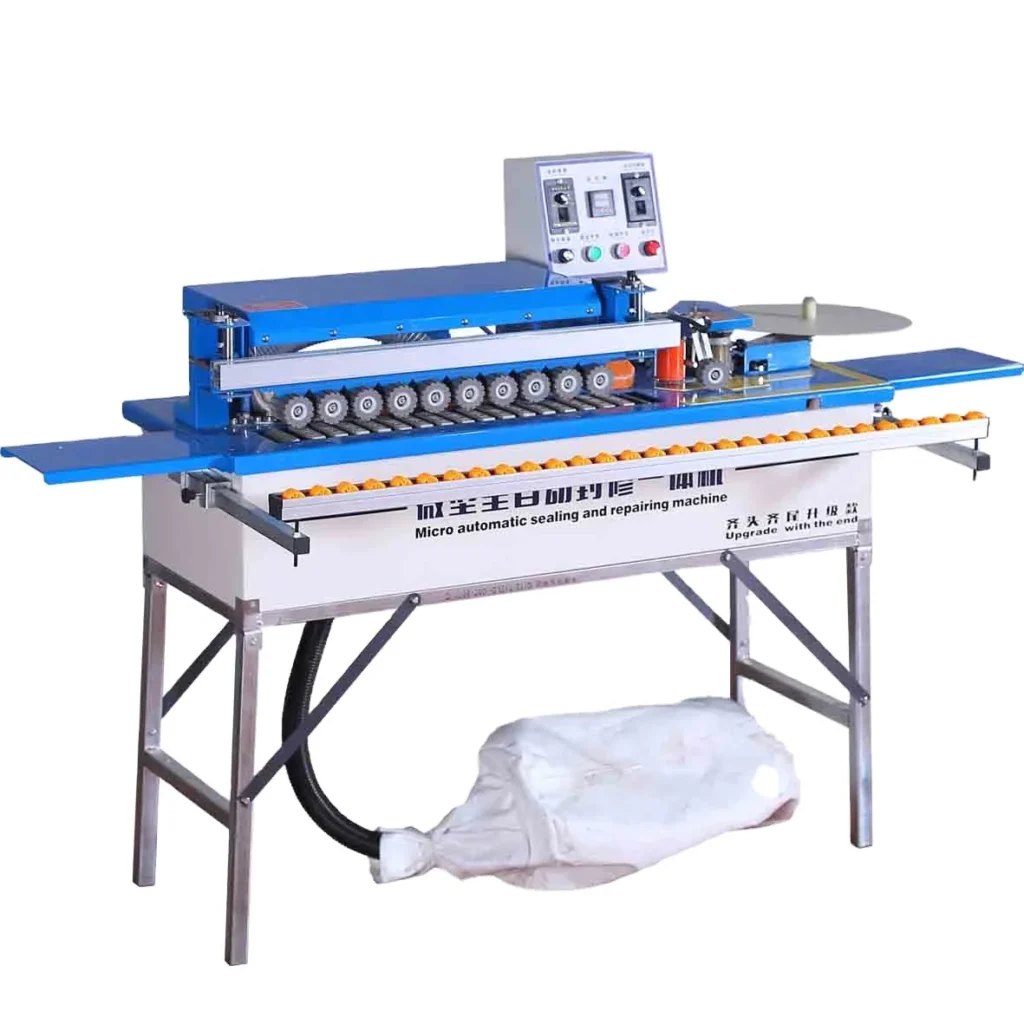
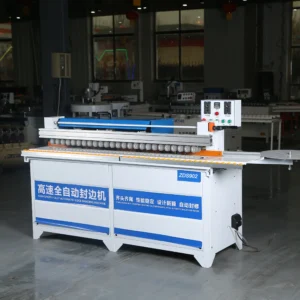
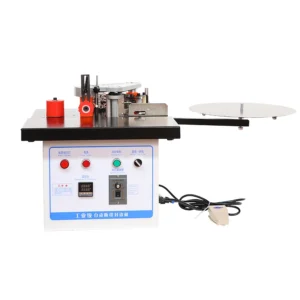
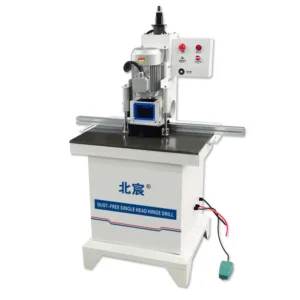
In-House Precision Manufacturing — every trimming component is ground and inspected on our factory floor before assembly into this compact automatic edge banding machine, verified through four-stage QC before dispatch.
Technical Specifications
| Parameter |
Value |
| Product Type |
Automatic Edge Banding Machine |
| Voltage |
220V (configurable from 110V to 440V) |
| Total Suction Power |
1200W |
| Belt Drive Power |
25W |
| Transmission Power |
60W |
| Polishing Power |
180W × 2 motors |
| Trimming Power |
800W × 2 motors |
| Conveying Speed |
0–15 m/min |
| Edging Speed |
0–6 m/min |
| Edge Height Range |
10–60 mm |
| Edge Thickness Range |
0.6–2 mm |
| Overall Dimensions |
120 × 54 × 72 cm |
| Net Weight |
81 kg |
| Gluing Method |
Double-sided adhesive |
| Gluing Device Rotation |
180° for curved edge banding |
| Feed Mechanism |
Double-row rubber pressure wheels |
| Control Panel |
Individual function control per station |
| Trimming Configuration |
Up and down trimming with integrated dust extraction |
| Polishing Configuration |
Up and down cross polishing |
| Key Features |
CE declaration of conformity, ISO 9001 certified manufacturing, OEM branding available |
Application Suitability
| Application |
Material or Output |
| Small joinery workshop transitioning from manual edge banding |
MDF and particleboard panels with PVC edge banding |
| Custom cabinet production with mixed profiles |
Straight and curved plywood edges with veneer or PVC |
| Prototype and short-run furniture fabrication |
Solid wood panels with 0.6–2 mm edge banding material |
| Distributor demo or training unit |
Mixed substrate edge processing across thickness ranges |
Why Voltage Confirmation Must Happen Before the Factory Floor Plan
Lock your supply voltage and frequency before any wiring enters the assembly line.
I once watched an entire workshop sit idle in Riyadh because a machine arrived configured for 380V 50Hz while the local supply ran 415V 60Hz. The motor ran slow, the trimming wheels chattered on PVC banding, and the crew waited weeks for a transformer that never matched the original spec. This miniature automatic edge banding machine factory configuration starts with confirming your electrical standard — 220V is the base build, but the motor winding and control transformer are specifiable from 110V to 440V before the first weld is laid down [NEED_CITE: voltage and frequency standards by export market]. For an OEM partner reselling into multiple territories, that flexibility means a single product type covers diverse markets without redesign.

How the 180° Gluing Unit Shapes Workshop Flexibility
Most entry-level banders force a workshop to choose between straight-line throughput and curved-edge capability. This automatic edge banding machine factory build addresses that limitation by mounting the glue device on a rotating head that swings through a full 180°, allowing the same machine to handle both flat panel runs and contoured cabinet components. The double-sided adhesive application eliminates the need for a separate hot-melt glue pot, which simplifies maintenance considerably in smaller workshops where a dedicated glue technician is not part of the staffing model.
Four-Stage QC at the Component Level
Precision in a compact machine depends entirely on how individual parts are finished before they ever meet the assembly bench. Each trimming spindle on this automatic edge banding machine factory product is ground and measured for runout at the component stage, then re-checked after mounting to the carriage. The four-stage inspection covers incoming material verification, in-process dimensional checks, finished assembly testing, and a pre-shipment verification run using actual panel stock [NEED_CITE: ISO 9001 process control requirements for machinery manufacturing]. For OEM buyers, this means the factory test record you receive reflects your specified panel thickness and edge material — not a generic benchmark.
Reading the Specs Against Your Production Reality
The 800W × 2 trimming motors are sized for continuous cuts through PVC and veneer up to 2 mm thick without stalling, which matters when a small workshop runs mixed materials throughout the day without pausing to swap tooling. The double-row rubber pressure wheel feed mechanism keeps the panel aligned through the entire station sequence, reducing the edge waviness that single-row feeds often introduce on narrower stock. Conveying speed reaches 15 m/min for positioning and transport between stations, while the actual edging speed caps at 6 m/min — a deliberate separation that lets the operator advance stock quickly without rushing the trimming and polishing cuts. The integrated dust extraction at the trimming station pulls waste directly from the cutter path, which keeps the polishing wheels clean and extends the interval between abrasive replacements.
The Hidden Cost of Ignoring Feed Height Compatibility
Buying a compact bander based on price alone often surfaces a problem only when the first tall panel runs through. If the edge height range stops short of your standard cabinet side thickness, operators compensate by tilting the panel, which pushes the trimming cut unevenly and leaves a visible step at the top edge. That step then fails the gap check during assembly, forcing rework that the machine was supposed to eliminate. The 10–60 mm height range on this unit covers standard MDF and particleboard thicknesses used in custom cabinetry without requiring manual workarounds [NEED_CITE: common panel thickness standards in custom furniture production].
Why Sourcing from the Manufacturing Floor Matters
This machine is built in a 10,000 square-meter facility where component grinding, assembly, and testing all happen under one roof — meaning a trimming tolerance issue is traced back to the spindle bench, not passed to a third-party supplier. OEM partners receive private-label documentation, custom panel colors, and branded control panels confirmed during the specification stage rather than added as an afterthought. The engineering team of 60 handles voltage and frequency customization as a standard part of the order process, which eliminates the transformer mismatch scenario I described earlier. Voltage, language, and specification customization is standard on every unit that leaves the line, not a premium option.
Documentation & Verification
- CE declaration of conformity issued under the manufacturing entity for OEM rebranding
- ISO 9001 certificate covering the production process of this edge banding machine
- Factory test record using your specified panel thickness and edge banding material
- Electrical schematic confirming your local voltage and frequency before assembly begins
- Operation manual in the operator’s language with station-by-station commissioning steps
- Spare parts list with part numbers matching the as-built configuration
Installation, Commissioning & Support
- Requires a dedicated 220V circuit with adequate breaker rating for the combined 800W trimming and 180W polishing loads
- Arrives partially assembled with KD-packed spare components to reduce shipping volume
- Overall footprint of 120 × 54 cm allows placement against a standard workshop wall
- Individual function control panel lets the operator activate each station independently during first-run calibration
- Double-row rubber pressure wheels should be checked for alignment before the first production panel enters
- Integrated dust extraction port connects to a standard workshop hose for immediate trimming waste removal
What to Include in Your Configuration Inquiry
To receive a specification-matched quotation, share the panel substrates you process most frequently, the edge banding material type and thickness range, and the local voltage and frequency at your installation site. If you are an OEM partner evaluating this unit for resale, indicate the branding scope you require — logo placement, machine color, control panel language, and documentation language all need confirmation before production begins. For workshops handling curved components, note the minimum radius you need to band so the 180° gluing unit is set up and tested against your actual workpieces before dispatch.
Frequently Asked Questions
Q: What does OEM and private-label scope cover on this machine?
A: Logo placement on the machine body, custom color, control panel language, and documentation branding are all configurable. Each element is confirmed during the specification stage before production begins, so the finished unit arrives matching your market identity without requiring local rebranding or label application after delivery.
Q: Can the voltage and frequency be customized for our export market?
A: Yes. The motor winding, control transformer, and electrical components are specified to your local supply from 110V to 440V during the order process. An electrical schematic confirming the exact voltage and frequency is provided before assembly starts, preventing the mismatch problems that cause weeks of idle time on the workshop floor.
Q: How do we verify trimming tolerance before committing to a bulk order?
A: Request a factory test record that documents trimming results using your specified panel thickness and edge banding material. The four-stage QC process includes a pre-shipment verification run, so the tolerance data you review reflects the actual production configuration rather than a generic demonstration on standard stock.
Q: What spare parts support is available for distributor partners?
A: A spare parts list with matching part numbers is included with every shipment, based on the as-built configuration. Distributor partners receive component-level documentation that enables their own service teams to perform trimming wheel replacement, pressure wheel adjustment, and polishing head maintenance without requiring a factory visit for routine servicing.