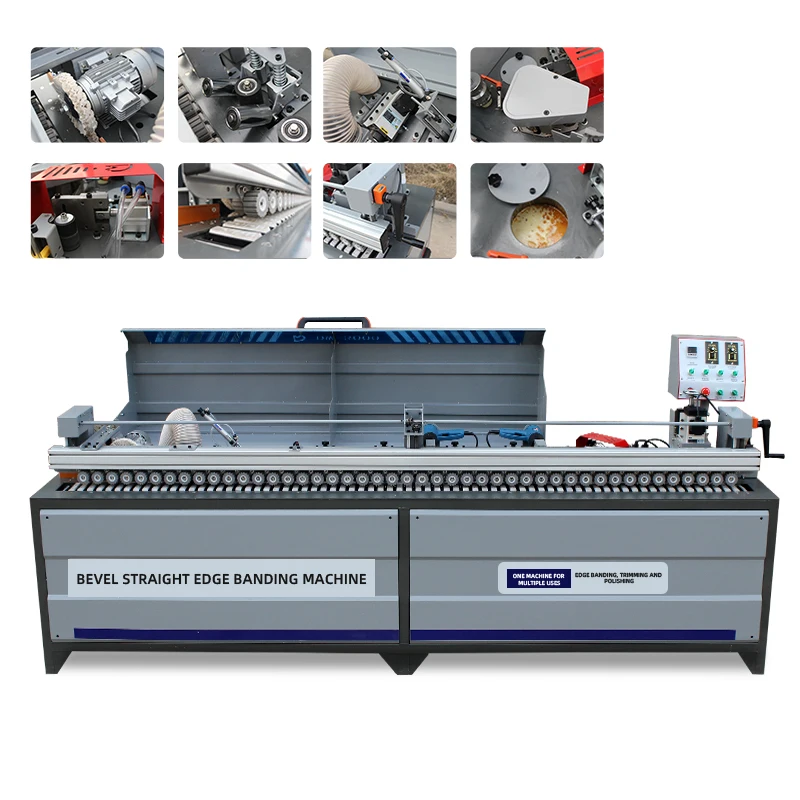
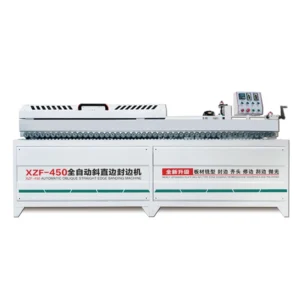
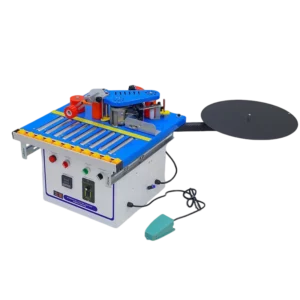
Precision Ground Components — The DW3000 edge banding machine is built with proprietary cutting mechanisms achieving verified tolerances, backed by four-stage quality control from incoming material through pre-shipment testing.
Technical Specifications
| Parameter |
Value |
| Model |
DW3000 |
| Product Type |
Fully Automatic Edge Banding Machine (Straight & Bevel Edge) |
| Total Power |
11 kW |
| Voltage & Frequency |
380V/415V, 50Hz/60Hz (basis to be confirmed) |
| Pre-milling Motor |
2.2 kW |
| Heating Power |
2.2 kW × 2 (dual heat gun) |
| Edge Feeding Motor |
160 W |
| Transmission Motor |
180 W |
| Trimming Motors |
2.2 kW × 2 (spindle) |
| Polishing Motors |
0.4 kW × 2 |
| Vacuum Power |
550 W |
| Edge Banding Thickness Range |
0.3–3 mm |
| Edge Banding Height Range |
0–50 mm |
| Minimum Panel Length |
30 cm |
| Minimum Panel Width |
15 cm |
| Glue Pot Capacity |
4000 ml |
| Air Source Pressure |
0.5–0.7 MPa |
| Standard Functions |
Pre-milling, 30–90° oblique/straight edge banding, slotting, edge trimming, scraping, polishing, vacuuming |
| Oblique Pressure Wheels |
8 sets, adjustable 30°–90° |
| Feed Mechanism |
Double cylinder feeding belt with auxiliary slide |
| Overall Dimensions (L×W×H) |
299 × 65 × 130 cm |
| Net Weight |
430 kg |
| Language Options |
Chinese/English standard; English-only, Spanish, or other languages on request |
| Plug Options |
EU, USA, AU, UK |
| Assembly State |
Fully assembled, pre-shipment test |
| Standards |
CE, ISO 9001 |
Application Suitability
| Application |
Material or Output |
| Cabinet door production |
MDF and particleboard with PVC or melamine edge banding |
| Panel furniture edge finishing |
Plywood panels with veneer or PVC strips |
| Straight and 45° bevel edge processing |
Custom furniture panels requiring multi-angle banding |
| Slotting for shelf and divider assembly |
Particleboard and MDF boards for cabinet interiors |
| Workshop transition from manual to automated |
Small to mid-size joinery shops scaling output |
Why Voltage Confirmation Must Precede the Purchase Order
An Edge banding machine OEM factory ships every DW3000 with a documented electrical schematic and confirmed voltage match to the destination market.
I once watched a customer in Southeast Asia receive a machine that sat idle for days because the frequency mismatch tripped the main contactor repeatedly. The supplier had quoted the unit without asking whether the workshop ran 50Hz or 60Hz. When you source from an Edge banding machine OEM factory, the voltage question should be settled before the quotation stage, not during commissioning. Mismatched electrical specifications remain one of the most common reasons machines arrive unusable at the buyer’s facility [NEED_CITE: voltage and frequency standards by export market].

Component Sourcing and Proprietary Mechanisms
Every DW3000 leaving this Edge banding machine OEM factory integrates a proprietary cutting mechanism protected by patent. The pre-milling spindle and trimming heads use precision-ground components machined in-house rather than sourced from generic suppliers. This vertical integration means replacement parts carry identical tolerances to the originals, which matters when a distributor stocks spares for their regional customer base.
Four-Stage Quality Control Protocol
The DW3000 passes through four distinct inspection gates: incoming material verification, in-process dimensional checks, finished product functional testing, and pre-shipment validation with recorded results. Each stage generates documentation that ships with the machine. For an importer managing a warehouse of Edge banding machine OEM factory units, having factory test records on file means you can respond to end-customer claims with actual production data rather than verbal assurances [NEED_CITE: CE machinery directive requirements for industrial equipment].
How Specifications Translate to Production Reality
The dual 2.2 kW heat gun design addresses a problem familiar to anyone running mixed materials: PVC edge banding activates at lower temperatures than melamine or veneer, and a single heating zone forces compromises. With two independent heat guns, the operator can set different thermal profiles across the glue application path, which keeps the bond line consistent when switching from 0.4 mm PVC to 2 mm melamine. The 8-set oblique pressure wheel array, adjustable from 30° to 90°, handles bevel edge banding without requiring a separate fixture change. On the trimming side, the 2.2 kW spindle motors carry enough inertia to maintain surface finish on dense particleboard without chatter marks. The 550 W vacuum system captures trim waste at the source, which matters in enclosed cabinet shops where airborne dust contaminates downstream finishing operations. Panel thickness range and feed speed interact directly: running 50 mm high edge banding at maximum feed speed risks insufficient glue activation, so the 0–12 m/min variable feed lets operators dial in the dwell time their specific material combination requires.
The Hidden Cost of Underspecified Configurations
Buying an edge bander based on a single quoted function often reveals gaps once production starts. A machine sold without pre-milling leaves visible chip lines on particleboard that show through thin PVC banding. Skipping the slotting function means the customer drills shelf pin holes manually after banding, adding a handling step that scratches finished edges. I have seen workshops purchase compact units rated for light duty, then push them through production volumes that wear the feed belt prematurely and produce inconsistent trim quality. When sourcing from an Edge banding machine OEM factory, specify every function your downstream processes depend on, not just the ones you need today [NEED_CITE: industrial machinery warranty claim patterns].
Why Procurement Partners Choose This Facility
In-house manufacturing means the DW3000 configuration can be modified at the engineering level, not just the cosmetic level. Distributors requesting private label branding receive OEM logo placement on machine panels, control interface screens, and packing materials as a documented scope before production release. The voltage and frequency are confirmed against destination market standards with a signed specification sheet. Multilingual control panels are produced as standard options, so a dealer in Latin America can request Spanish-language HMI text without custom development work. Factory test records accompany each unit, documenting tolerance measurements taken on the actual materials specified by the buyer. Engineer-led configuration recommendations arrive within 24 hours of inquiry, addressing feed mechanism selection, pressure wheel count, and function module inclusion based on the buyer’s stated production requirements.
Documentation & Verification
- CE declaration of conformity covering the DW3000 edge banding machine series
- Electrical schematic with confirmed voltage and frequency for destination market
- Factory test record documenting tolerance measurements on buyer-specified panel materials
- Operation and maintenance manual produced in the agreed language before shipment
- Spare parts list with OEM part numbers matching in-house manufactured components
- Packing photographs showing crate condition and component protection before dispatch
Installation, Commissioning & Support
- Requires 3-phase 380V/415V dedicated circuit with appropriate breaker rating for the 11 kW total load
- Minimum 0.5 MPa compressed air supply with inline filtration for the pneumatic pressure wheel system
- Ships fully assembled; requires forklift placement and leveling on workshop floor
- First-run commissioning includes glue pot temperature calibration for buyer’s specific edge banding material
- Operator training covers pressure wheel angle adjustment from 30° to 90° for bevel applications
- Spare trimming blades and feed belt segments included for initial production period
What to Include in Your Inquiry
Provide the edge banding material types you run most frequently, including thickness range and substrate material. Specify your local voltage and frequency so the electrical configuration matches before production begins. Indicate whether you need the control panel in a language other than Chinese or English, and confirm which plug type your market requires. If you are evaluating this as an OEM partner, state which customization elements you need documented: logo placement, color specification, or modified function modules.
Frequently Asked Questions
Q: What customization scope is available for OEM branding and electrical specification?
A: OEM customization covers logo placement on machine panels and packing materials, control panel language selection from Chinese, English, Spanish, or other languages on request, plug type matching EU, USA, AU, or UK standards, and voltage configuration between 380V and 415V with frequency confirmation. All customization elements are documented in a signed specification sheet before production release.
Q: How does the four-stage QC process work and what records ship with each unit?
A: Each DW3000 passes through incoming material inspection, in-process dimensional checks, finished product functional testing, and pre-shipment validation. The factory test record documents tolerance measurements taken on materials matching the buyer’s specification. This record ships with the machine and is available in digital format for distributor archives.
Q: Can the DW3000 be modified beyond the standard configuration for specific market requirements?
A: Yes, engineering modifications are handled at the specification stage before production release. This includes adding or removing function modules, adjusting pressure wheel configurations, or modifying feed mechanism parameters. All modifications require a confirmed engineering drawing and signed scope document before the unit enters the production queue.
Q: What is the procedure for distributors who want to visit the factory or request sample testing?
A: Factory visits include a walkthrough of the manufacturing floor, component sourcing area, and quality control stations. Distributors can bring their own panel materials and edge banding stock for live testing on a DW3000 unit, allowing them to verify edge quality and tolerance before placing a production order.
Q: How are spare parts supplied and what warranty applies to distributor partners?
A: Spare parts carry OEM part numbers matching the in-house manufactured components. The spare parts list ships with each machine and includes trimming blades, feed belt segments, and pressure wheel assemblies. Warranty terms for distributor partners are documented in the OEM agreement and cover manufacturing defects verified against the factory test record.