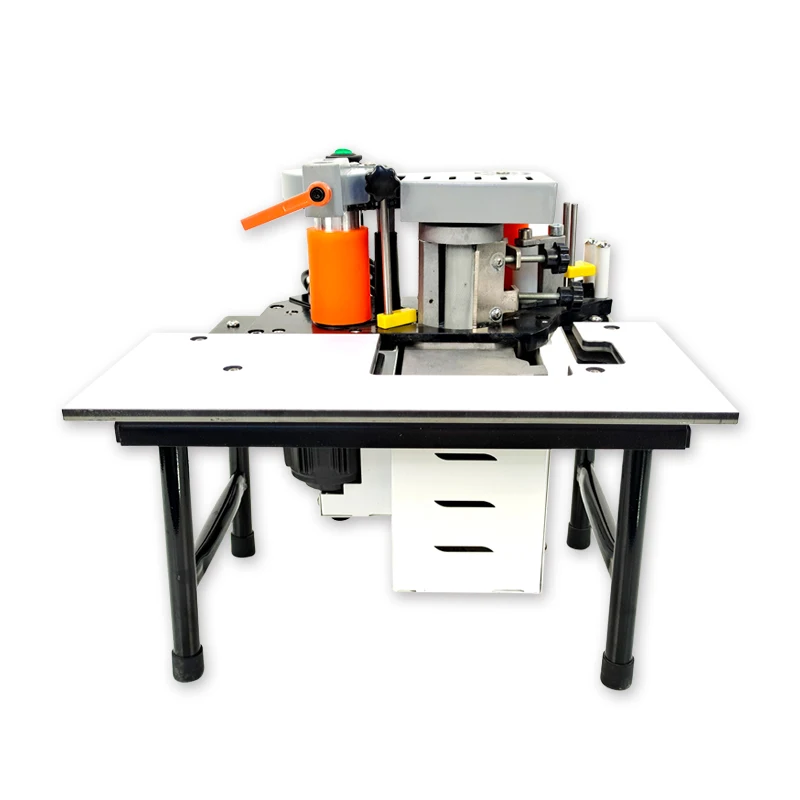
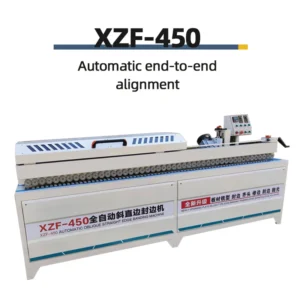
Precision-ground portable edge bander built in-house — every ST-30 leaves our facility with a factory test record run on your exact edge banding tape thickness and material, verified under our four-stage QC before crating.
Technical Specifications
| Parameter |
Value |
| Model |
ST-30 |
| Product Type |
Portable Edge Banding Machine |
| Total Power |
1000W |
| Voltage |
220V / 380V / customization available |
| Edge Banding Height |
0–50 mm |
| Edge Banding Thickness |
0.3–3 mm |
| Edge Power |
20W |
| Glue Pot Capacity |
1000 ml |
| Air Source Pressure |
0.5–0.8 MPa |
| Minimum Sheet Length |
25 cm |
| Minimum Sheet Width |
3 cm |
| Suitable Edge Banding Tape |
ABS, PVC, Melamine, Veneer |
| Edge Type |
Straight and curved edge |
| Product Size |
38 × 35 × 35 cm |
| Product Weight |
12 kg |
| Assembly State |
Portable |
Application Suitability
| Application |
Material or Output |
| Cabinet door edge finishing |
MDF and particleboard panels with PVC or ABS tape, straight and curved profiles |
| Custom furniture on-site trimming |
Plywood and blockboard with melamine or veneer banding, curved radii included |
| Small-batch interior joinery |
Solid wood panels with veneer edge banding for visible surfaces |
| Workshop prototyping and rework |
Mixed substrate offcuts requiring quick edge closure before assembly |
Why the Voltage Question Must Come Before the Quotation
A portable edge bander wired for the wrong grid is a 12-kilogram paperweight the day it arrives.
I once watched a container unload at a Dubai joinery shop where three single-phase machines had been ordered without anyone confirming the site ran on a 400V three-phase supply. The buyer assumed the edge banding machine OEM factory would default to local standards; the seller assumed 220V single-phase. Nobody asked. Those units sat on the dock for six weeks while transformers were sourced locally. [NEED_CITE: voltage and frequency standards by export market]
When an importer or distributor orders portable edge banders for regional resale, the voltage mismatch multiplies across every unit in the batch. This is why we confirm electrical specifications — voltage, frequency, plug type, and phase — in writing before the ST-30 enters production, and we ship an electrical schematic with every unit so your service team can trace any fault without guessing.

How the ST-30 Fits a Distributor’s Regional Portfolio
An edge banding machine OEM factory that offers a portable unit alongside its full-size line gives distributors something to sell into the smallest workshops — the carpenter doing curved cabinet fronts in a garage, the interior contractor carrying a bander between job sites. The ST-30 covers 0.3–3 mm tape thickness across ABS, PVC, melamine, and veneer, which means one SKU can serve most of your entry-level customer base without splitting inventory across sub-models.
Private-label capability means your brand goes on the machine, the manual, and the crate. The control panel language, the safety decal wording, and the packing photography can all match your market. This is how a regional distributor builds a recognizable product line rather than reselling someone else’s catalog.
What Four-Stage QC Means at the Portable Scale
Precision-ground components and proprietary glue application mechanisms matter just as much on a 12 kg portable unit as on a 300 kg automatic line machine. Our incoming material inspection checks the glue pot casting and motor windings before assembly begins. In-process QC verifies the curved-edge guide alignment and straight-edge feed path. Finished-product testing runs actual tape through the bander at the thickness and material the end user will see. Pre-shipment verification locks the parameters, photographs the run, and generates the factory test record that ships inside the crate. [NEED_CITE: CE machinery directive requirements for industrial equipment]
For a distributor, this documentation is what your own sales team shows when a buyer asks why your private-label portable bander is worth carrying over an unbranded alternative found on a marketplace.
Reading the Specs That Actually Matter on a Portable Bander
The 0.3–3 mm edge banding thickness range determines which tapes your customers can run without swapping hardware. A portable unit that tops out at 1 mm forces veneer users into a separate machine; the ST-30’s 3 mm ceiling keeps PVC and ABS users in the same footprint. The 0–50 mm edge banding height covers standard 16 mm and 18 mm panel stock as well as thicker shelving and countertop substrates.
The 1000 ml glue pot is sized for small-batch continuous runs — enough for a full day of intermittent curved-edge work without constant refills, yet small enough that the glue does not degrade from prolonged heating. The 0.5–0.8 MPa air source pressure requirement means any standard workshop compressor can supply the unit; no dedicated high-pressure line is needed.
Voltage configurability at 220V or 380V, with further customization on request, lets a distributor stock one product family across markets that run on different grids — a practical advantage when your territory spans two or three countries with incompatible electrical standards.
The Hidden Cost of Skipping Configuration Confirmation
When a distributor orders portable edge banders without confirming the tape thickness the end market actually uses, the result shows up as warranty claims. A glue pot calibrated for 0.5 mm PVC will struggle with 2 mm ABS — the temperature cannot keep pace, the adhesion fails, and the customer blames the machine. The ST-30’s spec sheet states its range clearly, but the factory test run must replicate the buyer’s real material. [NEED_CITE: typical edge banding adhesion failure causes on portable equipment]
Units sold without language-appropriate manuals and control labels stall commissioning at the customer site. The operator cannot read the temperature setting, guesses wrong, scorches the glue, and files a complaint. These are preventable failures that cost a distributor far more in reputation than the extra week spent confirming details before production.
Why Source the ST-30 from This Facility
In-house manufacturing means the same production floor that builds the full-size pre-milling edge banders also assembles the ST-30, so component quality and machining tolerances carry over to the portable range. Patented cutting mechanisms and precision-ground guide components are not reserved for the flagship models.
Full OEM and private-label support — custom logo, multilingual panels, tailored voltage — is handled as standard procedure, not as a special request that delays your order. The four-stage QC process generates documentation you can show your own buyers: factory test records, electrical schematics, and pre-shipment photographs. Engineer-led configuration review within one business day means your quotation includes a recommended spec matched to the market you described, not a generic price list.
Documentation & Verification
- CE declaration of conformity covering portable edge banding machinery
- ISO 9001 certificate confirming quality management across the production line
- Factory test record using your specified tape thickness and material before dispatch
- Electrical schematic with confirmed voltage, frequency, and wiring diagram
- Operation and maintenance manual translated into the target market language
- Spare parts list with part numbers matched to your private-label branding
Installation, Commissioning & Support
- Requires a dedicated 1000W circuit at the confirmed voltage to prevent shared-load tripping during glue pot heating
- Standard 0.5–0.8 MPa workshop compressor connection; no auxiliary air dryer needed for the ST-30
- Portable 38 × 35 × 35 cm footprint fits on any workbench; no floor anchoring required
- First-run parameter lock after testing with customer’s actual ABS, PVC, or veneer tape stock
- Curved-edge guide alignment verified at the factory and documented for field recalibration reference
- Glue pot cleaning cycle and replacement wiper schedule included in the multilingual manual
Preparing Your Inquiry
Tell us the edge banding tape materials and thicknesses your market buys most often, and we will configure the ST-30’s glue pot temperature profile and feed settings accordingly. Confirm the voltage and frequency at the destination country so the motor and heating elements are wound correctly before assembly. If you intend to sell under your own brand, send your logo files, the control panel language, and any safety decal requirements so these can be locked into the production schedule alongside the machine itself.
Frequently Asked Questions
Q: What is the OEM and private-label customization scope for the ST-30?
A: Custom logo placement on the machine body, crate, and documentation is standard. The control panel language, safety decals, and manual text are all produced in your target language. Voltage, frequency, and plug type are configured per market. Private-label distributors receive matched spare parts lists carrying their own branding so end-user support stays within the distributor’s ecosystem.
Q: How is voltage and frequency confirmed before production starts?
A: We request the destination country, site voltage, phase, and frequency in writing during the quotation stage. The electrical schematic is drafted to match and reviewed by our engineering team before the ST-30 enters assembly. A voltage confirmation document ships inside the crate, and the factory test record shows the machine running at the specified electrical configuration.
Q: Can the control panel and manual language be customized for my end users?
A: Yes. Control panel labels, digital display language if applicable, and the full operation manual are produced in the language you specify. This eliminates operator confusion at commissioning and reduces the support burden on your regional service team. We confirm the exact wording with you before printing.
Q: What does the four-stage QC process cover on a portable unit?
A: Incoming material inspection verifies castings and motor windings. In-process QC checks guide alignment and feed path accuracy. Finished-product testing runs your specified edge banding tape through the ST-30 under real conditions. Pre-shipment verification locks parameters, photographs the test run, and generates the documentation package that ships with the machine.
Q: How do you support distributors with spare parts and technical training?
A: Every ST-30 ships with a spare parts list carrying OEM part numbers. We provide technical documentation that your service team can use for field repairs, and we are available for remote troubleshooting based on the electrical schematic and factory test record. For distributors ordering in volume, we can arrange dedicated training sessions covering maintenance intervals and common fault diagnosis.