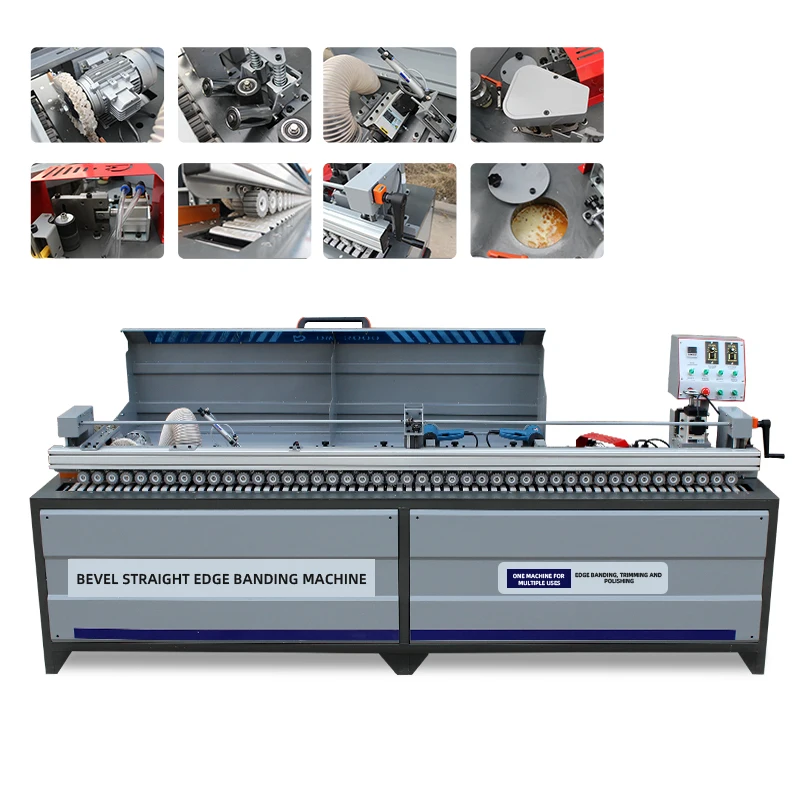
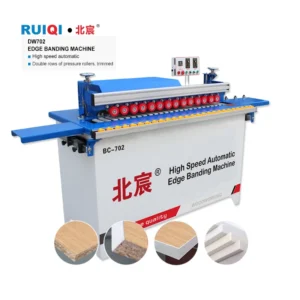
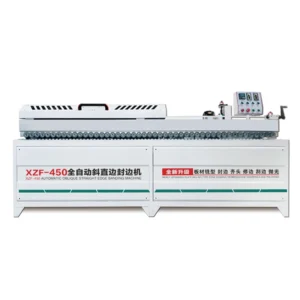
In-house manufacturing with patented cutting mechanisms — verified ±0.02 mm tolerance backed by four-stage QC documentation and full OEM private-label capability for distributors scaling a regional brand.
Technical Specifications
| Parameter |
Value |
| Model |
DW3000 |
| Product Type |
Automatic Straight and Bevel Edge Banding Machine |
| Total Power |
11 kW |
| Voltage & Frequency |
380V / 415V (configurable from 110V to 440V) |
| Pre-milling Motor |
2.2 kW |
| Heating Power |
2.2 kW × 2 (dual hot air) |
| Trimming Motor |
2.2 kW × 2 |
| Polishing Motor |
0.4 kW × 2 |
| Vacuum Power |
550 W |
| Edge Feeding Speed |
0–12 m/min |
| Transmission Speed |
0–12 m/min |
| Air Supply Pressure |
0.5–0.7 MPa |
| Glue Pot Capacity |
4000 ml |
| Edge Banding Height Range |
0–50 mm |
| Edge Banding Thickness Range |
0.3–3 mm |
| Minimum Sheet Length |
30 cm |
| Minimum Sheet Width |
15 cm |
| Bevel Angle Range |
30–90° |
| Standard Functions |
Pre-milling, bevel edge banding, trimming, scraping, polishing, vacuuming, edge band slotting |
| Product Size (L×W×H) |
299 × 65 × 130 cm |
| Net Weight |
430 kg |
| Language Options |
Chinese / English (other languages customizable) |
| Plug Options |
EU / USA / AU / UK |
| Key Features |
Dual hot air heating, eight adjustable oblique pressure wheels, double-cylinder feeding belt, one-key straight/bevel switching |
Application Suitability
| Application |
Material or Output |
| Straight-edge panel furniture banding |
MDF, particleboard, plywood with PVC or veneer tape |
| Bevel edge processing for custom cabinets |
30–90° angled profiles on MDF and particleboard |
| Joinery workshop production scaling |
Solid wood panels and plywood for door and frame components |
| Mixed straight and angled runs on one machine |
Switching between flat and bevel profiles without retooling |
| Distributor demo and showroom equipment |
Broad material compatibility for buyer demonstrations |
Why Voltage Confirmation Must Precede Every OEM Order
Specifying local voltage and frequency before production locks out the single most costly commissioning failure in cross-border machinery trade.
I spent years on the assembly floor before moving to technical sales, and I watched machines ship out with 380V/50Hz wiring headed for a 60Hz grid. The motor runs, the conveyor moves, but the spindle speed drifts and the glue pot overshoots temperature. Panels come off the line with scorched edge banding and the customer stops production. That exact scenario happened on a DW3000 we shipped to Turkey — frequency mismatch burned through two weeks of downtime before we flew out to swap the inverter. [NEED_CITE: voltage and frequency standards by export market]
Since then, every edge banding machine OEM factory quotation we issue includes a written voltage and frequency confirmation step. The DW3000 is configurable from 110V to 440V with matching plug standards, and we document the agreed electrical parameters before any component enters assembly. For a distributor placing a multi-unit OEM order, this single checkpoint prevents field failures that damage your brand reputation far more than they cost us in rework.

What Private-Label Partners Actually Receive
When a distributor orders the DW3000 under their own brand, the customization goes beyond a logo sticker on the enclosure. Control panel language is rewritten to match your target market — we have shipped units with Turkish, Arabic, and Spanish interfaces where every menu label and alarm message is localized. The operation and maintenance manual is produced in the same language, with exploded diagrams specific to the DW3000 configuration you selected, not a generic booklet.
Voltage and plug configuration are set at the component level, not adapted with an external transformer. The motor windings, contactor ratings, and heating elements are specified for your confirmed supply standard. This matters because an edge banding machine OEM factory that merely relabels a domestic unit creates hidden failure points that surface during the first summer heat wave or voltage dip.
Manufacturing Depth Behind the Nameplate
The DW3000 frame is machined and ground in-house, which means tolerance stack-up is controlled from the baseplate upward rather than assembled from sourced sub-frames of unknown flatness. The patented cutting mechanism in the pre-milling and trimming stations holds ±0.02 mm on MDF and particleboard — a figure we record on every factory test sheet, not just claim in a brochure. [NEED_CITE: CE machinery directive requirements for industrial woodworking equipment]
Eight adjustable oblique pressure wheels give the bevel station its 30–90° range, and the one-key switching between straight and bevel modes means your end customer does not need a technician on-site every time the production schedule changes profile type. The dual 2.2 kW hot air system maintains consistent glue activation across both flat and angled tape paths, which is where single-heater machines typically leave visible glue lines on bevel cuts.
How Each Specification Translates to Edge Quality
The 11 kW total power rating distributes across pre-milling, trimming, polishing, and vacuum stations simultaneously — meaning the machine does not starve one function when another engages. A lower-rated unit forces the operator to reduce feed speed to keep glue temperature stable, which then bottlenecks the entire panel line downstream.
The 0.3–3 mm edge banding thickness range covers standard PVC melamine tape at the thin end and solid wood veneer strips at the thick end. When a distributor stocks machines for a regional market where both budget particleboard furniture and premium veneer cabinets are in demand, this range eliminates the need for two separate machines.
The 0–50 mm height range with eight pressure wheel sets addresses bevel profiles that most straight-only edge banders cannot attempt. Scraper and polishing stations then remove residual glue lines and buff the edge to a finish that passes visual inspection under direct workshop lighting — a detail that separates furniture that sells at retail from furniture that comes back as a warranty claim.
The 4000 ml glue pot capacity supports sustained production runs without mid-shift refills, and the 0.5–0.7 MPa air supply requirement is compatible with standard workshop compressors already installed in most panel processing facilities.
The Hidden Cost of Skipping Pre-Shipment Verification
An edge bander that arrives with unverified tolerance does not fail dramatically — it fails quietly, panel after panel, until assembly jigs stop fitting and the furniture factory traces the problem back to edge thickness drift. By that point the machine has been running for weeks and the distributor has already invoiced the customer. [NEED_CITE: common edge banding defects linked to tolerance drift in assembly]
The other silent failure is control panel language. A machine with Chinese-only menus in a Portuguese-speaking workshop means the operator guesses at alarm codes, bypasses safety interlocks, and eventually damages a trimming spindle. These are not hypothetical risks — they are patterns I have seen repeat across multiple shipments before we formalized our confirmation process.
Why Distributors Source the DW3000 Here
In-house manufacturing with patented cutting mechanisms means your OEM order is not resold from a trading desk — the factory that builds the DW3000 is the same entity that signs the CE declaration of conformity.
Full product range within one family lets a distributor stock entry-level through full-function edge banders under a single brand relationship, simplifying spare parts inventory and technical training for your service team.
Voltage, language, and specification customization as standard means no surprise surcharges when your market requires 440V/60Hz or a Spanish HMI — these are baseline configurations, not special engineering orders.
Four-stage QC with pre-shipment verification delivers documented test records with measured tolerance values, giving your sales team evidence to show end customers during the evaluation phase.
Engineer-led configuration recommendation within 24 hours ensures that a distributor inquiry about a regional product mix receives a structured proposal, not just a price list forwarded from a catalog.
Documentation & Verification
- CE declaration of conformity covering the DW3000 bevel and straight edge banding configuration
- ISO 9001 certificate available for distributor due diligence and end-customer audit files
- Factory test record with measured ±0.02 mm tolerance values on your specified panel material
- Electrical schematic reflecting confirmed voltage, frequency, and plug standard for your market
- Operation and maintenance manual produced in the agreed language with DW3000-specific diagrams
- Spare parts list matched to the exact component configuration shipped
Installation, Commissioning & Support
- 299 × 65 × 130 cm footprint requires a level concrete pad with clearance for panel infeed and outfeed
- 11 kW total power draw requires a dedicated circuit breaker sized to confirmed voltage and local code
- Machine ships as a single 430 kg unit — no sub-assembly reassembly required on arrival
- First-run commissioning includes glue pot temperature calibration against your specific edge banding tape
- Operator training covers one-key switching between straight and 30–90° bevel modes
- Wear items including trimming cutters and scraper blades identified in the spare parts list for local stocking
What to Include in Your Inquiry
To receive a configuration proposal for the DW3000 under your brand, provide your target market’s voltage and frequency standard, the control panel language your customers require, and the edge banding materials most common in your region. If you are building a distributor product range, share the panel thickness and edge profile mix you expect to cover so we can confirm whether the DW3000’s 0–50 mm height and 30–90° bevel range aligns with your catalog strategy.
Frequently Asked Questions
Q: What OEM and private-label options are available for the DW3000?
A: Custom logo placement on the enclosure, control panel language localization, voltage and plug configuration from 110V to 440V, and private-label packaging are all available as standard options. Operation manuals and documentation are produced in your chosen language with model-specific content.
Q: How is the ±0.02 mm tolerance verified before the machine ships?
A: Every DW3000 undergoes a four-stage QC process including a pre-shipment test run on your specified panel material. Measured tolerance values are recorded on the factory test record and included in the shipment documentation package for your review.
Q: Can the factory build the DW3000 to non-standard specifications?
A: Yes. Voltage, frequency, plug type, control panel language, and certain mechanical configurations can be adapted to market requirements. We review custom drawing requests through an engineer-led evaluation and provide a formal proposal within 24 hours of receiving your specifications.
Q: What is the typical lead time for OEM orders?
A: Lead times depend on order volume and customization scope, typically spanning multiple weeks from specification confirmation to pre-shipment testing. Production scheduling is managed against confirmed orders, and we communicate dispatch dates once electrical and mechanical parameters are locked.
Q: What spare parts and training support do distributors receive?
A: Each shipment includes a spare parts list specific to your DW3000 configuration. We provide technical documentation and can arrange training for your service team covering maintenance intervals, wear part replacement, and troubleshooting common alarm codes.