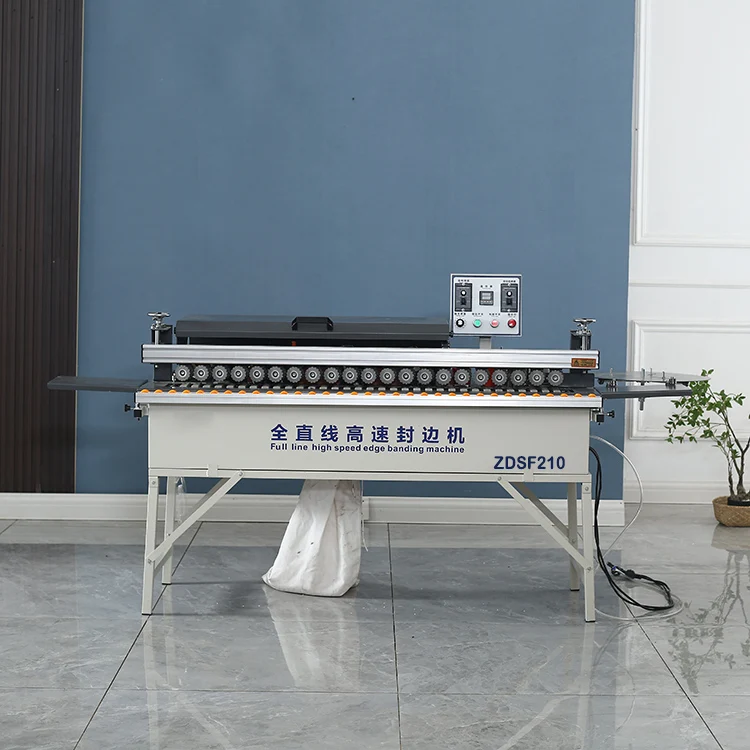
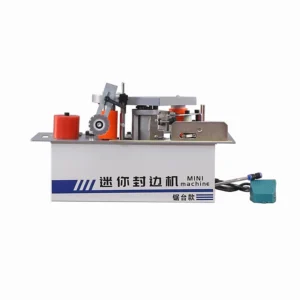
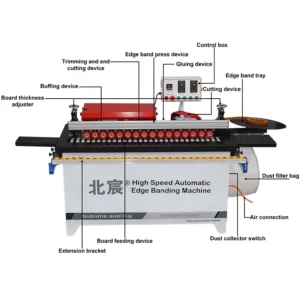
Voltage-Locked Configuration — every ZDSF210 Edge Banding Machine leaves our facility with a confirmed electrical schematic matched to your local grid, eliminating the three-week transformer delay I once watched a customer endure.
Technical Specifications
| Parameter |
Value |
| Model |
ZDSF210 |
| Product Type |
Edge Banding Machine |
| Edge Banding Speed |
6 m/min (basis not stated in source — confirm board thickness / material) |
| Belt Feed Motor |
25 W |
| Board Feed Motor |
120 W |
| Trimming Motor |
800 W × 2 |
| Heating Motor |
800 W |
| Vacuum Fan |
1200 W |
| Overall Dimensions (L×W×H) |
1500 × 570 × 630 mm |
| Net Weight |
155 kg |
| Glue Capacity |
1000 ml |
| Guide Rail Type |
Steel rod guide rail |
| Glue Pot |
Front and rear anti-shape profiling |
| Pressing |
Elastic device secondary pressing |
| Trimming |
Up/down, left/right profiling |
| Scraping |
Flexible edge scraping and glue line cleaning |
| Polishing |
Cross polishing |
| Dust Collection |
Airtight dust collection |
| Voltage |
Configurable from 110 V to 440 V |
| Warranty |
1 Year |
Application Suitability
| Application |
Material or Output |
| MDF cabinet door edge banding |
PVC and melamine edge banding on 16–25 mm MDF panels |
| Plywood furniture panel finishing |
Wood veneer and PVC banding on plywood substrates |
| Small-batch custom furniture production |
Particleboard and MDF with varying edge profiles |
| Entry-level automated workshop upgrade |
Transitioning from manual edge trimming to machine-assisted profiling |
Why Voltage Must Be the First Conversation, Not the Last
Confirming your local power supply before quotation eliminates the most common commissioning failure in exported woodworking machinery.
I spent years in the assembly bay before moving to technical sales, and the most painful downtime I witnessed had nothing to do with mechanics. A customer received a compact edge bander configured for 380 V / 50 Hz, but their facility ran on a different supply. The machine sat idle for weeks while a transformer was sourced and installed. Every ZDSF210 order now begins with a voltage and frequency confirmation document signed before production starts, and the electrical schematic travels with the machine [NEED_CITE: voltage and frequency standards by export market]. When an OEM Edge Banding Machine arrives at your dock, the motor rotation, heating element behavior, and control logic all depend on that single decision made at the quotation stage.

Private Label and OEM Branding Built Into the Assembly Sequence
When a distributor commits to adding this Edge Banding Machine factory model under their own brand, the branding is integrated during assembly rather than applied afterward. Custom color panels, logo placement on the machine body, and private label packaging are treated as line items in the build sheet. The control panel language is configured to match the end operator’s reading language, so commissioning does not stall on a screen full of unfamiliar characters. This approach means your brand identity is present from the moment the crate is opened, not bolted on as an afterthought.
Manufacturing Depth That Supports Distributor Due Diligence
Regional importers evaluating an Edge Banding Machine factory partner need to see beyond the brochure. The ZDSF210’s steel rod guide rail and frame-type motor base are machined and precision-ground in-house, which affects how the machine handles vibration during profiling trimming [NEED_CITE: precision grinding standards for woodworking guide rails]. The profiling glue pot — front and rear anti-shape — is assembled and tested as a unit before integration into the frame. We welcome factory audits where your engineering team can inspect component sourcing, trace the four-stage QC checkpoints, and review the test records generated during final assembly.
How Feed Speed, Guide Rail Design, and Trimming Stations Interact
At a rated 6 m/min feed speed (basis to be confirmed against your specific panel thickness and banding material), the steel rod guide rail maintains linear accuracy through the entire trimming zone. The two 800 W trimming motors handle up/down and left/right profiling independently, which matters when switching between PVC and thicker wood veneer banding. The elastic device secondary pressing station ensures the banding is fully bonded to the panel edge before the trimming heads engage — without this, profiling cutters can pull the banding away from the substrate on thinner boards. The airtight dust collection system captures trim waste at source, keeping the guide rail and glue pot free from particle buildup that would otherwise degrade tolerance over a production shift [NEED_CITE: dust extraction requirements for enclosed edge banding stations]. The 1200 W vacuum fan and sealed housing mean workshop air quality stays within acceptable limits without additional external extraction.
What Happens When Configuration Steps Are Skipped
The consequences of skipping voltage confirmation or ignoring panel thickness range show up in the first week of production. Control boards fail prematurely when running on an incompatible frequency. Trimming motors overheat when forced to cut wood veneer at feed speeds optimized for thin PVC. Glue application becomes uneven if the profiling pot is not calibrated to the banding thickness the operator actually uses. These are not manufacturing defects — they are configuration mismatches that compound into warranty claims and eroded trust between distributor and end user [NEED_CITE: common edge banding machine commissioning failures].
Why Distributors and OEM Partners Source This Model
In-house machining of the guide rail and motor base means replacement parts carry the same tolerance as the originals, protecting your after-sales reputation. Voltage and language customization is standard practice here, not a special request that adds lead time. The four-stage QC sequence — incoming material, in-process, finished product, pre-shipment — generates documentation that travels with every unit, giving your service team a baseline to work from. A product family that spans entry-level to full-function allows your catalog to grow without introducing a second supplier. The ZDSF210 is positioned as the compact, approachable model that workshops adopt when moving from manual methods to machine-assisted edge banding.
Documentation & Verification
- CE declaration of conformity covering the ZDSF210’s electrical and mechanical safety scope
- Factory test record run on your specified panel thickness and banding material before dispatch
- Electrical schematic confirming voltage, frequency, and circuit protection for your market
- Operation and maintenance manual translated into the language your service team reads
- Spare parts list with OEM part numbers matching your private label catalog
- Packing photographs showing crate configuration and machine securing points
Installation, Commissioning & Support
- Verify a dedicated circuit matching the confirmed voltage and the combined 3 kW+ motor load before delivery
- Allow minimum 1800 × 800 mm clear floor space for the 1500 × 570 × 630 mm frame plus operator access
- Commissioning includes profiling glue pot temperature calibration against your chosen PVC or wood veneer banding
- Trimming motor alignment checked on-site using your actual production panel material and thickness
- Flexible scraping and cross polishing stations adjusted to your target glue line finish standard
- Spare trimming cutters and scraping blades included in the initial shipment kit
What We Need From Your Inquiry
To configure the ZDSF210 correctly for your market, provide your target voltage and frequency, the primary banding materials you plan to stock (PVC thickness range and wood veneer type), and the panel substrates your customers process most frequently. If you are evaluating this model for a private label program, include your branding specifications and the operator language for the control panel. We will return an engineer-reviewed configuration proposal with a formal quotation within one working day.
Frequently Asked Questions
Q: Can you apply our logo, custom color, and private label packaging on the ZDSF210?
A: Yes. Custom color panels, logo placement on the machine body, and private label packaging are integrated into the assembly sequence as standard build items. You provide the artwork files, and we confirm placement positions on the production drawing before manufacturing starts.
Q: How do you ensure the machine matches our local power supply before shipment?
A: Voltage and frequency are confirmed in writing before production begins. The electrical schematic, motor rotation direction, and heating element specifications are all set to your grid standard. A factory test is run at the configured voltage, and the test record ships with the machine.
Q: Which components are machined in-house versus sourced externally?
A: The steel rod guide rail, frame-type motor base, and profiling glue pot assembly are machined and precision-ground in-house. Motors and electrical components are sourced from specified suppliers. Your team can verify this during a factory audit or through the QC documentation package.
Q: What inspection records and test reports ship with each unit?
A: Every ZDSF210 ships with a pre-shipment test record, incoming material inspection report, electrical safety verification, and a signed QC checklist covering all four inspection stages. These documents reference the specific unit serial number and your purchase order.
Q: Do you provide spare parts kits and technical training for our service team?
A: Yes. Initial spare parts kits include trimming cutters, scraping blades, and glue pot wear items. Technical training covers profiling adjustment, guide rail maintenance, and fault diagnosis on the ZDSF210, delivered either at our facility or via video-supported sessions for your regional team.