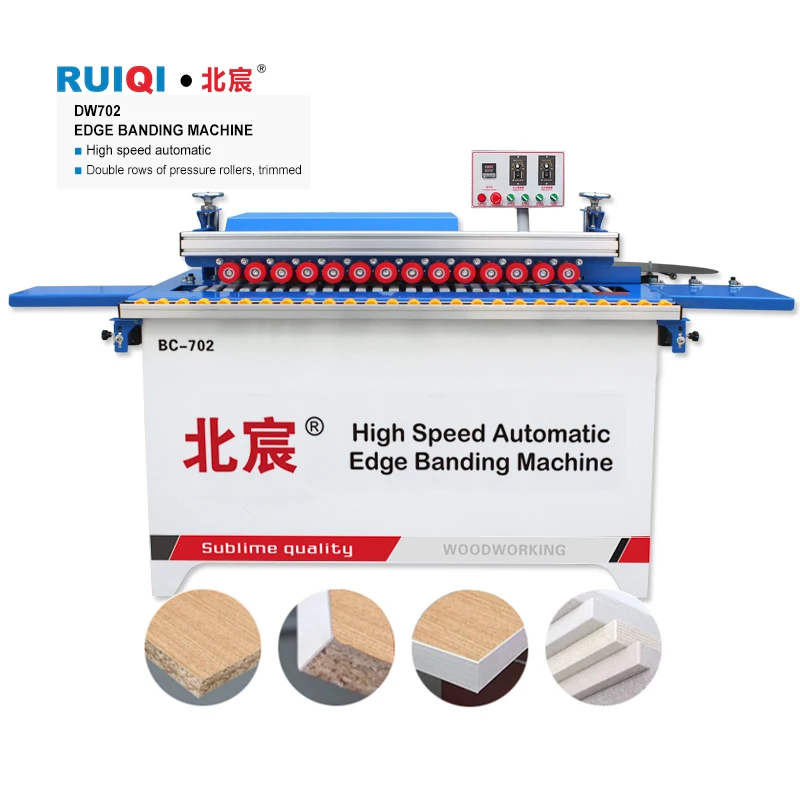
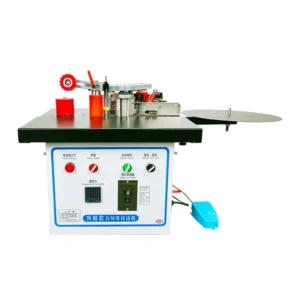
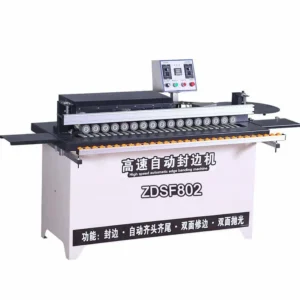
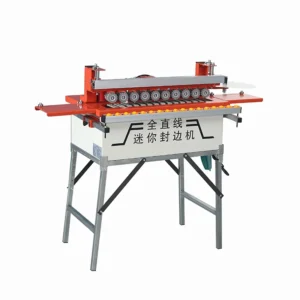
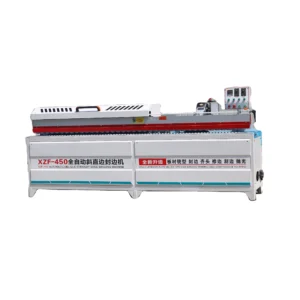
Precision-ground spindle assemblies — every DW702 edge bander undergoes four-stage inspection from incoming material through pre-shipment verification before leaving the factory.
Technical Specifications
| Parameter |
Value |
| Model |
DW702 |
| Product Type |
High-Speed Automatic Edge Banding Machine |
| Total Power |
3800W |
| Voltage & Frequency |
220V / 380V, configurable to local grid |
| Trimming Power |
800W × 2 |
| Polishing Power |
180W × 2 |
| Vacuum Power |
1200W |
| Edge Banding Thickness |
0.3–3 mm |
| Edge Banding Height |
0–50 mm |
| Minimum Sheet Length |
25 cm |
| Minimum Sheet Width |
10 cm |
| Glue Pot Capacity |
1000 ml |
| Air Source Pressure |
0.4–0.8 MPa |
| Product Dimensions |
120 × 55 × 110 cm |
| Product Weight |
105 kg |
| Plug Options |
EU, USA, AU, UK |
| Control Language |
Chinese, English; additional languages on request |
| Certification |
CE |
Application Suitability
| Application |
Material or Output |
| Cabinet door edge finishing |
MDF and particleboard with PVC or melamine edge band |
| Custom furniture panel processing |
Plywood and blockboard with veneer or ABS banding |
| Polymer door manufacturing |
Polymer composite panels with compatible adhesive systems |
| Medium-volume workshop production |
Furniture components requiring double-sided trimming and polishing |
Why Voltage Confirmation Must Happen Before the Machine Ships
A 380V machine wired for 50Hz arriving in a 60Hz market does not run — it burns.
Distributors and importers lose entire container shipments every year because the voltage and frequency question was skipped during quotation. The DW702 edge banding machine factory we operate builds each unit against a confirmed electrical specification sheet, not a default assumption. When an OEM edge banding machine arrives with the wrong motor winding or transformer tap, the cost of rewinding on-site often exceeds the freight savings. [NEED_CITE: voltage and frequency standards by export market]

In-House Manufacturing Depth for OEM Partners
Every DW702 is assembled on our own production floor, which means OEM partners can audit the process from spindle grinding to final wiring. We do not outsource core sub-assemblies to third-party workshops and rebrand them. When a distributor requests private-label branding, custom control panel graphics, or region-specific safety labeling, the modifications happen inside our facility under the same four-stage quality control protocol applied to our own brand. This level of manufacturing control is what separates an actual edge banding machine factory from a trading company that simply consolidates orders.
Private-Label Capability Without Sacrificing Build Integrity
OEM partners often worry that custom branding means compromised engineering. With the DW702, the mechanical platform remains identical regardless of whether the machine ships under our name or yours. The pre-milling unit, trimming spindles, and polishing heads are the same precision-ground components across all units. Logo placement, color matching, packaging format, and documentation language are treated as configurable parameters in the production order — not as afterthoughts applied at the packing stage. [NEED_CITE: CE machinery directive requirements for industrial equipment]
How Specifications Translate to Edge Quality
The 800W × 2 trimming motors on the DW702 provide sufficient torque to handle 3mm PVC edge band on dense particleboard without chatter marks. When feed speed and trimming power are mismatched, operators see visible ripple patterns along the trimmed edge, which then shows up as a glue line after polishing. The 1000ml glue pot maintains stable adhesive temperature across continuous runs, preventing the cold-start glue starvation that causes edge lift on the first few panels of each shift. Air source pressure between 0.4 and 0.8 MPa drives the pneumatic pressure rollers; running below this range reduces bonding pressure on thicker substrates, while exceeding it risks marking softer MDF surfaces.
The Hidden Cost of Underspecified Edge Banders
A workshop running thick PVC on high-density particleboard with a machine rated only for light-duty veneer will see spindle bearings degrade within months. The operator compensates by slowing the feed rate, which creates a bottleneck that backs up the entire panel line. Downtime for bearing replacement, combined with rejected panels from uneven trimming, quietly erodes margins long before anyone traces the problem back to the original equipment specification. [NEED_CITE: bearing failure patterns in edge banding spindles under continuous load]
Why Source This DW702 From Our Facility
Our patented cutting mechanism is manufactured in-house, not purchased from a catalog and bolted on. The four-stage QC process covers incoming material inspection, in-process assembly checks, finished-product functional testing, and pre-shipment verification with your specific panel material. We confirm voltage, frequency, plug type, and control language before production begins — not after the machine is crated. Factory visits are welcomed at any stage, and we run sample tests on the buyer’s actual substrate before dispatch.
Documentation & Verification
- CE declaration of conformity issued against the DW702 configuration shipped
- Factory test record on your specified panel thickness and edge band material before dispatch
- Electrical schematic confirming voltage, frequency, and plug type matched to your grid
- Operation and maintenance manual in the agreed language with exploded assembly diagrams
- Spare parts list with part numbers for trimming blades, polishing wheels, and pneumatic seals
- Packing photographs documenting crating condition before container loading
Installation, Commissioning & Support
- Floor space of approximately 120 × 55 cm required with clearance for panel infeed and outfeed
- Dedicated 220V or 380V circuit matching confirmed amperage draw of the 3800W total load
- Machine arrives fully assembled; connect power, air supply at 0.4–0.8 MPa, and dust extraction
- First-run parameter setting for glue temperature, feed rate, and trimming depth conducted via guided session
- Trimming blade and polishing wheel replacement intervals documented in the supplied manual
- Pneumatic cylinder seals and pressure roller surfaces listed as routine inspection items
What We Need to Configure Your DW702
Provide your standard panel material and thickness range, the edge band type and thickness you run most frequently, and your workshop’s local voltage and frequency. Let us know your preferred control panel language and whether you need OEM branding or standard configuration. If you are integrating the DW702 into an existing line, share the upstream saw and downstream boring equipment so we can verify feed-height compatibility.
Frequently Asked Questions
Q: What OEM and private-label customization is available for the DW702?
A: We offer custom logo application, color matching, control panel graphics, and region-specific safety labeling. Packaging format can be adjusted for retail-ready presentation or distributor bulk shipping. All modifications are applied during production under the same quality control protocol, not added after assembly.
Q: How do you confirm voltage and frequency before production starts?
A: We require a formal electrical specification confirmation — including voltage, phase, frequency, and plug type — before the production order is released. The electrical schematic is then generated to match your grid and included in the shipment documentation.
Q: Can I visit the factory to inspect manufacturing and run a sample test?
A: Factory visits are welcome at any stage. We can run sample edge banding tests on your specific panel material and edge band type to verify trimming and polishing quality before you commit to a production order.
Q: What documentation ships with each DW702 unit?
A: Every unit ships with a CE declaration, factory test record, confirmed electrical schematic, operation manual in your agreed language, spare parts list, and pre-shipment packing photographs. All documents reference the specific machine serial number.
Q: What spare parts support do you provide to distributor service teams?
A: We supply a detailed spare parts list with part numbers for consumable items like trimming blades and polishing wheels. Technical training on routine maintenance and component replacement is available for distributor service teams at our facility or remotely.