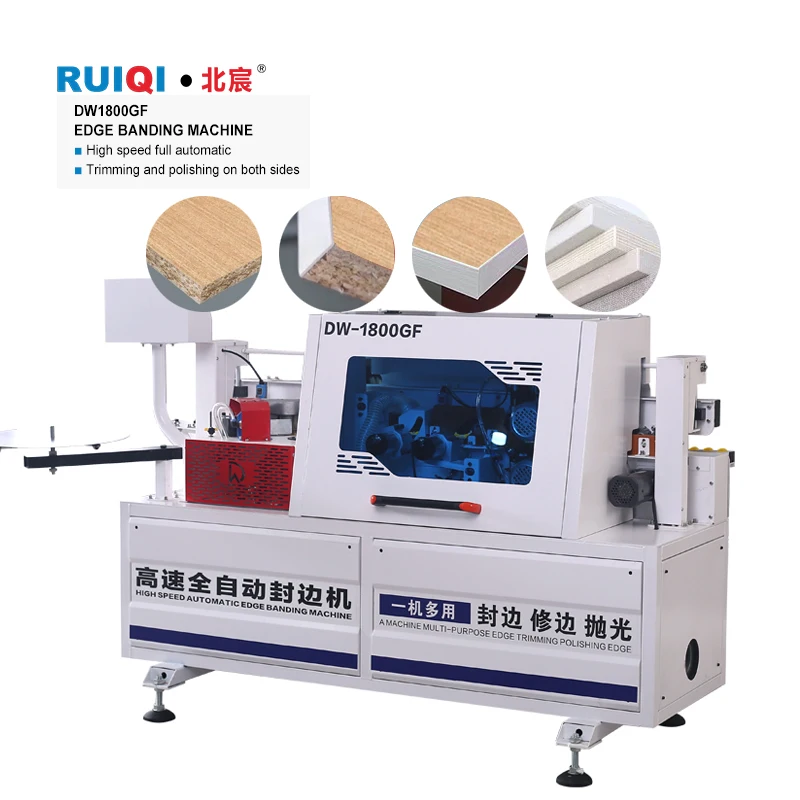
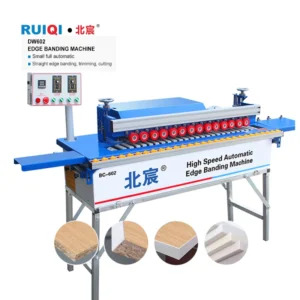
Patented Cutting Mechanisms — verified to ±0.02mm tolerance through in-house precision grinding and four-stage quality control, ensuring every DW1800 automatic edge banding machine leaves the factory with documented test records rather than unverified claims.
Technical Specifications
| Parameter |
Value |
| Model |
DW1800 |
| Product Type |
Automatic Edge Banding Machine |
| Total Power |
4.9KW |
| Voltage Options |
380V / 220V / 415V |
| Feed Speed |
0–14M/min |
| Edge Banding Thickness |
0.3–3MM |
| Edge Banding Height |
0–50MM |
| Minimum Sheet Length |
20CM |
| Minimum Sheet Width |
10CM |
| Glue Pot Capacity |
4000ml |
| Trimming Power / Speed |
800W × 2, 24,000 r/min |
| Polishing Power |
380W × 2 |
| Air Source Pressure |
0.4–0.6Mpa |
| Product Size |
220 × 65 × 125CM |
| Product Weight |
320KG |
| Language Options |
Chinese, English (customizable) |
| Plug Options |
EU, USA, AU, UK |
| Key Features |
Double-sided gluing, top/bottom trimming, top/bottom polishing, front/rear alignment, flexible edge scraping, dust suction, automatic corner rounding |
Application Suitability
| Application |
Material or Output |
| Custom cabinet door edging |
MDF and particleboard with PVC or melamine edge banding |
| Plywood casegoods production |
Plywood panels up to 50mm banding height with wood veneer strips |
| Office furniture panel finishing |
Particleboard and MDF with 0.3–3mm PVC or ABS edge material |
| Solid wood edge profiling |
Solid wood panels requiring corner rounding and flexible scraping |
| Retail fixture and shelving |
ABB boards and organic glass plates with thin-to-medium banding |
Why Voltage Confirmation Must Happen Before the Build Sheet
Every DW1800 automatic edge banding machine factory order begins with a signed voltage and frequency confirmation sheet — because a mismatch discovered after commissioning shuts down the entire panel line.
I have watched a container arrive in Southeast Asia with a motor wired for the wrong frequency. The control panel powered up, but the trimming motors overheated within the first shift. The factory spent weeks sourcing a transformer locally while cabinet orders backed up [NEED_CITE: voltage and frequency standards by export market]. That failure was not a design flaw — it was a communication gap. The DW1800 is configurable from 220V to 415V with plug options spanning EU, USA, AU, and UK standards. The build does not start until the destination market electrical specification is confirmed in writing, cross-checked against the motor nameplate rating and the control transformer tap setting.

Precision Grinding and Component Sourcing Under One Roof
The DW1800 automatic edge banding machine is manufactured entirely within a single facility where component sourcing, precision grinding, and final assembly happen under continuous quality oversight. The trimming stations rely on dual 800W motors running at 24,000 r/min. Those spindles are ground in-house to maintain concentricity, which directly affects how cleanly the top and bottom trimming knives follow the panel edge. When concentricity drifts, the trimmed edge shows micro-ripples that become visible after polishing — a defect that only appears once the panel reaches the assembly bench.
OEM and Private-Label Build Protocol
For distributors evaluating this machine as a private-label product, the DW1800 supports full OEM scope: custom logo placement, machine color, control panel language, and electrical specification matched to the target territory. A regional importer selling into Spanish-speaking markets can specify Spanish-language HMI screens alongside the correct voltage and plug configuration, so the machine arrives ready for operator training without an interim translation step [NEED_CITE: CE machinery directive requirements for industrial equipment]. Packaging, documentation, and nameplate branding are adjusted per the distributor’s requirements before the pre-shipment inspection begins.
Reading the Spec Sheet for What It Actually Means
The feed speed range of 0–14M/min covers the working envelope from slow, careful profiling on solid wood edges up to higher-speed runs on straight PVC banding for particleboard cabinet components. The practical throughput depends on which functions are engaged — running all trimming, scraping, and polishing stations simultaneously demands a feed rate that allows each station adequate dwell time on the panel edge. The 0.3–3mm banding thickness range means this machine handles thin decorative melamine strips as well as thicker PVC and ABS impact edges used on worktops and shelving. The glue pot at 4000ml capacity with double-sided gluing applies adhesive to both the panel edge and the banding strip, which improves bond strength on porous substrates like MDF where single-sided application can starve the joint. Air source pressure at 0.4–0.6Mpa drives the pneumatic pressure rollers and scraping stations — a stable compressor supply is essential to maintain consistent roller pressure across varying panel thicknesses.
The Hidden Cost of Skipping the Factory Test Record
When an edge bander ships without a documented pre-shipment test run on the buyer’s actual panel material, the first real quality check happens on the customer’s floor — during installation, under production pressure. Trimming accuracy, glue uniformity, and feed stability all behave differently on MDF versus particleboard versus plywood. A machine tuned on one substrate may leave visible glue lines or uneven profiles on another. The result is days of on-site adjustment while the panel line sits idle [NEED_CITE: edge banding quality standards for panel furniture assembly]. This is why every DW1800 leaves with a factory test record run on the material the buyer specifies.
Why Distributors Source This Automatic Edge Banding Machine Factory Direct
The DW1800 is built with in-house precision grinding rather than outsourced spindle assemblies, giving the factory direct control over the concentricity that determines trim quality. Four-stage quality control — incoming material, in-process, finished product, and pre-shipment verification — means each unit is inspected at points where defects can still be corrected rather than merely logged. Voltage and language customization is built into the production workflow as a standard step, not treated as a special request that delays the schedule. Patented cutting mechanisms achieve verified ±0.02mm tolerance, documented in the test record that accompanies every shipment. Factory visits are welcomed at the Ningjin facility, where distributors can inspect component inventory, the grinding process, and the assembly line before committing to an order.
Documentation & Verification
- CE declaration of conformity issued for the DW1800 configuration as shipped
- ISO 9001 certificate covering the manufacturing process for this machine family
- Factory test record documenting trimming accuracy and glue uniformity on specified panel material
- Electrical schematic and voltage confirmation sheet matching destination market supply
- Operation and maintenance manual in the agreed language with spare parts list
- Pre-shipment packing photographs provided before container loading
Installation, Commissioning & Support
- Requires a dedicated circuit matching the confirmed voltage (380V/220V/415V) with appropriate breaker rating for 4.9KW total draw
- Machine footprint of 220 × 65CM needs clear infeed and outfeed space for full-length panel handling
- Pneumatic supply at 0.4–0.6Mpa must be regulated and filtered before connecting to the machine air inlet
- First-run commissioning includes feed speed calibration and trimming head alignment on buyer’s actual panel stock
- Operator training covers glue pot temperature settings for different banding materials within the 0.3–3mm thickness range
- Trimming and polishing consumables included in initial spare parts kit for early production runs
Requesting a Build Quotation
To move from specification review to a formal quotation, share the panel materials you will be processing most frequently, the edge banding types and thicknesses in your product range, and the local voltage and frequency at the installation site. If you are evaluating the DW1800 for OEM or private-label distribution, indicate the target market languages, branding requirements, and whether you plan to visit the factory before order confirmation. Sample processing tests can be arranged on your panel stock to verify edge quality before production begins.
Frequently Asked Questions
Q: What can be customized under OEM and private-label arrangements for the DW1800?
A: Logo placement, machine color, control panel language, voltage and plug configuration, and packaging can all be adjusted. The electrical schematic is matched to the destination market, and the HMI screen text is translated into the agreed language. Custom specifications beyond standard options are reviewed during the engineering configuration phase before the quotation is finalized.
Q: Which components are machined in-house versus sourced externally?
A: Precision-ground spindle assemblies and the cutting mechanisms are machined in-house, which maintains control over the concentricity and tolerance critical to trimming quality. Electrical components, pneumatic valves, and bearings are sourced from established suppliers and inspected during incoming material quality control before entering the assembly line.
Q: How is voltage and frequency confirmed before production starts?
A: The buyer provides the exact voltage, phase, and frequency at the installation site. This is cross-referenced against motor ratings and control transformer taps, then documented on a voltage confirmation sheet signed by both parties. Production does not proceed until this sheet is approved, preventing the kind of mismatch that causes motor failure on commissioning.
Q: What does the pre-shipment test protocol cover for each unit?
A: Each DW1800 undergoes test runs covering trimming accuracy on the specified panel material, glue application uniformity across the full banding height range, feed stability at working speed, and pneumatic station response. Results are recorded in a factory test report that ships with the machine, providing a baseline for on-site commissioning comparison.
Q: Can I visit the factory to evaluate the DW1800 before placing an order?
A: Factory visits are welcomed and can be arranged to inspect the component inventory, precision grinding workshop, assembly line, and quality control checkpoints. A live demonstration on your panel material can be scheduled during the visit so you can verify edge quality, trimming finish, and machine behavior under conditions matching your production environment.