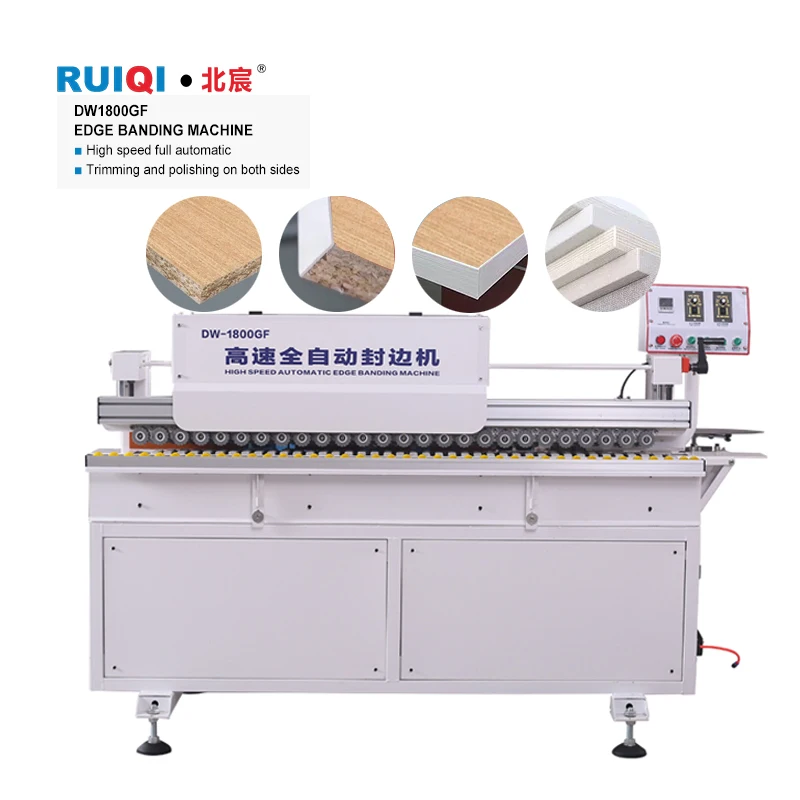
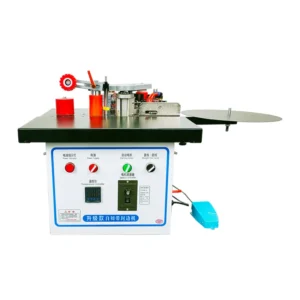
In-House Precision Manufacturing — Every DW1800 edge bander leaves our Shandong floor only after passing four-stage QC with hot-melt gluing verified on your specified panel stock.
Technical Specifications
| Parameter |
Value |
| Model |
DW1800 |
| Product Type |
Automatic Edge Banding Machine |
| Total Installed Power |
4.9 kW |
| Operating Voltage |
380V / 220V / 415V (frequency to be confirmed per market) |
| Feed Speed Range |
0–14 m/min (basis to be confirmed depending on panel thickness and material) |
| Edge Banding Height Capacity |
0–50 mm |
| Edge Banding Thickness Range |
0.3–3 mm |
| Minimum Sheet Length |
200 mm |
| Minimum Sheet Width |
100 mm |
| Glue Pot Capacity |
4000 ml |
| Gluing Method |
Hot melt, double-sided |
| Trimming Motors |
800 W × 2 at 24,000 r/min |
| Polishing Motors |
380 W × 2 |
| Vacuum Motor |
550 W |
| Air Source Pressure |
0.4–0.6 MPa |
| Overall Dimensions (L×W×H) |
220 × 65 × 125 cm |
| Net Weight |
320 kg |
| Tracking Function |
Profile tracking for corner rounding |
| Control Interface Language |
Chinese and English standard; Spanish and other languages available on request |
| Plug Options |
EU, USA, AU, UK |
| Key Workstation Features |
Double-sided gluing, top and bottom trimming, top and bottom polishing, front and rear alignment, flexible edge scraping, dust suction |
Application Suitability
| Application |
Material or Output |
| Custom cabinet door and carcass production |
MDF and particleboard with PVC or melamine edge banding |
| Plywood furniture panel finishing |
Plywood panels with veneer or ABS edge banding up to 3 mm |
| Workshop-scale joinery output |
Solid wood panels and organic glass plates requiring profile-tracked corners |
| Small-batch OEM furniture components |
ABB boards and similar hardness substrates with hot melt adhesion |
Why Voltage Confirmation Must Precede the Purchase Order
Specifying local voltage and frequency at the quotation stage eliminates the most common commissioning failure in cross-border equipment trade.
Distributors regularly receive machinery built for a default voltage that does not match the destination country’s grid. A 380V motor wired into a 415V supply runs hotter, degrades insulation prematurely, and voids warranty claims. Frequency mismatches between 50 Hz and 60 Hz markets alter motor speed, shifting the feed rate away from the value printed on the nameplate [NEED_CITE: voltage and frequency standards by export market]. For an automatic edge banding machine factory handling OEM orders, locking electrical configuration before production begins is the single most effective step toward zero-complaint delivery.

Manufacturing Depth Behind the DW1800 Platform
The DW1800 is built entirely on our factory floor, from precision-ground frame assemblies to the patented cutting mechanism that holds trimming tolerance within the specified range. Component sourcing stays within our verified supply chain, so an OEM partner requesting private-label branding receives a machine whose every sub-assembly traces back to controlled production records. This depth allows us to adjust frame geometry, motor specification, and workstation sequence without depending on external integrators.
OEM Customization Scope for Regional Distributors
Branding goes well beyond a logo decal. We configure control panel language, electrical cabinet labeling, plug type, and exterior color to match your market identity. For distributors covering multiple territories, the same automatic edge banding machine platform can ship in distinct voltage and language variants while sharing a common spare parts inventory [NEED_CITE: CE machinery directive requirements for industrial equipment]. Batch orders consolidate into a single production run with unified documentation, reducing per-unit administrative overhead.
Reading the Specification Sheet Against Real Workshop Conditions
The 0–14 m/min feed speed range must be evaluated against your typical panel thickness and edge banding material. Running 3 mm PVC on 18 mm particleboard demands a slower feed than 0.4 mm melamine on 12 mm MDF to maintain consistent glue transfer and clean trimming. The double-sided gluing system applies adhesive to both the panel edge and the banding strip, which improves bond strength on porous substrates like recycled MDF that tend to absorb glue unevenly. Profile tracking engages a dedicated rounding unit at each corner, replacing the sharp 90-degree edge that would otherwise require manual scraping downstream. The 4000 ml glue pot sustains continuous operation through a standard shift without frequent refills, while the 0.4–0.6 MPa air supply drives the pneumatic actuators across all trimming and scraping stations. Dust extraction at 550 W keeps the polishing zone clear of fine residue that would otherwise embed into freshly polished surfaces.
The Hidden Cost of Skipping Pre-Shipment Verification
When edge banding machines arrive overseas without factory test records matched to the buyer’s actual panel stock, the first production run becomes the commissioning test. Glue temperature that works on the supplier’s sample MDF may not wet out the recycled board a cabinet shop sources locally, leading to delamination within weeks. Pneumatic circuits tuned at one altitude may under-perform at another, producing inconsistent trimming pressure [NEED_CITE: effects of altitude on pneumatic system performance]. These issues surface only after the container has sailed, turning a routine installation into a multi-week troubleshooting cycle.
What Our Factory Delivers Beyond the Machine
Our in-house manufacturing keeps every DW1800 workstation assembled, aligned, and tested under one roof before crating. The four-stage QC sequence — incoming material, in-process, finished product, pre-shipment — means tolerance and electrical safety checks occur at multiple gates rather than only at the shipping dock. Voltage, plug type, and control language are confirmed against the destination market at the order stage, not guessed from a default setting. OEM partners receive full private-label capability including custom packaging, branded documentation, and exterior finish. Factory visits are open so buyers can witness precision grinding, assembly, and test runs on their own panel samples.
Documentation & Verification
- CE declaration of conformity issued against the applicable machinery directive for each DW1800 unit
- ISO 9001 certificate covering our manufacturing process available with every shipment
- Electrical schematic and voltage confirmation sheet matching your ordered configuration
- Factory test record documenting trimming and polishing results on your specified panel material
- Operation and maintenance manual printed in the language confirmed at order stage
- Packing photographs archived for each crate before dispatch
Installation, Commissioning & Support
- Allocate a level floor area exceeding 220 × 65 cm with clearance on the infeed and outfeed sides for panel handling
- Provide a dedicated circuit matching the confirmed voltage option (380V / 220V / 415V) with correct frequency for your grid
- The 320 kg net weight requires standard pallet-jack unloading; no overhead crane is needed for positioning
- First startup includes glue pot temperature calibration and feed speed adjustment against your panel thickness range
- Operator training covers profile tracking setup, trimming motor speed tuning, and daily dust extraction filter cleaning
- Spare parts list identifies wear items including trimming blades, polishing wheels, and glue scraper inserts
Preparing Your Inquiry
To match the right DW1800 configuration to your market, share the panel materials and edge banding types your customers run most often, along with the local voltage and frequency standard. Let us know the control panel language your technicians need and whether you require a sample test on your own stock before production begins.
Frequently Asked Questions
Q: What dimensions of OEM customization are available for the DW1800?
A: We adjust brand logo placement, exterior color, control panel language, plug type, and packaging artwork to match your market. Electrical cabinet labeling and documentation language are configured per order. The core workstation layout remains standardized so spare parts compatibility is preserved across all OEM variants.
Q: How do you guarantee the voltage matches our local grid before shipment?
A: Voltage and frequency are locked in writing during the quotation stage. The electrical schematic and a signed voltage confirmation sheet travel with every machine. Our pre-shipment test runs the DW1800 at the ordered voltage to verify motor current and heating behavior under load.
Q: Can we send our own panel stock for a factory test run?
A: Yes. Send representative samples of your MDF, particleboard, or plywood along with the edge banding material you use. We run trimming, polishing, and profile tracking on those samples and share a video record plus a written test report before you approve shipment.
Q: How is spare part supply handled for bulk OEM orders?
A: Each batch order includes a recommended spare parts list calibrated to your order volume. Wear items like trimming blades and polishing wheels ship with the main consignment. We maintain inventory of pneumatic valves, motors, and glue pot components for ongoing replenishment orders.
Q: How does the DW1800 throughput align with upstream panel saws and downstream boring stations?
A: The adjustable feed speed range allows you to set a line pace that matches your cutting and drilling cycle times. Share your existing equipment models and target batch size so we can recommend a feed speed setting that avoids bottlenecks between workstations.