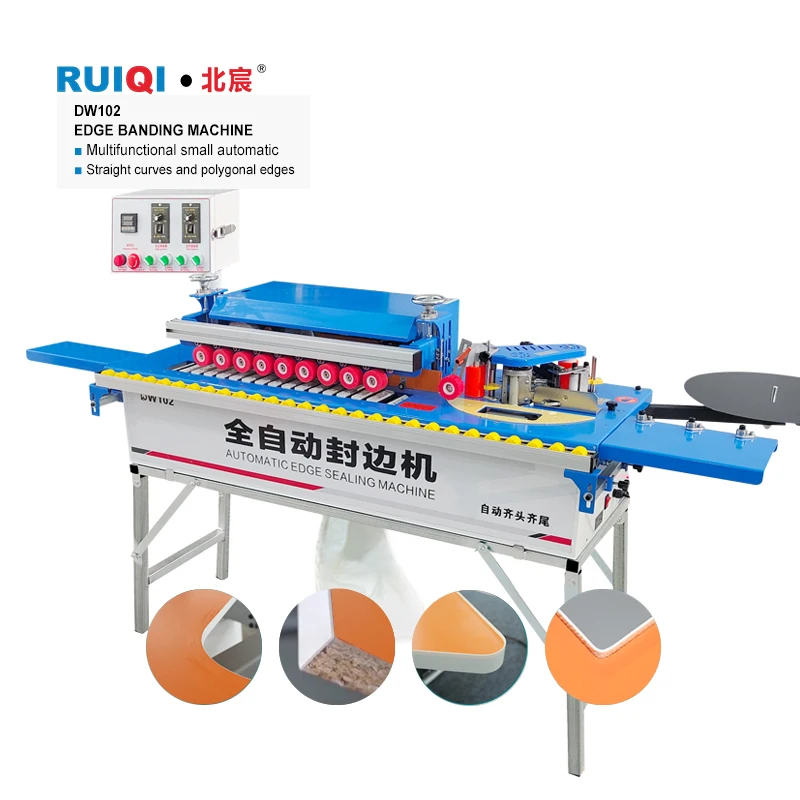
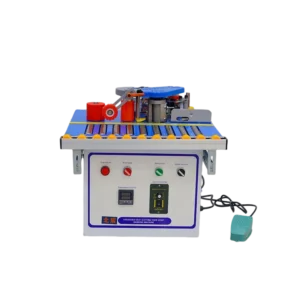
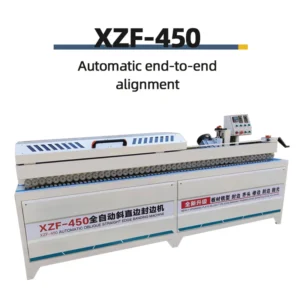
Precision Assembly Transparency — every DW102 unit traces back through component sourcing, four-stage inspection, and pre-shipment factory testing before it leaves Shandong.
Technical Specifications
| Parameter |
Value |
| Model |
DW102 |
| Product Type |
Semi-Automatic Edge Banding Machine |
| Total Power |
3800W |
| Voltage |
220V / 380V / customization |
| Edge Power |
20W |
| Transmission Power |
60W |
| Trimming Power |
650W × 2 |
| Polishing Power |
180W × 2 |
| Vacuum Power |
1200W |
| Glue Pot Capacity |
1000 ml |
| Air Source Pressure |
0.5–0.8 MPa |
| Minimum Sheet Length |
25 cm |
| Minimum Sheet Width |
5 cm |
| Edge Banding Height |
0–50 mm |
| Edge Banding Thickness |
0.3–3 mm |
| Product Size |
128 × 47 × 69 cm |
| Product Weight |
75 kg |
| Assembly State |
Portable / Bench-top format |
| Standard Features |
Curved and straight edge banding, edge trimming, polishing, automatic head and tail cutting, vacuum |
| Standards |
CE |
Application Suitability
| Application |
Material or Output |
| Cabinet door panel finishing |
MDF and particleboard with PVC or veneer edge banding |
| Custom furniture edge processing |
Plywood and blockboard panels up to 50 mm edge height |
| Small-batch workshop production |
Solid wood panels for joinery and bespoke furniture |
| Polymer door edge sealing |
Polymer door blanks with compatible banding material |
| Curved component banding |
Shaped MDF and plywood panels for contoured furniture parts |
Why Voltage Confirmation Must Happen Before the Edge Banding Machine OEM Order Ships
An Edge Banding Machine OEM build that skips electrical verification is a crate of expensive dead weight the moment it reaches a workshop with the wrong grid.
I learned this the hard way. We once shipped a unit to the Middle East and only discovered at commissioning that the local supply frequency did not match our test setup — the glue pot could not hold temperature and the trimming motors ran hot within the first hour. The operator was staring at a Chinese-language panel he could not read, and the entire site stood idle for three days while we scrambled to send corrected documentation and remote guidance. That delay cost the distributor credibility with his own customer. Now every order locks in the exact voltage, frequency, and control language before production begins. [NEED_CITE: voltage and frequency standards by export market]
Component Sourcing and Assembly Integrity
The DW102 starts with precision-ground components that move through multi-stage inspection before assembly. Each function station — banding feed, trimming, polishing, and head-tail cutting — is built as a modular unit, which means a distributor can request specific station configurations based on what their regional market actually demands. The 75 kg bench-top footprint is deliberate: it keeps container loading efficient for bulk export, and it lets a small workshop place the machine on an existing bench without dedicated floor space. For an Edge Banding Machine OEM partner, this modularity translates to a configurable product line without re-engineering the base platform.
Quality Gates That Catch Problems Before the Crate Is Sealed
Our four-stage QC sequence covers incoming material verification, in-process dimensional checks during assembly, finished product performance testing, and a final pre-shipment run on actual panel stock. The DW102 is put through curved and straight banding cycles on the material thickness range it will handle in the field. Glue pot temperature stability, air pressure response at the trimming station, and vacuum hold at the polishing stage are all recorded. If any reading drifts outside tolerance during this final gate, the unit does not ship — it goes back to the bench. This is the kind of discipline that separates a credible Edge Banding Machine OEM operation from a workshop that simply bolts purchased parts together. [NEED_CITE: CE machinery directive requirements for industrial equipment]

What the Specification Sheet Actually Means on the Shop Floor
The 0.3–3 mm edge banding thickness range matters more than it looks on paper. PVC banding at 0.3 mm demands precise glue roller pressure and lower glue pot temperature to avoid squeeze-out; veneer at 2–3 mm needs higher temperature and heavier pressure from the trimming station to achieve a clean cut. The 650W × 2 trimming motors provide enough torque to handle that full range without stalling on thicker stock. The 1000 ml glue pot is sized for batch work rather than continuous production — it holds enough adhesive for a typical cabinet run without requiring mid-job refills, but it is not designed for eight-hour unattended operation. The 0.5–0.8 MPa air supply requirement means the host workshop needs a compressor capable of sustaining that pressure across all pneumatic actuators simultaneously, not just at the regulator. Minimum sheet dimensions of 25 cm length and 5 cm width define the smallest component the feed system can grip reliably — anything smaller needs a dedicated jig or a different machine class entirely.
The Hidden Cost of Skipping OEM Configuration Checks
When a distributor sources machines without confirming the destination workshop’s electrical infrastructure, the consequences compound. The machine arrives, the electrician opens the panel, and the wiring does not match the local three-phase configuration. A transformer gets added as a workaround, but it introduces voltage drop under load, which causes the polishing motors to run below rated speed — and the edge finish degrades without anyone understanding why. The operator blames the banding material, the distributor blames the operator, and the real root cause sits inside the electrical cabinet. We have seen this pattern repeat across multiple export markets. [NEED_CITE: common causes of edge banding machine field failures]
Why OEM Partners Build Their Product Range Here
The DW102 sits within a full product family that scales from entry-level bench-top units through to full-function pre-milling machines, so a distributor can grow their catalog without adding a second supplier. Private-label branding is applied at the factory — custom logo on the machine body, customized color on the housing, and control panels printed in the operator’s local language as standard. Voltage is confirmed per order against the destination grid, not assumed from a default setting. Every unit ships with a factory test record that documents performance on the panel material specified by the buyer. Engineer-led configuration means the proposal accounts for how the machine will actually be used, not just what fits in a container.
Documentation & Verification
- CE declaration of conformity covering the DW102 semi-automatic platform
- ISO 9001 certificate documenting our quality management system
- Machine specification sheet with confirmed voltage and frequency per order
- Electrical schematic matching the as-built wiring configuration
- Factory test record on buyer-specified panel material and edge banding thickness
- Operation and maintenance manual in the agreed control panel language
Installation, Commissioning & Support
- Bench-top placement requires a stable work surface rated for 75 kg static load minimum
- Dedicated circuit required matching confirmed voltage and 3800W total draw
- Portable format means no foundation work — uncrate, level, and connect air and power
- First-run glue pot calibration performed with buyer’s actual PVC or veneer banding sample
- Trimming and polishing station adjustment verified on-site using buyer’s panel stock
- Spare parts list included covering wear items for the first maintenance interval
Before You Request a Quote — What We Need to Know
Send us your destination market voltage and frequency, the panel materials your customers will process, and the edge banding type and thickness range they use most often. If you are building a private-label range, let us know which function stations matter for your territory and which languages the control panel must support.
Frequently Asked Questions
Q: What OEM customization options are available for the DW102?
A: We configure logo placement, housing color, voltage from 220V to 380V and beyond, and control panel language per order. Function stations can be adjusted to match your market requirements. Every customization point is documented in the specification sheet before production begins, so the as-built machine matches the agreed configuration exactly.
Q: How does the four-stage QC process work on each unit?
A: Incoming materials are inspected against tolerance before assembly starts. During build, dimensional checks verify component alignment. The finished machine then runs a full banding cycle on test panels. Finally, a pre-shipment validation repeats critical measurements and records glue pot stability, trimming quality, and vacuum performance against acceptance criteria.
Q: Can you produce machines to our own drawings or specification sheets?
A: We accept buyer-supplied specification sheets and review them against our manufacturing capabilities. Where your requirements fall within our platform range, we configure accordingly. Where they require modifications, our engineering team assesses feasibility and provides a formal proposal. Not every request can be accommodated, and we will tell you honestly before committing.
Q: What documentation ships with each DW102 for customs and compliance?
A: Each unit includes a CE declaration of conformity, the confirmed specification sheet, electrical schematic matching as-built wiring, factory test record, packing photographs, and operation manual in the agreed language. These documents support both customs clearance in the destination country and end-user compliance requirements.
Q: What is the typical lead time for an OEM production run?
A: Lead time depends on order volume, customization scope, and current production scheduling. A single customized unit moves through our standard workflow, while larger private-label batches require dedicated production slots. We provide a confirmed timeline with the formal quotation after reviewing your configuration requirements.