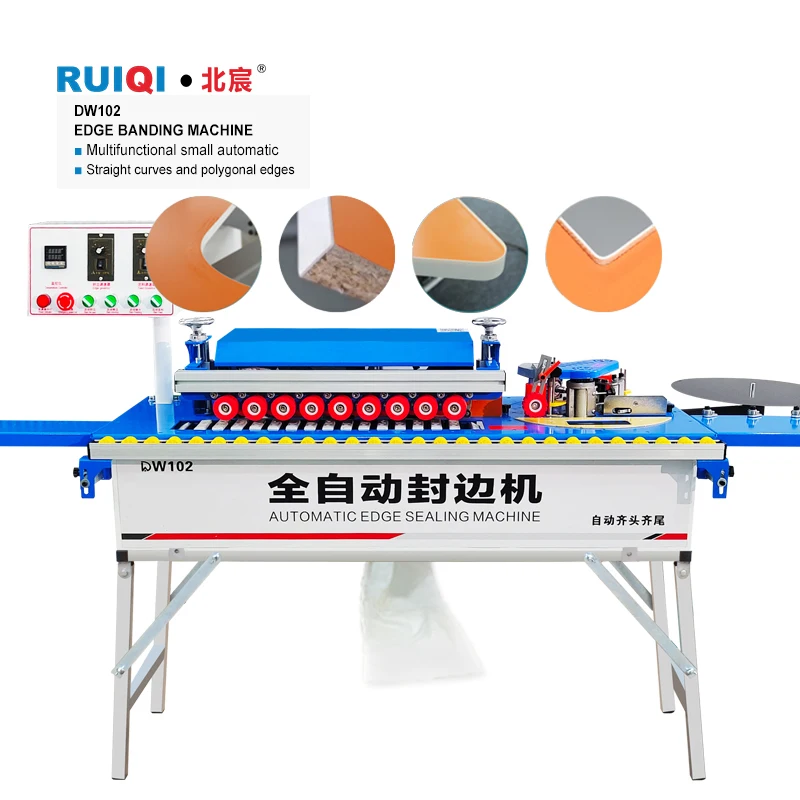
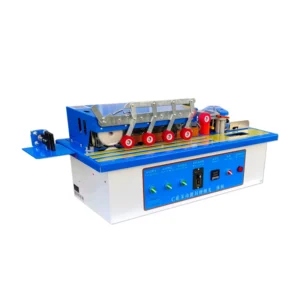
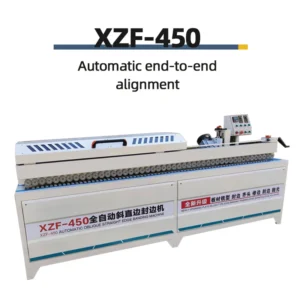
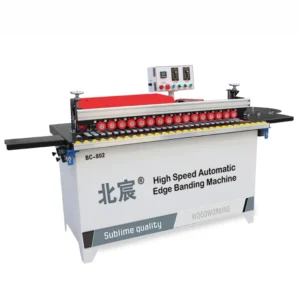
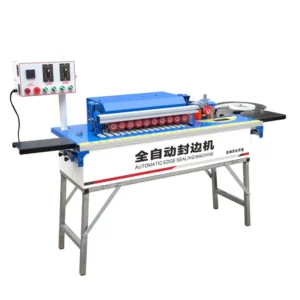
Precision Assembly Line — Every DW102 unit passes through four distinct quality gates before release, with incoming components traced back to their source batch.
Technical Specifications
| Parameter |
Value |
| Model |
DW102 |
| Product Type |
Automatic Edge Banding Machine |
| Total Power |
3800W |
| Voltage Options |
220V / 380V / Custom configuration |
| Glue Pot Capacity |
1000 ml |
| Edge Banding Thickness Range |
0.3–3 mm |
| Edge Banding Height Range |
0–50 mm |
| Minimum Sheet Length |
25 cm |
| Minimum Sheet Width |
5 cm |
| Trimming Motor |
650W × 2 |
| Polishing Motor |
180W × 2 |
| Conveyor Motor |
60W |
| Vacuum Motor |
1200W |
| Air Source Pressure |
0.5–0.8 MPa |
| Machine Dimensions (L×W×H) |
128 × 47 × 69 cm |
| Net Weight |
75 kg |
| Assembly State |
Fully assembled, bench-top format |
| Key Features |
Curved and straight edge banding, edge trimming, polishing, automatic head and tail cutting, vacuum hold-down |
Application Suitability
| Application |
Material or Output |
| Cabinet door panel edging |
MDF, plywood, particleboard with PVC banding |
| Custom furniture component finishing |
Blockboard and solid wood panels up to 50 mm edge height |
| Polymer door production |
Polymer substrates with 0.3–3 mm PVC edge material |
| Small-batch joinery work |
Mixed panel types requiring curved and straight contour banding |
| Workshop-scale edge processing |
Panels as small as 25 cm × 5 cm with automatic head and tail cutting |
Why "Universal Voltage" Should Never Be an Assumption
Confirming your local frequency and phase before production prevents a machine from arriving as dead weight on the dock.
Distributors regularly quote edge banding machines without verifying whether the destination workshop runs on 50Hz or 60Hz, single-phase or three-phase. The DW102 edge banding machine OEM factory configuration allows voltage selection from 220V through 380V with custom winding on request, but this must be locked at order stage. I have watched containers arrive in South America with 380V three-phase motors when the local grid only delivers 220V single-phase — the buyer then faces rewinding or replacing the motor entirely before the machine can run a single board [NEED_CITE: voltage and frequency standards by export market].

Component Traceability from Incoming Inspection to Crate
Every motor, bearing, and pneumatic valve entering the assembly hall passes incoming material inspection before it reaches the DW102 build station. The 650W trimming motors and 180W polishing motors are logged by batch so that if a field issue surfaces months later, the source lot can be identified without pulling apart the entire machine history. This traceability matters most when a distributor is placing repeat orders across seasons and needs consistent behavior from unit to unit.
Private-Label Readiness Without Re-Engineering
The bench-top DW102 platform accepts custom logo placement, color-matched guards, and control panel overlays in the destination market language before the machine leaves the line. An OEM partner specifying Spanish-language HMI labels and CE-marked documentation receives those elements integrated into the build sequence rather than applied as an afterthought. The electrical schematic and plug standard — EU, USA, AU, or UK — are confirmed during the specification review so the machine arrives ready for immediate commissioning [NEED_CITE: CE machinery directive requirements for industrial equipment].
What the Motor Configuration Tells You About Edge Quality
The dual 650W trimming motors provide independent rough and finish trimming stages, which directly affects how cleanly the PVC banding meets the panel face on both MDF and particleboard. On softer substrates like low-density particleboard, insufficient trimming power leaves a visible step at the edge junction that shows through laminate finishes. The 180W × 2 polishing motors then burnish the trimmed edge to remove micro-scratches — a step that becomes critical when the finished panel will be visible in assembled furniture. The 1000 ml glue pot maintains stable adhesive temperature across a production run, preventing the glue viscosity drift that causes white glue lines on melamine-faced boards.
The Cost of Skipping the Sample Run
Ordering a container load based solely on a spec sheet leaves distributors exposed when the actual panel stock in their market behaves differently from the test material. A machine that produces invisible glue lines on standard MDF may show adhesive starvation on high-density particleboard common in certain regions. Without a factory test using the buyer’s own panel samples before shipment, the first indication of trouble comes after the container has been unpacked and the end user has already committed to a production schedule [NEED_CITE: edge banding adhesion failure modes on varying substrate densities].
Why Source This Edge Bander Here
The DW102 is built on a dedicated assembly line where each station has a defined quality checkpoint rather than a single end-of-line inspection. In-house machining of critical components means tolerance claims can be verified on the factory floor rather than taken on trust from a third-party supplier. Voltage and language customization happens during production, not as a post-assembly modification that voids warranties. Pre-shipment testing runs the buyer’s actual panel material through the full banding cycle with video documentation provided per unit. The CE declaration of conformity and ISO 9001 certificate are issued against the specific machine serial number, supporting customs clearance and end-user compliance audits.
Documentation & Verification
- CE declaration of conformity tied to the DW102 serial number for destination-market customs clearance
- ISO 9001 certificate covering the assembly line producing this edge banding machine
- Factory test record showing edge banding results on your specified panel thickness and material
- Electrical schematic with confirmed voltage, phase, and plug type matching your local standard
- Operation and maintenance manual in the agreed language with illustrated spare parts identification
- Packing photographs documenting crate condition and accessory completeness before the container is sealed
Installation, Commissioning & Support
- Bench-top format at 75 kg requires a stable workbench rated for vibration under the 3800W total load
- Dedicated circuit matching confirmed voltage and phase, with isolation switch within reach of the operator
- Fully assembled delivery means no on-site mechanical alignment — connect power and air supply to begin
- Air source must deliver 0.5–0.8 MPa clean dry air to the machine inlet for consistent vacuum hold-down
- First-run parameter setting covers glue pot temperature, feed speed, and trimming depth for your panel stock
- Spare parts list identifies consumable trimmer blades and polishing wheels with reorder part numbers
What to Include with Your Inquiry
Provide the panel materials and thickness range you will process most frequently so the glue pot and trimming setup can be matched before build. Confirm your workshop voltage, phase, and frequency along with the plug standard required at destination. Specify the control panel language and any private-label requirements including logo placement and documentation branding.
Frequently Asked Questions
Q: How deep is the in-house manufacturing on the DW102 — which parts are machined on-site?
A: Critical structural components and the trimming mechanism assemblies are machined and ground in-house to maintain tolerance control. Motors, pneumatic valves, and electrical elements are sourced from named suppliers with batch traceability logged at incoming inspection. This balance keeps precision where it matters while avoiding unnecessary cost on commodity components.
Q: What OEM customization can be applied without delaying the build schedule?
A: Logo placement, guard color, control panel language overlay, plug standard, and documentation branding are all configured during the standard production sequence. Custom voltage windings require additional lead time depending on the specific motor specification requested. Confirming these details at order stage keeps the machine on the normal assembly flow.
Q: Can I audit the production line or request a video before committing to a bulk order?
A: Factory visits are available for distributors evaluating manufacturing depth before placing container-quantity orders. Where travel is impractical, a live video walk-through of the assembly line and a recorded pre-shipment test on your sample panels can be arranged. Both options let you verify build practices before the order enters production.
Q: What documentation ships with each unit for customs and end-user handover?
A: Every DW102 ships with the CE declaration of conformity, ISO 9001 certificate, electrical schematic with confirmed voltage details, operation manual in the agreed language, spare parts list, and packing photographs. These documents support both customs clearance at destination and the compliance file your end user needs for their own audits.
Q: How does lead time differ between standard-spec and OEM-configured units?
A: Standard-spec machines in common voltage and language configurations move through the existing production queue. OEM units requiring custom motor winding, non-standard panel language, or private-label packaging follow a slightly extended schedule to accommodate the additional setup steps. Confirming specifications early locks the build slot.