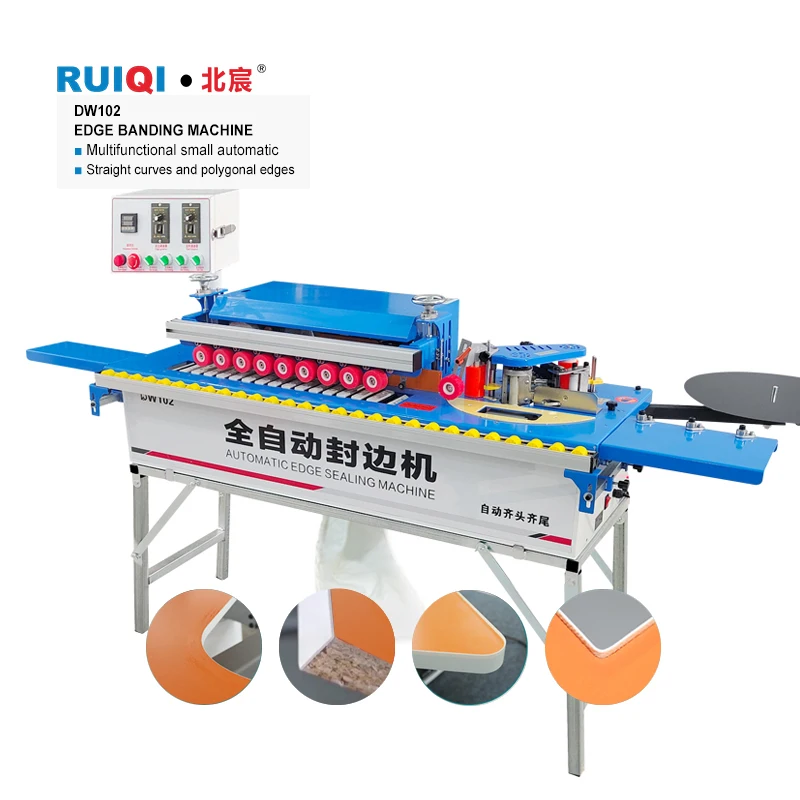
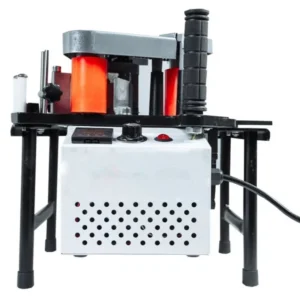
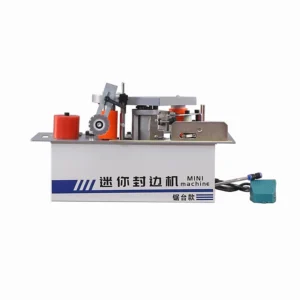
Manufacturing Depth Verified — Every DW102 rolling off the assembly floor carries a buyer-specified voltage and plug configuration tested before crating, not guessed at the dock.
Technical Specifications
| Parameter |
Value |
| Product Type |
Automatic Edge Banding Machine |
| Model |
DW102 |
| Total Power |
3800W |
| Voltage |
220V / 380V / customizable |
| Trimming Power |
650W × 2 |
| Polishing Power |
180W × 2 |
| Edge Power |
20W |
| Transmission Power |
60W |
| Vacuum Power |
1200W |
| Edge Banding Height |
0–50 mm |
| Edge Banding Thickness |
0.3–3 mm |
| Minimum Sheet Length |
25 cm |
| Minimum Sheet Width |
5 cm |
| Glue Pot Capacity |
1000 ml |
| Air Source Pressure |
0.5–0.8 MPa |
| Product Size |
128 × 47 × 69 cm |
| Product Weight |
75 kg |
| Assembly State |
Fully assembled |
| Language Options |
Chinese, English, customizable to Spanish or other languages |
| Plug Options |
EU, USA, AU, UK |
| Key Features |
Curved and straight edge banding, edge trimming, polishing, automatic head and tail cutting, vacuum hold-down |
Application Suitability
| Application |
Material or Output |
| Cabinet panel edge banding |
MDF and particleboard with PVC or veneer tape |
| Furniture component finishing |
Plywood and blockboard with 0.3–3 mm edging |
| Polymer door edge treatment |
Polymer substrates requiring curved and straight trimming |
| Small-batch custom joinery |
Solid wood panels in workshop-scale production |
| Medium-volume furniture runs |
Standard sheet goods for cabinet and wardrobes manufacturing |
Why Voltage Confirmation Must Happen Before the Purchase Order
A 380V machine landed in a 220V-only workshop is dead weight until an electrician rewires the panel or the factory upgrades its supply.
I have watched container loads of woodworking equipment sit idle on the factory floor because the supplier shipped a fixed-voltage unit to a market where the grid runs differently. The buyer assumed the seller would ask; the seller assumed the buyer would specify. For an Edge Banding Machine manufacturer building for export, this conversation should happen at quotation stage, not at the customs warehouse [NEED_CITE: voltage and frequency standards by export market].
The DW102 is configured to buyer-specified voltage and plug type before production begins. Whether the destination workshop runs on 220V single-phase or 380V three-phase, the motor winding, control transformer, and plug are matched to the local grid. This avoids the costly delay of rewiring or replacing components after arrival.

OEM Configuration and Private-Label Build
The DW102 is produced on the same floor where distributor-branded lines are assembled, meaning an Edge Banding Machine manufacturer can apply custom logos, panel graphics, and control panel language without splitting the production run. A distributor stocking equipment for a Spanish-speaking market can specify Spanish interface labels and region-appropriate safety markings in the same purchase order as the hardware.
The machine ships fully assembled at 75 kg, which simplifies rebranding logistics — the distributor receives a ready-to-resell unit rather than coordinating separate labeling and assembly steps at destination. Plug options spanning EU, USA, AU, and UK configurations allow a single stocking decision to cover multiple territories within one sales region.
Precision-Ground Component Assembly
Each DW102 moves through a four-stage quality check covering incoming material inspection, in-process assembly verification, finished product testing, and pre-shipment validation. The trimming stations use matched 650W motors on each side, and the spindle alignment is verified before the guards go on. This matters because uneven trimming motor calibration shows up as visible score lines on the finished edge, especially on melamine-faced MDF where the decorative layer chips easily [NEED_CITE: CE machinery directive requirements for industrial equipment].
The pneumatic system, operating at 0.5–0.8 MPa, drives the head-and-tail cutting and pressure rollers. Inconsistent air pressure causes the banding tape to lift at the panel ends, a defect that only becomes visible after the glue cures. Factory test records confirm each unit holds stable pressure across a full run cycle before packing.
How Core Specs Translate on the Shop Floor
The 0.3–3 mm edge banding thickness range means the DW102 handles thin PVC decorative tape and thicker solid wood veneer without a tooling changeover. A workshop switching between cabinet carcasses in 0.4 mm PVC and visible-end panels in 2 mm veneer simply adjusts the tape guide and trimming depth — no separate machine or station swap is needed.
The 1000 ml glue pot capacity supports continuous operation through a typical batch without mid-run refills. For workshops processing standard 18 mm particleboard, this volume covers a full morning shift of panel edging before the operator needs to top up the adhesive reservoir. The glue temperature must be matched to the banding material: PVC tapes generally bond well at standard EVA temperatures, while thicker veneer edges may require a higher melt point for adequate penetration.
The 25 cm minimum sheet length and 5 cm minimum width allow the DW102 to handle small offcuts and narrow drawer-side stock that larger automated lines cannot grip reliably. This is where a compact edge banding machine earns its place alongside a full-size production unit — handling the short-run and small-part work that would otherwise be done by hand.
The Hidden Cost of Skipping Configuration Alignment
When a buyer orders an edge bander without specifying the actual panel density they run daily, the machine may feed and trim correctly on standard particleboard but struggle on high-density MDF. The trimming motors work harder, the glue adhesion drops, and the operator spends time compensating rather than producing. I have seen workshops blame the machine when the real mismatch was in the material specification at order stage [NEED_CITE: MDF density variation and its effect on edge banding adhesion].
Equally, a workshop that neglects to confirm air supply capacity will find the pneumatic actuators cycling sluggishly. The head-and-tail cutter fires late, leaving overhang that the operator must scrape by hand — defeating the purpose of automatic trimming. The DW102 requires a stable 0.5–0.8 MPa supply; if the workshop compressor cannot sustain that across multiple machines running simultaneously, the fault will look mechanical when it is actually pneumatic starvation.
Why Procurement Teams Source This Model Here
The DW102 is built in-house rather than assembled from outsourced sub-assemblies, which means an Edge Banding Machine manufacturer controls the grinding tolerances on the trimming spindles and the pressure roller alignment from raw casting to final test. Distributors evaluating manufacturing depth can verify this on a factory visit rather than relying on catalog claims.
Voltage, plug, language, and logo customization are standard line items, not special orders requiring minimum quantities. A regional distributor ordering a mixed batch of entry-level and full-function models can specify different branding and interface languages per unit within the same shipment.
The four-stage QC process generates a factory test record specific to each machine serial number, documenting trim quality, pneumatic response, and glue feed consistency before crating. This record ships with the unit, giving the buyer a baseline for comparison when the machine is powered up on-site.
Documentation & Verification
- CE declaration of conformity matching the DW102 model designation
- ISO 9001 certificate covering the manufacturing process for this unit
- Electrical schematic confirming buyer-specified voltage and wiring layout
- Factory test record on your panel thickness range before dispatch
- Operation and maintenance manual in your chosen language
- Spare parts list with part numbers matching the as-built configuration
Installation, Commissioning & Support
- Requires a dedicated circuit matching the specified 220V or 380V supply
- Air compressor must sustain 0.5–0.8 MPa at the machine inlet
- Ships fully assembled at 75 kg — position and connect utilities on arrival
- First-run calibration of trimming depth and glue temperature on your actual panels
- Operator training covers tape loading, tension adjustment, and daily maintenance
- Spare trimming cutters and polishing wheels included for initial wear replacement
Moving to a Formal Quotation
To receive a configuration-specific proposal for the DW102, share the panel materials and thicknesses you run most often, your workshop voltage and frequency, and the control panel language your operators need. If you are evaluating this model for a regional stocking plan, indicate the plug types and branding requirements for each destination market so the quotation reflects the correct build configuration.
Frequently Asked Questions
Q: What OEM and private-label customization is available for the DW102?
A: The DW102 supports custom logos on the machine body, private-label packaging, and control panel language configuration beyond the standard Chinese and English options. Distributors can specify region-specific safety markings and branding elements within the same production run. Each unit receives matching documentation reflecting the chosen brand identity and language.
Q: How is voltage and frequency confirmed before production to avoid arrival issues?
A: During the quotation stage, the buyer confirms local voltage, frequency, and plug type. The DW102 is then built with matched motor windings, control transformer, and plug configuration for that specific market. An electrical schematic and voltage confirmation document are provided before shipment so the buyer can verify the build matches their workshop supply.
Q: Can the control panel language be customized beyond Chinese and English?
A: Yes. The control interface can be configured to Spanish or other languages based on the buyer’s operator requirements. This customization is specified at order stage and applied during assembly, so the machine arrives with the correct language already loaded — no aftermarket reprogramming or overlay labels needed on the shop floor.
Q: What does the four-stage QC process cover before shipment?
A: Incoming material inspection verifies casting and component quality. In-process checks confirm trimming spindle alignment and pneumatic assembly. Finished product testing runs the DW102 through a full edge banding cycle on sample panels. Pre-shipment verification documents trim finish, glue feed consistency, and electrical safety, producing a factory test record that ships with the machine.
Q: Is sample testing or factory visit available before bulk order commitment?
A: Buyers are welcome to visit the production floor to inspect assembly processes and verify manufacturing depth. Sample processing tests can be arranged using the buyer’s own panel materials, allowing direct evaluation of edge finish quality on the actual substrates the machine will handle in daily production.