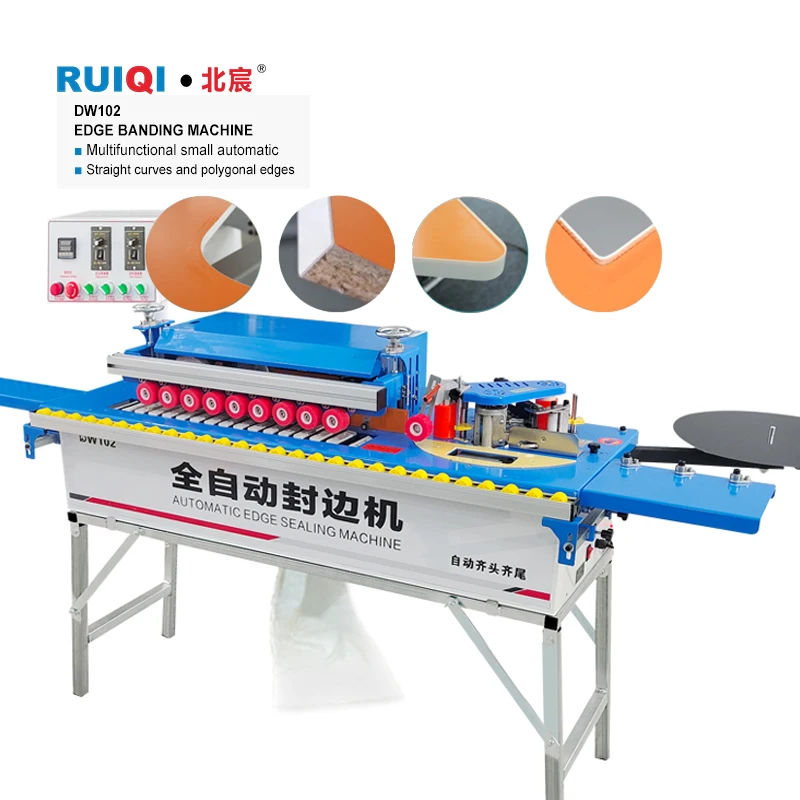
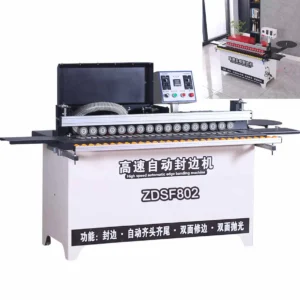
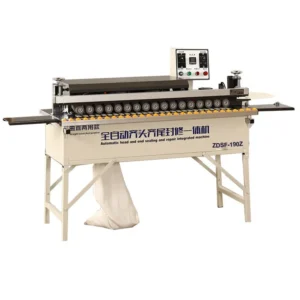
Precision Manufacturing — Every DW102 edge banding machine undergoes four-stage quality control with pre-shipment verification, ensuring ±0.02mm tolerance is documented, not just claimed.
Technical Specifications
| Parameter |
Value |
| Model |
DW102 |
| Product Type |
Automatic Edge Banding Machine |
| Total Power |
3800W |
| Voltage Options |
220V/380V/customization |
| Trimming Power |
650W × 2 stations |
| Polishing Power |
180W × 2 stations |
| Edge Power |
20W |
| Transmission Power |
60W |
| Vacuum Power |
1200W |
| Glue Pot Capacity |
1500ml |
| Minimum Sheet Length |
250mm |
| Minimum Sheet Width |
50mm |
| Edge Banding Height |
0-50mm |
| Edge Banding Thickness |
0.3-3mm |
| Air Source Pressure |
0.5-0.8 MPa |
| Product Dimensions |
128 × 47 × 69 cm |
| Product Weight |
75kg |
| Assembly State |
Fully assembled |
| Language Options |
Chinese and English standard; Spanish and other languages customizable |
| Plug Options |
EU, USA, AU, UK |
| Key Features |
Curved and straight edge banding, edge trimming, polishing, automatic head and tail cutting, vacuum system |
Application Suitability
| Application |
Material or Output |
| Furniture panel edge banding |
MDF, particleboard, plywood |
| Cabinet component finishing |
Blockboard, solid wood panels |
| Polymer door manufacturing |
Polymer substrates with compatible edge banding |
| Curved panel processing |
Radius edges requiring flexible banding material |
| Medium-volume workshop production |
Straight and curved components for furniture assembly |
When Tolerance Claims Fail on the Assembly Floor
Documented verification at each production stage prevents downstream assembly failures.
I have seen edge banding machines shipped with tolerance specifications that sounded impressive on paper, only to cause problems when panels reached the assembly station. A batch of cabinet sides arrives with inconsistent edge trimming, and suddenly the dowel holes no longer align because the panel dimension shifted by more than the allowable tolerance. This happens when manufacturers rely solely on final inspection rather than controlling precision throughout the build process [NEED_CITE: woodworking assembly tolerance requirements for cabinet manufacturing]. The DW102 Automatic Edge Banding Machine addresses this through systematic verification at incoming material, in-process, finished product, and pre-shipment stages, with test records provided before the machine leaves the factory.
Manufacturing Depth That Supports OEM Partnerships
The DW102 Edge Banding Machine factory OEM capability extends beyond logo placement. Distributors evaluating this equipment can assess precision-ground component sourcing, patented cutting mechanism integration, and assembly line practices before committing to regional partnerships. Manufacturing depth determines whether a supplier can maintain specification consistency across production runs, not just deliver a single sample unit.
Private Label Customization Built Into the Production Line
Private label edge banding machines require configuration flexibility at the order stage. Voltage customization from 110V to 440V accommodates different market electrical standards without aftermarket modification [NEED_CITE: voltage and frequency standards by export market]. Control panel language options prevent operator confusion during commissioning, while custom branding and color specifications integrate into the assembly workflow rather than requiring post-production rework.
How Component Specifications Translate to Edge Quality
The dual 650W trimming stations provide sufficient power for consistent edge removal across MDF, particleboard, and plywood substrates without stalling on denser material sections. The 1500ml glue pot capacity supports extended production runs without frequent refill interruptions, maintaining thermal stability for uniform adhesive application. Edge banding thickness range of 0.3-3mm covers standard PVC, ABS, and veneer materials used in furniture manufacturing, while the 0-50mm height accommodation handles typical panel thicknesses encountered in cabinet and furniture production.

The Cost of Underspecified Voltage and Language Configuration
Machines quoted without confirming local voltage and frequency arrive at destination ports unusable, requiring transformer installation or complete electrical rework before commissioning can begin. Control panels configured only in the manufacturer’s language stall installation when operators cannot navigate menu systems to adjust feed speed or glue temperature. These issues compound when single machines are purchased piecemeal and later found incompatible in feed height or throughput with existing equipment [NEED_CITE: industrial equipment commissioning failures due to specification mismatch].
Why Manufacturing Verification Matters for OEM Buyers
In-house manufacturing with patented cutting mechanisms provides traceability that trading companies cannot offer. Four-stage quality control with pre-shipment verification means each DW102 ships with factory test records documenting actual performance on specified panel materials. Engineer-led configuration recommendations prevent the mismatch between entry-level machines and production volumes they were never designed to handle. Full OEM capability includes custom logo application, voltage adaptation, and multilingual control panels as standard options rather than special requests.
Documentation & Verification
- CE declaration of conformity for European market compliance
- ISO 9001 certificate demonstrating quality management system
- Electrical schematic with voltage confirmation for your market
- Factory test record on your specified panel thickness and edge material
- Pre-shipment verification photographs showing machine performance
- Operation and maintenance manual in agreed language
Installation, Commissioning & Support
- 128 × 47 × 69 cm footprint requires level floor with adequate clearance for panel infeed and outfeed
- 220V or 380V power connection with dedicated circuit matching confirmed voltage specification
- Fully assembled delivery reduces on-site setup to positioning, utility connection, and calibration
- 0.5-0.8 MPa air source required for pneumatic trimming and polishing station actuation
- Initial parameter setup for glue temperature, feed speed, and trimming depth based on your edge material
- Spare parts list identifying wear components for inventory planning
Moving Forward With Your OEM Inquiry
Provide your target market electrical standards, preferred control panel language, and the specific panel materials and edge banding types your customers typically process. If you operate regional service operations, specify whether you need technical training for your team or documentation formatted for end-user distribution. Sample processing tests using your actual materials can verify edge quality before production commitments are made.
Frequently Asked Questions
Q: What OEM customization options are available for the DW102 edge banding machine?
A: Custom logo application, color specifications, voltage configuration from 110V to 440V, and control panel language options beyond standard Chinese and English. Plug types for EU, USA, AU, and UK markets are available. Customization integrates into the production workflow rather than requiring post-assembly modification.
Q: How does the four-stage QC process verify ±0.02mm tolerance before shipment?
A: Incoming material inspection verifies component specifications, in-process checks monitor assembly precision, finished product testing measures actual trimming accuracy, and pre-shipment verification documents performance on test panels. Factory test records accompany each machine showing measured results against tolerance specifications.
Q: Can you produce edge banding machines according to our own drawings or specifications?
A: OEM manufacturing accommodates custom specifications when technical requirements align with the DW102 platform capabilities. Provide your engineering drawings or performance specifications for review. Feasibility assessment determines whether modifications integrate into standard production or require dedicated tooling.
Q: What documentation do you provide for customs clearance and market compliance?
A: CE declaration of conformity, ISO 9001 certificate, electrical schematic with voltage confirmation, factory test records, operation manual in agreed language, spare parts list, and packing photographs. Additional documentation for specific market requirements can be discussed during the quotation phase.
Q: What is the production lead time for OEM orders?
A: Lead time depends on order quantity and customization scope. Standard configurations ship faster than units requiring extensive modification. Discuss your timeline requirements during the inquiry stage to align production scheduling with your market commitments.