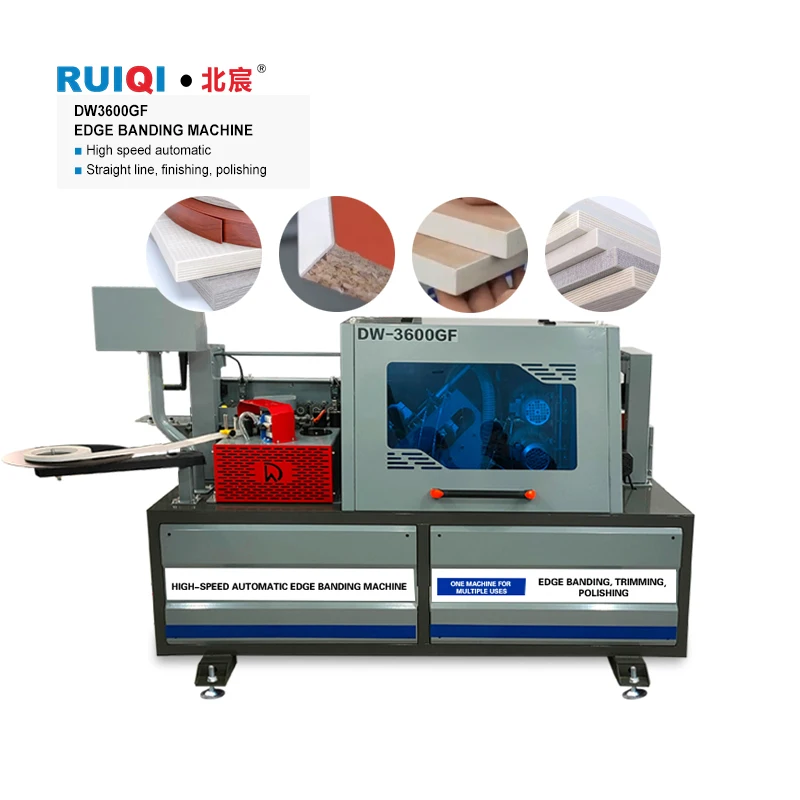
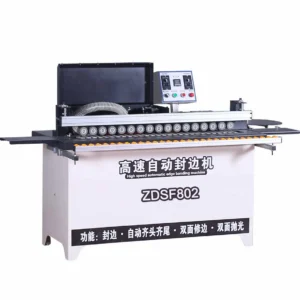
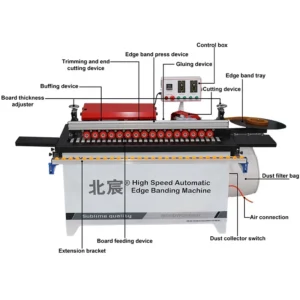
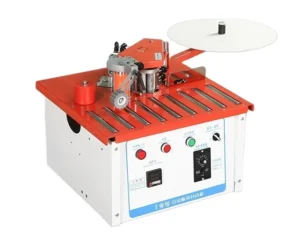
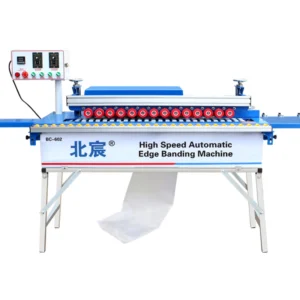
Precision Ground In-House — Every DW-3600GF unit passes through four-stage QC with documented factory test records before crating, ensuring verifiable tolerance for OEM partners.
Technical Specifications
| Parameter |
Value |
| Model |
DW-3600GF |
| Product Type |
Automatic PVC Edge Banding Machine with Pre-milling |
| Voltage & Frequency |
380V Three-Phase Four-Wire (50Hz/60Hz configurable) |
| Total Power |
4.9kW |
| Overall Dimensions (L×W×H) |
2200×650×1250mm |
| Net Weight |
320kg |
| Edge Band Height Range |
0–50mm |
| Edge Band Thickness Range |
0.3–3mm |
| Minimum Plate Length |
200mm |
| Feed Speed |
0–14m/min |
| Air Supply Requirement |
0.4–0.6 MPa |
| Trimming Motor Power |
800W×2 at 24000 r/min |
| Polishing Motor Power |
400W×2 |
| Edge Banding Motor Power |
160W |
| Transmission Motor Power |
180W |
| Standard Functions |
Gluing, Trimming, Front and Rear Trimming, Scraping, Polishing, Vacuuming |
| Language Options |
Chinese, English (additional languages customizable) |
Application Suitability
| Application |
Material or Output |
| Furniture panel edge banding |
MDF and particleboard for custom cabinet production |
| Plywood edge gluing |
Plywood sheets for carpentry and joinery projects |
| PVC edge banding application |
PVC strips for straight-edge panel processing in workshops |
Why the Voltage Question Should Come Before the Price on an Edge Banding Machine OEM factory Order
Confirming local voltage and frequency at the quotation stage prevents the machine from sitting idle on arrival.
I remember a shipment of automatic PVC edge banding machines destined for South America a few years back. The buyer confirmed 220V/60Hz locally, but the paperwork only stated "standard voltage," and the units left the floor wired for 380V. When the containers opened on-site, nothing powered up. The entire line stalled for nearly three weeks while electrical retrofits were arranged [NEED_CITE: voltage and frequency standards by export market]. That delay cost the distributor far more than the machines themselves. When evaluating an Edge Banding Machine OEM factory, the electrical specification is not a footnote; it is the first checkpoint that separates a working machine from a very expensive crate of steel.

How Four-Stage QC Builds Distributor Confidence
An Edge Banding Machine OEM factory that controls its own precision grinding and assembly can document every tolerance claim. The DW-3600GF goes through incoming material inspection, in-process checks during sub-assembly, finished product verification, and a final pre-shipment run using actual panel stock. Each stage generates a record that ships with the crate. For a regional distributor, this means your service team can trace any field issue back to a specific build step rather than guessing.
Private-Label Capability Without Compromising Build Integrity
OEM partners often worry that branding changes might come at the expense of core components. Here, custom logo application, control panel language selection, and voltage adaptation from 110V to 440V are handled as standard configuration options, not afterthoughts. The internal cutting mechanisms and drive assemblies remain identical across all branded variants [NEED_CITE: CE machinery directive requirements for industrial equipment]. This keeps your warranty claims predictable and your spare parts inventory unified across different market SKUs.
Decoding the Numbers That Matter on the Shop Floor
The trimming motors rated at 800W each running at 24000 r/min are the heart of edge quality. That spindle speed allows clean shearing of PVC banding up to 3mm thick without chipping or leaving visible witness lines on the substrate edge. Feed speed adjustability from 0 to 14m/min lets operators slow down for delicate veneer work or push through MDF runs at full pace. The 0.4–0.6 MPa air supply requirement is modest; most workshops with an existing compressor network can feed this machine without adding a dedicated unit. Straight edge banding across the 0–50mm height range covers the majority of cabinet door and shelving profiles encountered in small to mid-size production.
The Hidden Cost of Skipping Pre-Shipment Verification
When a machine arrives with an unconfirmed control panel language, the commissioning technician cannot navigate the menus. When tolerance is claimed but never measured against a test panel, the first sign of trouble appears during furniture assembly, where edges do not meet flush. These are not manufacturing defects in the traditional sense; they are specification gaps that could have been closed with a proper pre-shipment check [NEED_CITE: international machinery acceptance standards]. For a distributor holding inventory for regional customers, one unverified unit can erode trust across an entire territory.
Why Source the DW-3600GF From This Edge Banding Machine OEM factory
In-house manufacturing with proprietary cutting mechanisms means the factory holds the patents and the tooling, not a third-party integrator. Full product range from entry-level to full-function models allows a distributor to cover a regional market with one supplier relationship rather than juggling multiple factories. Voltage and language customization are treated as order-line items, not special requests requiring engineering surcharges. Four-stage QC with documented pre-shipment verification gives your import documentation the traceability that customs and end-users increasingly demand. Engineer-led configuration means the quotation you receive within 24 hours reflects the buyer’s actual production requirement, not a generic catalog price.
Documentation & Verification
- CE declaration of conformity matching the DW-3600GF configuration as shipped
- ISO 9001 certificate available for third-party audit verification
- Factory test record showing measured tolerance on your specified panel material
- Electrical schematic with confirmed voltage and wiring diagram for local electricians
- Operation and maintenance manual translated into the agreed operator language
- Spare parts list with part numbers matching the as-built configuration
Installation, Commissioning & Support
- Requires a level concrete floor capable of supporting 320kg static load across the 2200×650mm footprint
- Dedicated three-phase circuit matching the confirmed 380V or custom voltage specification
- Arrives fully assembled; connect compressed air at 0.4–0.6 MPa and power before first run
- Initial calibration of trimming motors at 24000 r/min verified against sample panel stock
- Operator training covers feed speed adjustment from 0 to 14m/min for different banding thicknesses
- Polishing and scraping stations require periodic consumable replacement per the included spare parts list
What We Need to Prepare Your Quotation
To configure the DW-3600GF for your market, please share the local voltage and frequency, the primary panel materials you process (MDF, plywood, or particleboard), and the edge banding type and thickness range your customers demand. If you plan to private-label, specify logo placement, color preferences, and the control panel language required by your end-users. Let us know your target order quantity so we can align production scheduling and pre-shipment inspection windows accordingly.
Frequently Asked Questions
Q: What OEM customization scope is available for the DW-3600GF?
A: Custom logo placement, machine color, voltage configuration from 110V to 440V, control panel language, and specification modifications such as feed speed range or motor sizing are all available. Each customization is documented on the order confirmation and reflected in the as-built test record that ships with the unit.
Q: How is the four-stage QC process documented for each machine?
A: Every DW-3600GF receives incoming material inspection, in-process sub-assembly checks, finished product verification, and a pre-shipment functional run. The resulting test record includes measured tolerance on sample panels and is packed with the machine for your records and end-user handover.
Q: Can the factory adapt the DW-3600GF to buyer-supplied drawings or regional requirements?
A: Yes. The engineering team reviews buyer-supplied drawings or adapts the existing model to meet regional voltage, safety, or labeling standards. A formal configuration proposal is issued before production begins, ensuring the adapted unit remains within the verified performance envelope.
Q: What spare part backup and training are provided to distributor service teams?
A: A spare parts list matching the as-built configuration ships with every unit. Distributor service teams receive technical documentation covering trimming motor replacement, polishing station maintenance, and electrical troubleshooting based on the confirmed voltage schematic.