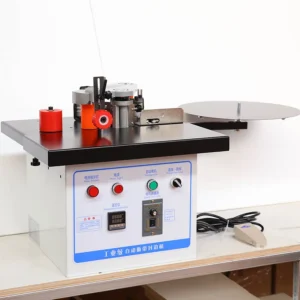
Precision Manufacturing Depth — Every portable edge bander leaves our Ningjin facility with verified tolerance, documented voltage confirmation, and full OEM capability before the motor is even bolted down.
Technical Specifications
| Parameter |
Value |
| Product Type |
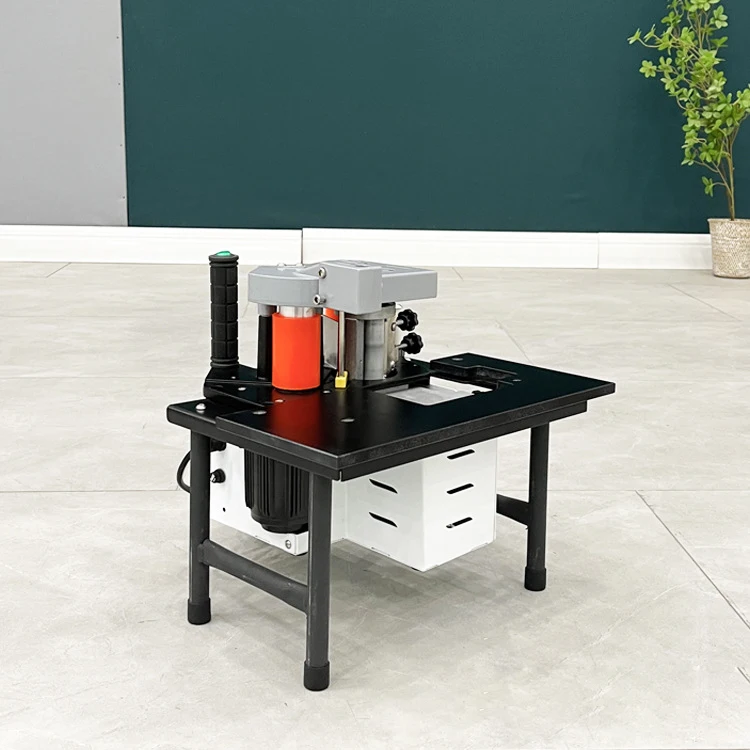
Portable Edge Banding Machine |
| Shape of Edge-banding Plates |
Curved, Straight and Special-shaped Sheet |
| Edge Thickness |
0.3–3mm |
| Edge Sealing Speed |
0–6m/min (source value — verify against manufacturer catalog) |
| Edge Sealing Height |
7–60mm |
| Gluing Method |
Double-sided gluing |
| Glue Pot Volume |
1000ml |
| Machine Weight |
14kg |
| Assembly State |
Portable / Handheld |
| Plug Options |
EU / AU / UK / USA / CN |
| Customization |
Logo and private label available |
| Certification |
CE, ISO 9001 |
Application Suitability
| Application |
Material or Output |
| Small-scale furniture workshop edge finishing |
MDF, plywood, particleboard panels |
| On-site cabinet installation edge sealing |
Curved and straight solid wood components |
| Joinery prototyping and short-run production |
PVC and veneer edge banding materials |
| OEM distributor regional stock for resale |
Packaged portable units with private label |
Why the Voltage Question Should Come Before the Price
A portable edge banding machine that cannot run on your local supply is a 14kg paperweight sitting in a crate.
I once shipped a curve trim bander to a small cabinet shop without double-checking their 220V single-phase supply. Our standard wiring at the time was three-phase. That machine sat unopened for weeks while we scrambled to source a converter locally. The buyer lost commissioning time, I lost credibility, and the lesson burned itself in. Now, on every Portable Edge Banding Machine factory OEM order we process, voltage and frequency confirmation happens before the motor gets mounted [NEED_CITE: voltage and frequency standards by export market]. The plug type, phase configuration, and local supply frequency are documented on the electrical schematic and signed off before production begins.
In-House Build With Full Manufacturing Control
Our Ningjin workshop produces each portable edge banding machine from precision-ground components through a four-stage QC sequence — incoming material inspection, in-process checks, finished product verification, and pre-shipment testing. The double-sided gluing system is assembled and pressure-tested on our floor, not outsourced. When a distributor places an OEM order for private-label units, the manufacturing depth remains identical; only the branding changes. This is the difference between a trading company relabeling stock and a factory that owns the production line end to end.
OEM and Private Label Configuration
Distributors sourcing a Portable Edge Banding Machine factory OEM partner need more than a logo swap. We configure plug types across EU, AU, UK, USA, and CN standards, match voltage from 110V to 440V, and supply control labeling in the buyer’s required language [NEED_CITE: CE machinery directive requirements for industrial equipment]. Packaging, documentation, and spare parts kits are built to the distributor’s specification so that regional customers receive a product that looks and reads as a local brand. Single-unit sample orders through to container-load production runs follow the same QC protocol.
Reading the Spec Sheet Against Real Workshop Conditions
The 0.3–3mm edge thickness range covers most PVC and veneer banding stock used in cabinet and furniture work, but the practical implication is that switching between thin veneer for visible faces and thicker PVC for shelving edges requires no machine change — just a different coil. The 7–60mm sealing height accommodates standard panel thicknesses from thin drawer bottoms up to heavy shelf boards. Double-sided gluing at a 1000ml pot volume means the adhesive coverage stays consistent through a typical production run without constant refilling, which matters when an operator is working through a batch of curved chair components where stopping to top up glue breaks the rhythm and risks uneven adhesion on the next piece.

The Cost of Skipping Pre-Shipment Electrical Verification
When a portable edge bander arrives with the wrong phase configuration or an incompatible plug, the consequences cascade beyond the machine itself. The workshop electrician gets pulled off other work to jury-rig a solution. Commissioning delays push back the entire production schedule. In some markets, running equipment on mismatched voltage voids the local insurance coverage if a fault occurs [NEED_CITE: CE machinery directive requirements for industrial equipment]. The fix is not expensive — it is a conversation and a documented confirmation before production starts — but the cost of skipping it is always larger than anyone expects.
Manufacturing Accountability You Can Trace
Every Portable Edge Banding Machine factory OEM order is backed by verifiable production steps rather than marketing claims. Our four-stage QC covers incoming material through pre-shipment photography. Patented cutting mechanisms are built in-house, not sourced from a third-party catalog. Voltage and plug specifications are confirmed in writing before assembly begins. Factory visits are welcomed — you can walk the floor, watch the precision grinding on components, and run your own panel samples through a test unit before committing to a production order.
Documentation & Verification
- Factory test record on your specified edge thickness and panel material before dispatch
- Electrical schematic confirming voltage, phase, frequency, and plug type for your market
- Operation and maintenance manual supplied in your agreed language
- CE declaration of conformity and ISO 9001 certificate included with every shipment
- Pre-shipment inspection photographs showing your unit running under test conditions
- Spare parts list matched to your unit’s specific configuration
Installation, Commissioning & Support
- Confirm single-phase or three-phase supply matches your ordered voltage before uncrating
- 14kg weight requires no special foundation — place on any stable workbench
- 1000ml glue pot needs initial fill and temperature stabilization before first run
- Verify correct plug type and circuit breaker rating against the supplied electrical schematic
- Test on scrap panels of your actual material to confirm edge adhesion and trim quality
- Replacement glue pots and cutting blades stocked for distributor spare parts programs
What We Need to Configure Your Order
To match a portable edge bander to your workshop or distribution market, share your local voltage and frequency, the plug standard required, and the primary panel materials and edge banding types your customers use. If you are a distributor evaluating OEM options, let us know your branding requirements, documentation language, and target order volume so we can prepare a production proposal with lead timing.
Frequently Asked Questions
Q: How is local voltage and plug type confirmed before manufacturing?
A: We request your supply voltage, phase, frequency, and plug standard at the inquiry stage. An electrical schematic documenting these values is sent for your approval before the motor is mounted. This eliminates the risk of receiving a machine wired for a different market. The confirmation is recorded in the factory test documentation that ships with your unit.
Q: What OEM customization is available for distributors?
A: Logo placement, private-label packaging, and custom documentation language are standard OEM options. Plug types are configurable across EU, AU, UK, USA, and CN standards, and voltage is matched from 110V to 440V. Each unit still goes through the same four-stage QC process regardless of branding. We work with distributors from single sample units up to full container production runs.
Q: How does the four-stage QC process verify each portable unit before shipment?
A: Incoming materials are inspected first, followed by in-process checks during assembly. The finished unit is tested under running conditions with your specified edge thickness and panel type. Pre-shipment verification includes photographic documentation of your specific machine operating under test. Any deviation found at any stage triggers correction before the next stage begins.
Q: Can I visit the factory to inspect production and run sample tests?
A: Factory visits are welcomed at our Ningjin facility. You can observe the precision grinding process, review the four-stage QC stations, and run your own panel and edge banding samples through a test unit. Sample testing confirms edge adhesion quality, trim accuracy, and gluing consistency on your actual materials before you commit to a production order.
Q: What spare parts and technical support are provided for distributors?
A: Each order ships with a spare parts list matched to the unit’s configuration, covering wear items like cutting blades and glue pot components. Distributors receive technical documentation and can arrange training for their local service teams. Ongoing parts supply is maintained through our manufacturing facility to support regional after-sales commitments.