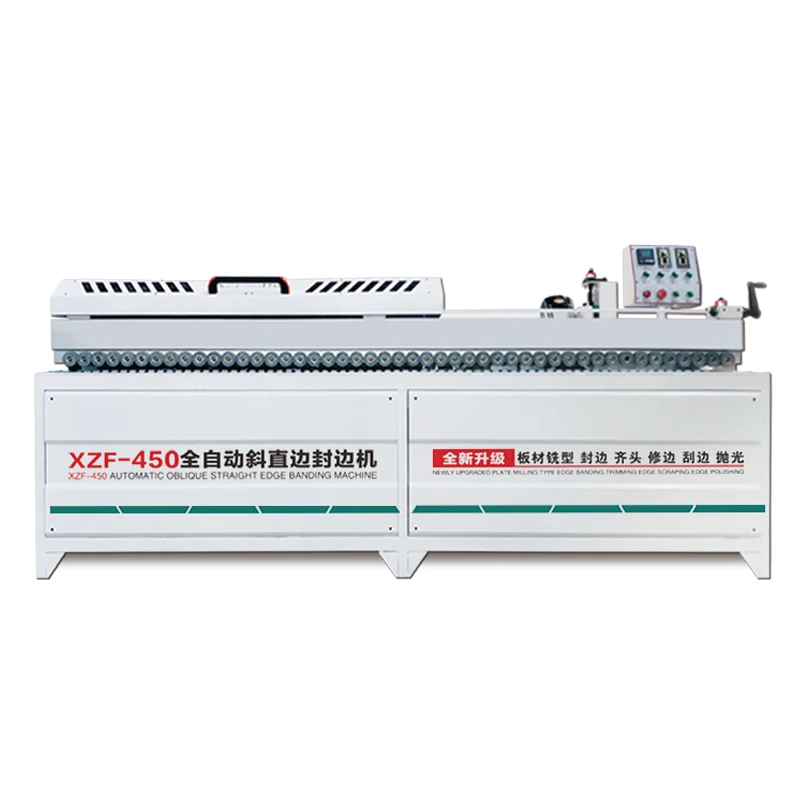
Precision-ground assembly — every XZF-450 edge banding machine undergoes four-stage verification before crating, with pre-milling spindle runout checked against a 0.02mm tolerance threshold on the factory floor.
Technical Specifications
| Parameter |
Value |
| Model |
XZF-450 |
| Product Type |
Full-Automatic Edge Banding Machine with Pre-milling |
| Total Power |
9.5 kW |
| Voltage |
380V / 415V (configurable to other standards) |
| Pre-milling Motor |
4 kW |
| Feed Speed |
0–12 m/min |
| Edge Banding Thickness |
0.3–3 mm |
| Edge Banding Height |
0–50 mm |
| Minimum Sheet Length |
30 cm |
| Minimum Sheet Width |
15 cm |
| Trimming Power |
2.2 kW × 2 |
| Polishing Power |
0.4 kW × 2 |
| Vacuum Power |
550 W |
| Glue Pot Capacity |
4000 ml |
| Air Source Pressure |
0.5–0.7 MPa |
| Transmission Power |
180 W |
| Machine Dimensions |
300 × 65 × 135 cm |
| Machine Weight |
430 kg |
| Control Panel Language |
Chinese, English (customizable to Spanish or other languages) |
| Plug Standard |
EU, USA, AU, UK options |
Application Suitability
| Application |
Material or Output |
| Cabinet door edge finishing |
MDF and melamine-faced particleboard with PVC strip |
| Custom furniture panel banding |
Plywood and blockboard with veneer or melamine edge |
| Polymer door profile wrapping |
Polymer composite profiles at 30°, 45°, or 60° bevels |
| Wardrobe and shelving production |
Particleboard panels with 0.3–3 mm ABS or PVC edging |
| Small-batch joinery components |
Solid wood boards requiring pre-milling before gluing |
Why Voltage Confirmation Must Precede the Purchase Order
An edge banding machine OEM factory ships only after matching the motor winding and control transformer to the buyer’s grid specification.
I once watched a distributor in Southeast Asia take delivery of a bander wired for 380V/50Hz, only to discover the local industrial supply ran at 440V/60Hz. The pre-milling motor overheated within the first shift, and the glue pot thermostat drifted far enough to scorch the adhesive. The downtime cost the workshop an entire production run before anyone traced the fault back to the nameplate. When you source an Edge banding machine OEM factory, confirming voltage and frequency in writing before production begins is non-negotiable [NEED_CITE: voltage and frequency standards by export market].
OEM Scope and Private-Label Configuration
An Edge banding machine OEM factory engagement begins with a configuration sheet that covers more than a logo swap. The XZF-450 allows brand placement on the machine body, custom color for the enclosure panels, and private-label packaging built to the distributor’s shipping spec. Control panel language is set at the HMI level so the operator sees menus and fault codes in a familiar language from the first power-on, eliminating the commissioning delays that occur when a Spanish-speaking technician faces a Chinese-only interface.
Assembly Depth and Component Traceability
Distributors evaluating manufacturing depth need to see where precision is built into the frame, not just declared on paper. The XZF-450 pre-milling station uses a 4 kW motor mounted on a machined baseplate, and the spindle assembly is ground in-house to hold runout within tolerance. The seven-function working group — pre-milling, gluing, end trimming, rough trimming, fine trimming, scraping, and polishing — is assembled on a single bed so that each station’s reference datum carries through the entire pass [NEED_CITE: CE machinery directive requirements for industrial equipment]. This matters when a distributor needs to audit the production floor and trace a component batch back to its incoming inspection record.
How Feed Speed and Pre-milling Interact on the Shop Floor
The 0–12 m/min variable feed on the XZF-450 is not a single optimal number; it shifts depending on the substrate and the edge strip being applied. Running 3 mm PVC at the upper end of the speed range requires the 4 kW pre-milling station to remove a consistent chip load from the panel edge, ensuring the glue film bonds to a clean, square surface rather than a torn fiber edge. The 4000 ml glue pot holds enough adhesive for extended runs without frequent refills, and its temperature stability directly affects bond quality on melamine-faced boards where the surface resin can reject cooler glue. Meanwhile, the dual 2.2 kW trimming motors handle the end-cut and flush-trim passes, and the scraping station removes the slight rounding left by the trimming knives so the polishing wheels produce a uniform finish rather than chasing surface irregularities.

What Happens When Specifications Are Assumed Instead of Confirmed
A distributor who assumes the standard configuration fits every market will eventually face a customer claim. Panels arrive with visible glue lines on plywood edges because the pre-milling depth was never adjusted for the substrate. Operators bypass safety interlocks they cannot read, leading to inconsistent feed pressure. The vacuum hood, rated at 550 W, pulls adequately at the factory’s altitude but underperforms in a coastal workshop where humid air carries heavier dust loads, leaving trimming debris embedded in the fresh glue [NEED_CITE: industrial dust extraction requirements for woodworking machinery]. These failures rarely show up in a single-machine trial; they surface after a batch order is in the field and the distributor’s reputation is on the line.
Why Distributors Source This Edge Banding Machine OEM Factory
In-house grinding of the pre-milling spindle baseplate means the tolerance is held at the component level, not achieved through selective assembly. The four-stage QC sequence — incoming material, in-process, finished product, and pre-shipment — generates a traceable record for every unit that leaves the floor. Voltage and frequency are confirmed against the destination grid before the control transformer is wound, so the machine powers on correctly at arrival. Custom control panel language is flashed at the HMI, not stickered over after the fact. OEM partners receive logo placement, enclosure color, and packaging built to their own brand guidelines, with the engineering team providing a formal configuration quotation within one working day of receiving the spec sheet.
Documentation & Verification
- CE declaration of conformity covering the XZF-450 pre-milling and trimming stations
- ISO 9001 certificate linked to the four-stage QC protocol for this production line
- Electrical schematic showing confirmed voltage, frequency, and breaker sizing for your grid
- Factory test record running your specified panel thickness and edge strip material before dispatch
- Operation and maintenance manual written in the language agreed at order confirmation
- Spare parts list with OEM part numbers matching your private-label documentation
Installation, Commissioning & Support
- Requires a level concrete floor with anchor points matching the 300 × 65 cm footprint
- Dedicated 380V/415V three-phase circuit with breaker sized for the 9.5 kW total draw
- Ships as a single assembly; the 430 kg weight requires forklift access at receiving
- First-run calibration of the 4 kW pre-milling spindle against your actual panel stock
- Operator training covers the seven-function sequence, glue pot refill, and knife change intervals
- Trimming and scraping knife sets included as initial spare parts with reorder part numbers
Preparing Your Inquiry
To move from catalog review to a firm quotation, share the panel materials you run most frequently, the edge strip thickness range your customers demand, and the voltage and frequency at your warehouse. If you plan to apply your own branding, specify logo placement preferences and the control panel language your service team needs. Let us know whether you want sample panels processed and shipped for evaluation before committing to a batch order.
Frequently Asked Questions
Q: What private-label customizations are available for the XZF-450?
A: OEM partners can specify logo placement on the machine body, custom enclosure color, private-label packaging, and control panel language flashed at the HMI level. Voltage and plug configuration are built to the destination market. The engineering team provides a configuration sheet for approval before production begins, ensuring every visual and electrical detail matches the distributor’s brand standard.
Q: Can the machine be built to match our country’s voltage and frequency?
A: Yes. The XZF-450 is configurable across common industrial voltages, and the control transformer and motor windings are matched to your confirmed grid specification before assembly. The electrical schematic provided with each shipment documents the exact voltage, frequency, and breaker sizing. Confirming these details at the quotation stage prevents field failures caused by mismatched supply conditions.
Q: Can we send sample panels for a processing test before ordering?
A: The factory accepts sample panels and edge strip materials for a supervised processing test on the XZF-450. You receive the finished samples along with a test record documenting feed speed, pre-milling depth, and glue temperature used during the run. On-site factory audits are also available for distributors who want to inspect assembly depth and QC records in person.
Q: What spare parts backup is provided for OEM partners?
A: Each shipment includes an initial set of trimming knives, scraping blades, and polishing wheels matched to the XZF-450 configuration. A spare parts list with OEM part numbers is included in the documentation package. Reorder lead times depend on the component and batch size, and the factory maintains stock of high-wear items for distributor partners.
Q: What is the production lead time for an OEM batch order?
A: Lead time depends on batch size, customization scope, and current production scheduling. Once the configuration sheet is approved and the order is confirmed, the factory provides a production timeline with milestone dates for assembly, QC verification, and dispatch. Early confirmation of voltage, language, and branding requirements helps compress the schedule.