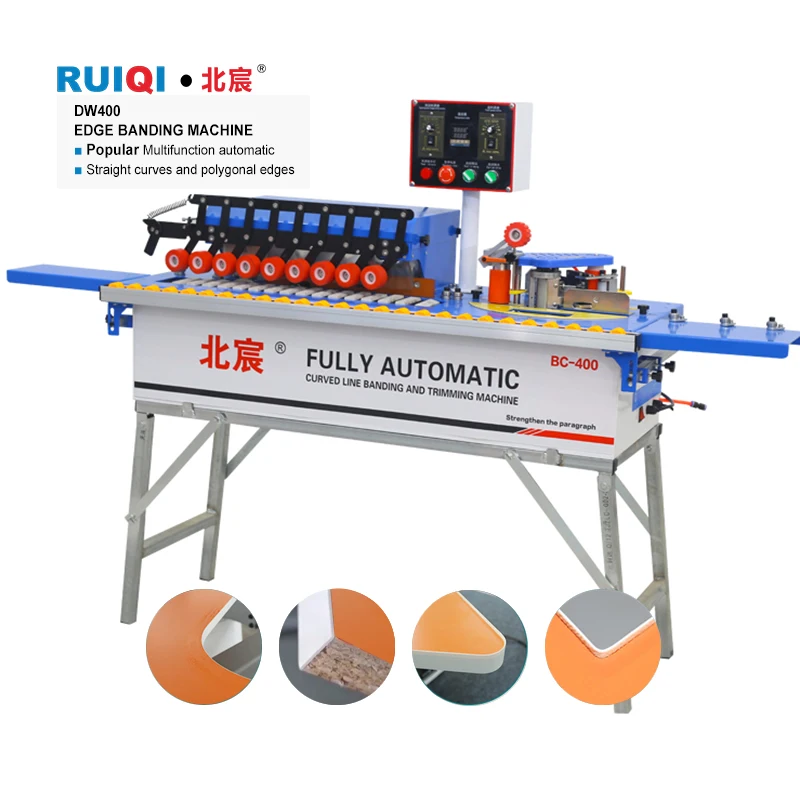
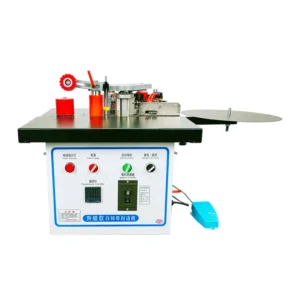
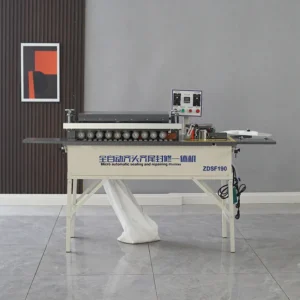
Precision-ground components with proprietary cutting mechanisms — verified to ±0.02mm tolerance on every DW400 unit before it leaves the assembly floor, with full OEM configuration available from a single source.
Technical Specifications
| Parameter |
Value |
| Model |
DW400 |
| Product Type |
Automatic Edge Banding Machine |
| Total Power |
3800W |
| Voltage |
220V / 380V / customization |
| Edge Banding Height |
0–50mm |
| Edge Banding Thickness |
0.3–3mm |
| Minimum Sheet Length |
250mm |
| Minimum Sheet Width |
100mm |
| Trimming Power |
650W × 2 |
| Polishing Power |
180W × 2 |
| Vacuum Power |
1200W |
| Air Source Pressure |
0.5–0.8 MPa |
| Glue Pot Capacity |
1000ml |
| Product Size |
1160 × 470 × 690mm |
| Product Weight |
70kg |
| Assembly State |
Fully assembled |
| Control Panel Language |
Chinese, English, customizable to Spanish or other languages |
| Standard Features |
Straight edge banding, trimming, polishing |
| Standards |
CE, ISO 9001 |
Application Suitability
| Application |
Material or Output |
| Cabinet door edge finishing |
MDF, particleboard, blockboard with PVC or veneer banding |
| Furniture panel processing |
Plywood and solid wood panels for wardrobe and shelving components |
| Polymer door production |
Polymer substrate with compatible edge banding material |
| Small-batch custom joinery |
Mixed panel runs requiring quick thickness changeover |
Why the Voltage Question Must Come Before the Machine Ships
Every DW400 Edge Banding Machine factory OEM order begins with a confirmed electrical schematic matched to the destination grid.
I spent years on the assembly floor before moving into technical sales, and one early mistake still drives how I handle every order. A cabinet manufacturer in the Middle East ordered a unit without a thorough voltage review. When the machine arrived, it could not connect to the local supply. Three weeks went into rewiring and transformer work before the line could run. That delay is entirely preventable. Voltage and frequency vary significantly across export markets, and confirming the spec before production avoids costly on-site rework [NEED_CITE: voltage and frequency standards by export market]. With this DW400 Automatic Edge Banding Machine, voltage is configurable across a defined range, and the electrical schematic is reviewed against the buyer’s local standard before the unit enters final assembly.

How In-House Manufacturing Controls the Tolerance Chain
The DW400 is built on a floor where component sourcing, precision grinding, and assembly happen under one roof. This means the Edge Banding Machine factory OEM process does not rely on external workshops for critical sub-assemblies. Proprietary cutting mechanisms are machined and fitted by the same team that runs final QC, keeping tolerance accountability in a single chain. When a distributor or importer evaluates manufacturing depth, seeing the grinding station next to the assembly bay tells a different story than a brochure.
Four-Stage QC from Raw Material to Crate
Incoming material inspection catches substandard castings and bearings before they enter the line. In-process checks at each assembly station verify alignment and torque specifications. Finished product testing runs actual panel stock through the complete banding, trimming, and polishing cycle. Pre-shipment verification involves a documented test on the buyer’s specified panel thickness range. Each stage generates a record that ships with the machine, providing a traceable quality history [NEED_CITE: CE machinery directive requirements for industrial equipment].
Reading the Specs That Matter on the Shop Floor
The 0.3–3mm edge banding thickness range covers thin PVC through thicker solid wood veneer strips, which determines how many banding materials a workshop can run without switching machines. The dual 650W trimming motors provide enough torque to cleanly score and trim dense banding on particleboard without chipping the substrate edge. Air source pressure at 0.5–0.8 MPa drives the pneumatic feed and pressure rollers; operating outside this window affects band adhesion consistency. The 1000ml glue pot capacity suits continuous production runs on MDF cabinet components without frequent refill stops. Panel minimum dimensions of 250mm × 100mm set the lower boundary for small offcut processing, relevant for custom joinery shops running mixed-size batches.
The Cost of Skipping Configuration Verification
When a distributor places a bulk order without confirming the control panel language, operators on the receiving end cannot navigate the setup menus. Commissioning stalls until someone translates the interface or waits for a replacement panel board. Similarly, machines specified without confirming the local air supply pressure arrive and underperform on banding adhesion, blamed on the machine rather than the compressor. These issues do not show up in a spec sheet comparison; they surface only after installation, when downtime has a real cost [NEED_CITE: industrial equipment commissioning failure causes].
Why Procurement Teams Source This Machine Here
Proprietary cutting mechanisms are developed and manufactured in-house, so tolerance claims are traceable to the tooling, not borrowed from a supplier catalog. Full OEM capability covers private label, voltage range, and multilingual control panels under one order. The four-stage QC process produces documented records at each gate, not just a final sign-off sheet. Engineer-led configuration recommendations arrive within 24 hours, matched to the buyer’s panel types and production volume. Factory visits are open, letting distributors and importers walk the assembly line and witness testing before committing to a production run.
Documentation & Verification
- CE declaration of conformity covering the DW400 edge banding configuration
- ISO 9001 certificate for the manufacturing quality management system
- Electrical schematic confirming voltage and frequency for destination market
- Factory test record on buyer-specified panel thickness and banding material
- Machine specification sheet with verified tolerance and power ratings
Installation, Commissioning & Support
- 3800W total draw requires a dedicated circuit matching confirmed voltage and frequency
- Fully assembled 70kg unit positions on a level floor without foundation work
- Air supply connection at 0.5–0.8 MPa verified against workshop compressor output
- Multilingual control panel activated in agreed language before first production run
- Spare parts list covering trimming blades, polishing wheels, and glue pot seals
What We Need to Quote Your Configuration
To prepare an accurate specification and pricing, share the panel materials and thickness range you process most frequently. Confirm your local voltage and frequency so the electrical build matches your facility supply. Let us know the preferred control panel language and whether your existing dust extraction and air compressor systems will feed this station, or if auxiliary equipment should be included in the line proposal.
Frequently Asked Questions
Q: What can be customized under OEM for this edge banding machine?
A: The DW400 supports custom logo application, voltage configuration across a defined range, multilingual control panel setup, and specification adjustments such as glue pot size or feed mechanism tuning. Each OEM parameter is confirmed in writing before production begins, with a pre-shipment sample test available for buyer approval.
Q: How is manufacturing precision verified before delivery?
A: Each unit passes four QC stages covering incoming components, in-process assembly, finished product testing, and pre-shipment verification. The proprietary cutting mechanism tolerance is measured and recorded. A factory test record documenting actual banding and trimming results on specified panel material ships with the machine.
Q: What is the minimum order for OEM production?
A: OEM runs are accepted from single-unit sample orders through to large batch production. Single units are configured to full OEM specification, allowing distributors to evaluate build quality and finish before committing to volume orders. Lead time varies with order size and customization scope.
Q: Can the machine be built to customer-provided drawings?
A: Engineering review of customer drawings is available for modifications that fall within the machine platform’s mechanical and electrical envelope. Feasibility is confirmed during the configuration phase, and any dimensional or performance changes are documented in a revised specification sheet before production starts.
Q: How are factory visits and sample testing arranged?
A: Visits are scheduled directly with the sales engineering team, typically within a few working days of request. During the visit, buyers can walk the assembly line, observe QC stations, and witness a live test run on their own panel samples to verify banding quality and trimming accuracy firsthand.