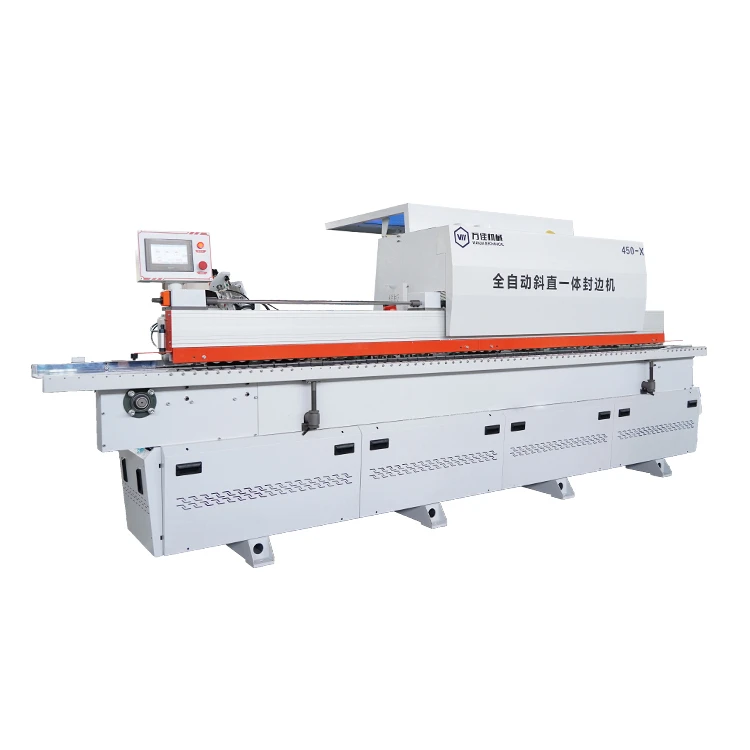
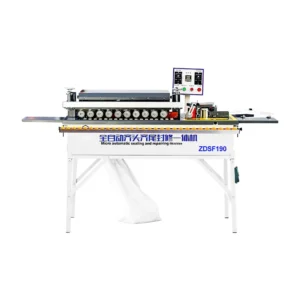
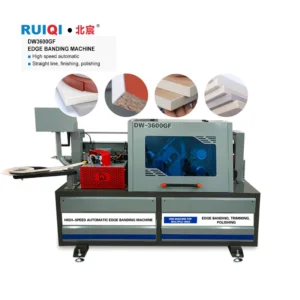
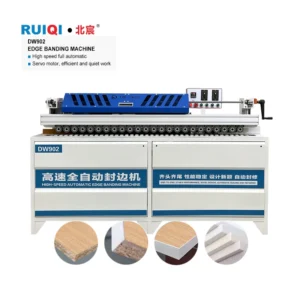
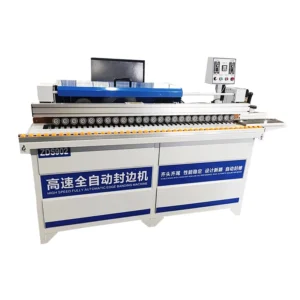
Custom-Built Manufacturing Depth — from precision-ground components to OEM logo application, every unit leaves the factory with specifications verified against your regional electrical and labeling requirements.
Technical Specifications
| Parameter |
Value |
| Product Type |
Automatic Edge Banding Machine with Pre-milling |
| Overall Dimensions (L×W×H) |
435 × 92 × 165 cm |
| Total Installed Power |
17.5 kW |
| Voltage & Frequency |
380V / three-phase five-wire / 50Hz (configurable 110V–440V) |
| Conveying Motor |
2.2 kW with inverter |
| Feed Speed |
0–12 m/min variable, inclined straight edge |
| Pre-milling Motor |
3.5 kW |
| Glue Pot Capacity |
2000 mL |
| Glue Pot Operating Temperature |
150–170°C |
| Glue Pot Heating Power |
1.2 kW |
| Heat Gun Power |
2 kW |
| Trimming Motors |
0.75 kW ×2 |
| End Trimming Motors |
0.37 kW ×2 |
| Polishing Motors |
0.37 kW ×2 |
| Selection Motor |
4 kW |
| Slotted Motor |
220V 0.8 kW |
| Edge Feeding Motor |
0.18 kW with inverter |
| Lifting Motor |
0.25 kW with inverter |
| Air Source Pressure |
0.6–0.8 MPa |
| Air Storage Tank Volume |
5 L |
| Dust Extraction Port Diameter |
100 mm |
| Edge Banding Width |
20–50 mm |
| Edge Banding Thickness |
Up to 1.2 mm |
| Panel Thickness Range |
18 / 22 / 25 mm |
| Minimum Panel Width |
>100 mm |
| Minimum Panel Length |
>250 mm |
| Control System |
Xinjie industrial touch screen |
| Inverter |
Xinjie industrial inverter |
| Key Features |
Pre-milling station, variable feed speed, OEM branding available, multilingual panel option |
Application Suitability
| Application |
Material or Output |
| Cabinet door and carcass edge finishing |
MDF and particleboard with PVC edge banding |
| Custom furniture panel processing |
Plywood and melamine-faced board with straight and curved edges |
| Mid-volume workshop production runs |
Panel thicknesses 18–25 mm, edge thickness up to 1.2 mm |
| OEM-branded equipment supply |
Private-label machines configured for distributor territories |
Why the Voltage Question Should Come Before the Quotation on Any Automatic Edge Banding Machine OEM Factory Order
An edge bander wired for 380V/50Hz becomes dead weight in a 220V/60Hz market — electrical confirmation belongs in the engineering phase, not the packing phase.
I once watched a container arrive at a South American port with a fully automatic edge bander rated for Chinese grid standards. The buyer’s electrician opened the panel and found motors, inverters, and a glue pot heater all locked to 380V three-phase. Retrofitting that machine on-site cost more than the freight. Now, before any Automatic Edge Banding Machine OEM factory order enters production, the destination voltage, frequency, and plug configuration are documented and locked into the electrical schematic [NEED_CITE: voltage and frequency standards by export market]. This machine supports configuration from 110V to 440V, and the Xinjie inverter and touch screen are re-mapped accordingly before assembly begins.

Precision-Ground Components and the Manufacturing Chain
Every bearing seat, guide rail, and pressure roller on this Automatic Edge Banding Machine OEM factory build goes through multi-stage inspection before final assembly. The pre-milling station runs a 3.5 kW motor that removes substrate irregularities before the edge meets the glue — a step that only holds tolerance when the mounting surfaces beneath it are ground flat. In-house machining means component sourcing stays under one roof, which matters when a distributor needs to trace a dimensional fault back to a specific production batch.
Four-Stage Quality Control Before the Crate Closes
Incoming materials, in-process assembly, finished-product testing, and pre-shipment verification form the QC sequence here. Each stage generates its own test record. For an OEM partner, those records become part of the documentation package shipped with the machine — the distributor’s service team can reference factory test data when troubleshooting in the field [NEED_CITE: CE machinery directive requirements for industrial equipment]. The glue pot system is run at operating temperature (150–170°C) during pre-shipment testing to confirm consistent PVC adhesion across the full edge width.
Reading the Specs That Actually Determine Edge Quality
The 0–12 m/min variable feed speed, controlled by the Xinjie inverter on both the conveying and lifting motors, directly governs how uniformly glue transfers from the pot to the panel edge. Slower feed on thicker PVC (approaching 1.2 mm) gives the adhesive more dwell time under the pressure rollers. The dual 0.75 kW trimming motors clean the top and bottom overhang, while the 0.37 kW ×2 end-trimming motors square the leading and trailing edges — together they determine whether a panel passes visual inspection or gets pulled for rework. The 100 mm dust extraction port connects to the workshop’s central system; undersizing this line causes PVC dust to accumulate on the glue roller, degrading bond quality over a production shift. Panel thickness options of 18, 22, and 25 mm cover standard furniture board, but running the thinnest stock at maximum feed speed risks chatter marks — the inverter exists so operators can dial back rather than push through.
The Hidden Cost of Skipping OEM Configuration Details
Machines ordered without specifying the control panel language arrive with menus the operator cannot read. Commissioning stalls while the distributor sources a translator or waits for a firmware update. I have seen edge banders of this class sit idle for weeks because the error codes on the touch screen were in a language the local technician did not recognize [NEED_CITE: multilingual HMI requirements for exported machinery]. Similarly, an OEM logo applied after the paint booth — rather than during the coating process — chips within months and undermines the distributor’s brand in front of end users. These are not engineering failures; they are specification omissions that could have been caught during the quotation phase.
Why Distributors Source Their Private-Label Line Here
In-house manufacturing covers the full machine — not just assembly from third-party sub-assemblies. Patented cutting mechanisms carry verified tolerances rather than claimed ones. The product family spans entry-level to full-function pre-milling models, so a distributor can offer a tiered catalog under one brand without juggling multiple suppliers. Voltage, language, and packaging customization are treated as standard order parameters, not special requests. Factory visits are open to buyers who want to walk the grinding, assembly, and QC floors before committing to a production run.
Documentation & Verification
- CE declaration of conformity matched to the destination market’s machinery directive
- ISO 9001 certificate covering manufacturing and QC scope
- Electrical schematic with confirmed voltage and frequency for your grid
- Factory test record run on your specified panel thickness and edge material
- Operation and maintenance manual produced in the agreed operator language
- Spare parts list with part numbers cross-referenced to assembly diagrams
Installation, Commissioning & Support
- 17.5 kW total power requires a dedicated three-phase circuit matching confirmed voltage
- 435 cm length demands clear floor space for infeed and outfeed conveyor alignment
- Air supply at 0.6–0.8 MPa must be filtered and dried before reaching the 5 L tank
- Xinjie touch screen parameters are set to local feed speed and glue temperature during commissioning
- Trimming and polishing motor alignment verified on buyer’s actual panel stock at startup
- Spare wear parts for the pre-milling cutter and pressure rollers included in first shipment
What to Share With Your Inquiry
Distributors and OEM partners get the most accurate configuration proposal when the inquiry includes the destination market’s voltage and frequency standards, the target panel materials and edge banding types your customers run most often, and the branding and packaging requirements for your territory. If your service team needs technical training on the pre-milling station or inverter parameters, flag that early so it can be built into the production and delivery timeline.
Frequently Asked Questions
Q: What OEM customization options are available for branding and packaging?
A: Logo placement, machine color, control panel language, and export packaging can all be customized. Logo application happens during the coating process for durability, and packaging is built to the shipping method and destination port requirements. Each customization is confirmed on the engineering drawing before production starts.
Q: How is the correct voltage and frequency confirmed before manufacturing begins?
A: The buyer provides the destination grid specifications during the quotation phase. The electrical schematic is then produced with those values locked in, covering all motors, the Xinjie inverter, and the glue pot heater. This document is signed off before the machine enters assembly.
Q: Can buyers review quality control records before the machine ships?
A: Yes. The four-stage QC process generates test records at incoming inspection, in-process assembly, finished-product testing, and pre-shipment verification. Buyers or their appointed inspectors can review these records, and copies are included in the documentation package shipped with the machine.
Q: What is the typical lead time and minimum order for an OEM production run?
A: Lead times vary with customization scope and order volume — single-unit OEM orders are accepted alongside larger production runs. The formal quotation, issued within one working day of configuration confirmation, includes the projected production schedule. Contact the engineering team with your order plan for a timeline.