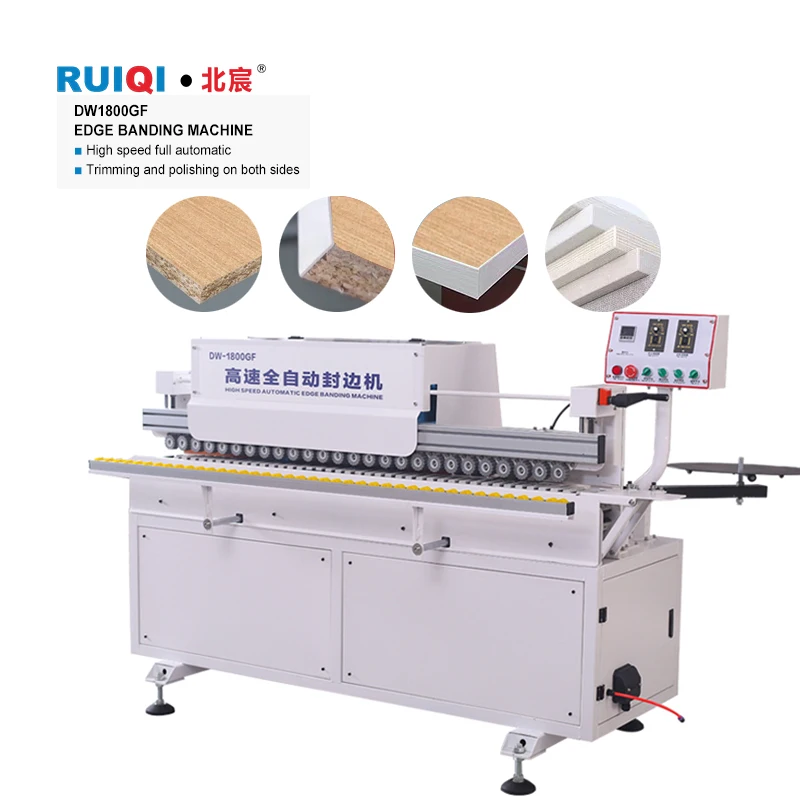
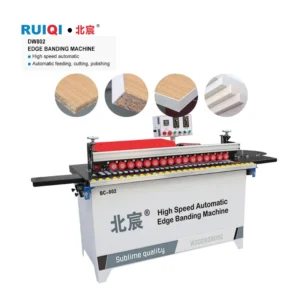
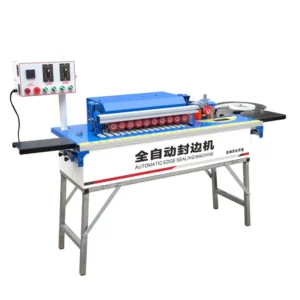
Precision-ground aluminum frames — The DW1800 automatic edge banding machine is built on a high-strength extruded aluminum alloy workstation with oxidation treatment, maintaining dimensional stability through the four-stage QC process that distributors require before committing to private label partnerships.
Technical Specifications
| Parameter |
Value |
| Model |
DW1800 |
| Product Type |
Automatic Edge Banding Machine |
| Total Power |
4.9 kW |
| Voltage Options |
380V / 220V / 415V (frequency to be confirmed per destination market) |
| Feed Speed |
0–14 m/min |
| Edge Banding Thickness Range |
0.3–3 mm |
| Edge Banding Height Range |
0–50 mm |
| Minimum Sheet Length |
20 cm |
| Minimum Sheet Width |
10 cm |
| Trimming Power / Speed |
800 W × 2 / 24,000 r/min |
| Polishing Power |
380 W × 2 |
| Vacuum Power |
550 W |
| Transmission Power |
180 W |
| Edge Motor Power |
160 W |
| Glue Pot Capacity |
4000 ml |
| Air Source Pressure |
0.4–0.6 MPa |
| Overall Dimensions (L×W×H) |
220 × 65 × 125 cm |
| Net Weight |
320 kg |
| Standard Functions |
Double-sided gluing, top and bottom trimming, top and bottom polishing, front and rear alignment, flexible edge scraping, dust extraction |
| Workstation Frame |
High-strength extruded aluminum alloy, oxidation-treated |
| Control System Language |
Chinese/English, customizable (e.g., Spanish) |
| Assembly State |
Fully assembled, mobile table with roll-ball differential structure |
Application Suitability
| Application |
Material or Output |
| Cabinet door and drawer front edge finishing |
MDF and particleboard with PVC or melamine edge banding |
| Furniture table and desk panel edging |
Plywood and blockboard with veneer or ABS strips |
| Custom joinery and built-in wardrobe components |
MDF, particleboard, and solid wood panels |
| Retail fixture and shelving production |
ABB boards, organic glass plates, and similar hardness panels |
| OEM-branded machine distribution |
Full private label configuration for regional resale |
Why the Voltage Question Should Come Before the Price on an Edge Banding Machine Factory Order
Specifying local voltage and frequency before production prevents machines from arriving dead on the warehouse floor.
I have unloaded edge banders in West Africa where the buyer negotiated aggressively on price but never confirmed whether the destination grid runs at 50 Hz or 60 Hz. The motor overheated within the first shift. An edge banding machine factory that builds to stock rarely asks these questions. An OEM edge banding machine partner will request the destination electrical standard before cutting the first frame [NEED_CITE: voltage and frequency standards by export market]. The DW1800 is configurable across 380V, 220V, and 415V, but the frequency must be locked in during the quotation stage so the correct motor and transformer are installed at the assembly station.

Four-Stage QC Before the Crate Is Sealed
The DW1800 moves through incoming material inspection, in-process checks during sub-assembly, finished product verification under load, and a final pre-shipment test. Each stage generates a documented checkpoint. For an edge banding machine factory evaluating private label depth, this means you can trace every critical component back to its incoming inspection record before the machine leaves the production floor.
OEM and Private Label Scope
Private label on the DW1800 extends beyond a logo plate. The control panel language, electrical schematic labeling, and operation manual are all produced in the agreed language before packing. Voltage is wired to the destination market standard. For distributors planning a regional model mix, the factory confirms specification modifications in writing before the production run begins, ensuring each OEM edge banding machine matches the territory’s requirements [NEED_CITE: CE machinery directive requirements for industrial equipment].
Reading the Spec Sheet Against Actual Workshop Conditions
The 0–14 m/min feed speed range on the DW1800 determines daily throughput, but the usable speed depends on the edge banding thickness and substrate density. Running 3 mm PVC on recycled particleboard at maximum feed speed often leaves insufficient glue open time, resulting in peel failures downstream. The 800 W trimming motors at 24,000 r/min are sized to handle this material range, but the operator must match feed speed to the specific board and banding combination. The 0.4–0.6 MPa air pressure requirement also means the workshop compressor must deliver clean, dry air at this pressure consistently, or the pneumatic cylinders controlling the pressure rollers will stutter.
The Hidden Cost of Skipping the Factory Test Record
When a distributor accepts shipment without reviewing the factory test record, the first real test happens on the customer’s floor. I have watched commissioning stall because the edge scraping station was never adjusted for the buyer’s specific PVC thickness, leaving a visible ridge on every panel. The DW1800 is tested at the factory, but if the test is run on a board material different from what the end user will process, the settings may not transfer. Requesting a test run on your own sample material before dispatch eliminates this gap [NEED_CITE: material-specific edge banding adhesion testing standards].
Why Source the DW1800 From This Production Floor
The workstation frame uses high-strength extruded aluminum alloy with oxidation treatment, resisting the humidity and temperature swings common in tropical distribution warehouses. The roll-ball differential mobile table provides stable panel feeding without the belt slippage seen on lighter assemblies. Every DW1800 ships with a complete electrical schematic matched to the destination voltage, not a generic diagram. The factory supports specification modifications for regional markets, from control panel language to glue pot capacity adjustments, documented before production starts. Distributors receive technical training materials structured for their own service teams, not translated end-user manuals.
Documentation & Verification
- CE declaration of conformity matched to the DW1800 configuration and destination market
- ISO 9001 certificate covering the production process for this edge bander series
- Factory test record run on the panel thickness and banding material you specify
- Electrical schematic and voltage confirmation sheet matching the ordered voltage option
- Operation and maintenance manual in the agreed language with a matched spare parts list
Installation, Commissioning & Support
- Requires a level concrete floor capable of supporting 320 kg net weight plus dynamic load
- Dedicated electrical circuit matching the confirmed 380V, 220V, or 415V supply with proper grounding
- Arrives fully assembled; position, level, connect air at 0.4–0.6 MPa, and power on
- First-run parameter setting for feed speed, glue temperature, and trimming depth included in manual
- Glue pot cleaning and scraper blade inspection scheduled by operating hours in the manual
- Spare parts list covers wear items: trimming cutters, polishing wheels, scraper blades, and feed rollers
What to Include With Your Inquiry
Send the panel materials and edge banding types your market primarily processes, along with typical board thickness and maximum panel dimensions. Confirm the local voltage and frequency at the destination port. If you are evaluating the DW1800 for private label, specify the control panel language, logo placement requirements, and any specification modifications needed for your territory. Sample material can be shipped to the factory for a test run before the order is finalized.
Frequently Asked Questions
Q: What is included in the OEM and private label scope for the DW1800?
A: The scope covers custom logo application, control panel language (standard Chinese/English, with options such as Spanish), voltage wiring to 380V, 220V, or 415V based on destination, and specification modifications confirmed in writing before production. Electrical schematics and manuals are labeled in the agreed language.
Q: How can a distributor verify manufacturing depth before placing a bulk order?
A: The factory welcomes visits to inspect component sourcing, precision grinding stations, and the four-stage QC process. If a visit is not possible, the factory provides component traceability documentation and a pre-shipment test record run on the buyer’s specified panel material.
Q: What does the four-stage QC process cover on the DW1800?
A: Incoming material inspection verifies raw components, in-process checks cover sub-assembly alignment, finished product verification tests the machine under load, and pre-shipment verification confirms all functions with documentation. Each stage produces a record available to the buyer before dispatch.
Q: Can I send my own panel material for a test run before ordering?
A: Yes. Ship representative samples of the MDF, particleboard, or plywood your market uses, along with the edge banding material. The factory runs the DW1800 on your material, documents the settings, and includes the test record with the quotation.
Q: What territory support is available for regional distributors?
A: Distributors receive model mix planning guidance, technical training materials for their service teams, and a dedicated spare parts supply channel. Warranty terms and territory exclusivity are confirmed during the partnership discussion, with documentation matched to the destination market.