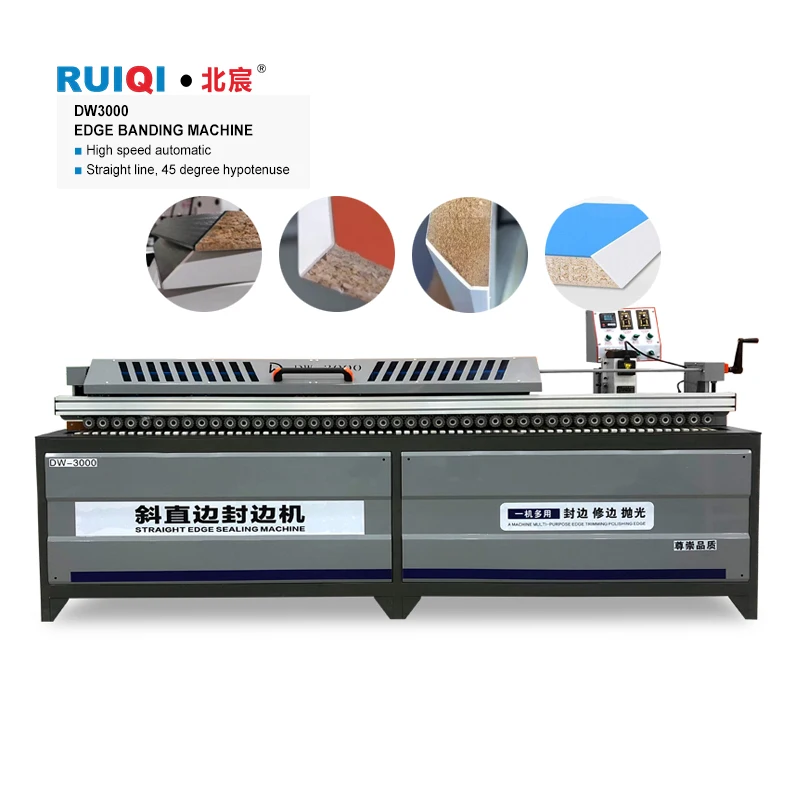
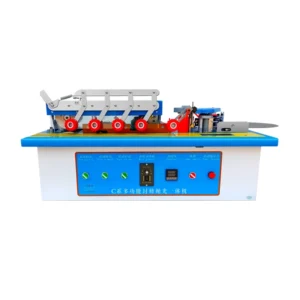
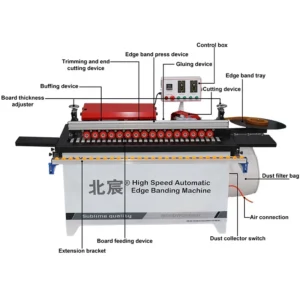
Verified Tolerance on Every Unit — each DW3000 edge bander ships with a documented factory test record proving ±0.02mm accuracy before it leaves our assembly floor.
Technical Specifications
| Parameter |
Value |
| Model |
DW3000 |
| Product Type |
Automatic Edge Banding Machine |
| Total Power |
11 kW |
| Pre-milling Motor |
2.2 kW |
| Trimming Power |
2.2 kW × 2 (3 spindle motors total, includes 800W silent trimming motor) |
| Heating System |
2.2 kW × 2 (double heat gun) |
| Polishing Power |
0.4 kW × 2 |
| Vacuum Power |
550 W |
| Feed Speed |
0–12 m/min (160W edge power) |
| Transmission Speed |
0–12 m/min (180W) |
| Glue Pot Capacity |
4000 ml |
| Edge Banding Thickness |
0.3–3 mm |
| Edge Banding Height |
0–50 mm |
| Minimum Sheet Length |
300 mm |
| Minimum Sheet Width |
150 mm |
| Oblique Pressure Wheels |
8 groups, adjustable 30–90° |
| Feeding System |
Double cylinder feeding belt |
| Air Source Pressure |
0.5–0.7 MPa |
| Voltage Options |
380V / 415V (configurable from 110V to 440V) |
| Control Panel |
Multilingual customizable (Chinese, English, others on request) |
| Plug Options |
EU, USA, AU, UK |
| Overall Dimensions (L×W×H) |
2990 × 650 × 1300 mm |
| Net Weight |
430 kg |
| Standards |
CE, ISO 9001 |
Application Suitability
| Application |
Material or Output |
| Cabinet door and carcass edge banding |
MDF and particleboard with PVC or melamine edge band |
| Plywood furniture panel finishing |
Plywood substrates with veneer or PVC edge banding |
| 45-degree bevel edge processing |
MDF, particleboard and plywood panels for angled joint assemblies |
| Straight edge banding for custom furniture |
Artificial board substrates from 0.3 mm to 3 mm banding thickness |
| Small-batch workshop production |
Panel runs requiring quick changeover between banding materials |
Why Voltage Confirmation Must Happen Before the Machine Ships
An Automatic Edge Banding Machine factory that skips pre-shipment voltage verification is gambling with your production schedule. Every DW3000 leaves our floor with a signed electrical schematic matching your local supply.
Early in my career installing woodworking lines across Southeast Asia, I watched a cabinet factory lose two full weeks because the edge bander arrived wired for a voltage that did not match the local grid. The pre-milling motor burned out on first start-up, and the replacement parts had to cross two borders. That kind of failure is entirely preventable with a confirmation step that takes less than a day [NEED_CITE: voltage and frequency standards by export market]. The DW3000 is built with configurable voltage from 110V to 440V, but configuration only matters if someone checks the destination supply before the control cabinet is sealed.

Component Sourcing and Assembly Depth
As an OEM partner or regional distributor, you need to see beyond the nameplate. The DW3000 uses proprietary spindle trimming mechanisms developed in-house, with precision-ground components that pass through multi-stage inspection before assembly. Each unit moves through a four-stage quality control sequence — incoming material check, in-process verification, finished-product testing and pre-shipment audit — before it is crated.
Our factory welcomes on-site visits so that distributors can trace every critical component back to its sourcing record. When you evaluate manufacturing depth, you want to see the grinding stations, the assembly jigs and the test rigs, not just a showroom floor [NEED_CITE: CE machinery directive requirements for industrial equipment].
OEM and Private-Label Configuration
Private-label partnerships require more than a sticker on the side panel. The DW3000 supports full OEM customization: your logo on the machine body, custom color schemes, control panel language in the operator’s native script and electrical configuration matched to the destination market. We have shipped units with multilingual HMI panels so that commissioning does not stall because the operator cannot read the error codes.
For distributors building a regional brand, this means the same Automatic Edge Banding Machine platform can serve multiple territories without re-engineering. Voltage, plug type and documentation language are locked in at the order stage, not improvised on the dock.
What the Spec Sheet Means on the Shop Floor
The double heat gun design — two 2.2 kW heating elements — ensures that glue reaches activation temperature even when running thicker PVC banding on dense particleboard. A single heat gun often struggles with 3 mm banding in cool workshops, leaving weak adhesion that peels during assembly.
Three spindle motors, including a dedicated 800W silent trimming unit, deliver a consistent edge finish across the full 0.3–3 mm banding range. The eight-group oblique pressure wheel system adjusts from 30 to 90 degrees, which is what makes 45-degree bevel edge banding possible without a separate station. On the feed side, the double cylinder belt keeps panels stable at any speed from 0 to 12 m/min, eliminating the chatter marks that show up as visible glue lines on glossy PVC [NEED_CITE: edge banding adhesion standards for panel furniture].
The 4000 ml glue pot provides enough capacity for extended production runs without constant refilling, reducing thermal cycling that degrades adhesive quality over time.
The Cost of Skipping the Factory Audit
Distributors who source edge banders on price alone often discover the real cost after the container arrives. Tolerance claims that were never verified at the factory turn into assembly-line rejections when panel joints do not close. Control panels in the wrong language delay commissioning by days while operators decipher menu structures.
Machines ordered without confirming local frequency arrive with motors that overheat or run at incorrect feed speeds, damaging both the workpiece and the trimming tooling [NEED_CITE: common causes of edge banding machine failure in export markets]. These are not defects in the machine — they are gaps in the procurement process that a responsible Automatic Edge Banding Machine factory closes before production begins.
Why Source the DW3000 Here
In-house manufacturing with patented cutting mechanisms means we control tolerance from the spindle housing to the final test cut, not outsource it.
Full model family from entry-level to pre-milling configuration under one roof, so your regional catalog can scale without adding a second supplier.
Voltage, language and specification customization treated as standard order procedure, not a special request that delays lead time.
Four-stage quality control with pre-shipment verification — every DW3000 ships with a factory test record documenting measured tolerance on your specified panel thickness.
Engineer-led configuration with formal quotation within 24 hours, so your bidding process does not stall waiting for a reply.
Factory visits open to distributors and OEM partners who want to inspect precision grinding, assembly process and QC records in person.
Documentation & Verification
- CE declaration of conformity covering the DW3000 for European market entry
- ISO 9001 certificate validating the four-stage quality management system
- Factory test record with measured tolerance on your panel thickness range before dispatch
- Electrical schematic and voltage confirmation sheet signed off before production starts
- Operation and maintenance manual in the agreed operator language
- Spare parts list with part numbers matching the as-built configuration
Installation, Commissioning & Support
- Requires a dedicated 11 kW circuit with voltage matching the confirmed electrical schematic
- Overall footprint of 2990 × 650 mm needs clear access on both sides for maintenance
- Air supply at 0.5–0.7 MPa must be clean and dry to protect pneumatic cylinders
- First run includes glue temperature calibration against your specific banding material
- Operator training covers the multilingual control panel and 30–90 degree wheel adjustment
- Spare trimming blades and pressure wheel seals included in the initial parts kit
What to Include in Your Inquiry
Tell us the panel substrates and edge banding materials you run most often, along with the thickness range you need to cover. Share your local voltage and frequency so we can configure the DW3000 before quoting. If you are evaluating this machine for OEM or distribution, let us know your target markets and any branding requirements so the configuration matches your regional catalog.
Frequently Asked Questions
Q: What OEM and private-label customization is available for the DW3000?
A: We support custom logo placement, machine color, control panel language and full electrical configuration from 110V to 440V. Plug types are matched to the destination market. OEM partners can also request private-label documentation and packaging, all confirmed at the quotation stage so production proceeds without delays.
Q: How is edge banding tolerance verified before shipment?
A: Every DW3000 undergoes a pre-shipment test run using panel material matching your specification. Measured tolerance is recorded on the factory test record that ships with the machine. Our four-stage QC process covers incoming material, in-process assembly, finished-product testing and this final verification step.
Q: Can the DW3000 be configured for specific regional voltage and frequency?
A: Yes. Voltage is configurable from 110V to 440V, and frequency is confirmed against your local grid standard before the control cabinet is wired. An electrical schematic and voltage confirmation sheet are provided for your approval before production begins, preventing arrival-unusable situations.
Q: What does the four-stage quality control process cover?
A: Incoming raw material inspection, in-process assembly verification, finished-product functional testing and pre-shipment tolerance validation. Each stage has documented checkpoints. The final stage produces the factory test record that accompanies the machine, giving distributors verifiable proof of accuracy for their customers.
Q: What component sourcing and precision processes are used?
A: Critical components including the spindle trimming mechanism are manufactured in-house with proprietary designs and precision grinding. Multi-stage inspection verifies dimensional accuracy before assembly. Factory visits are available for distributors who want to audit sourcing records, grinding stations and assembly procedures directly.