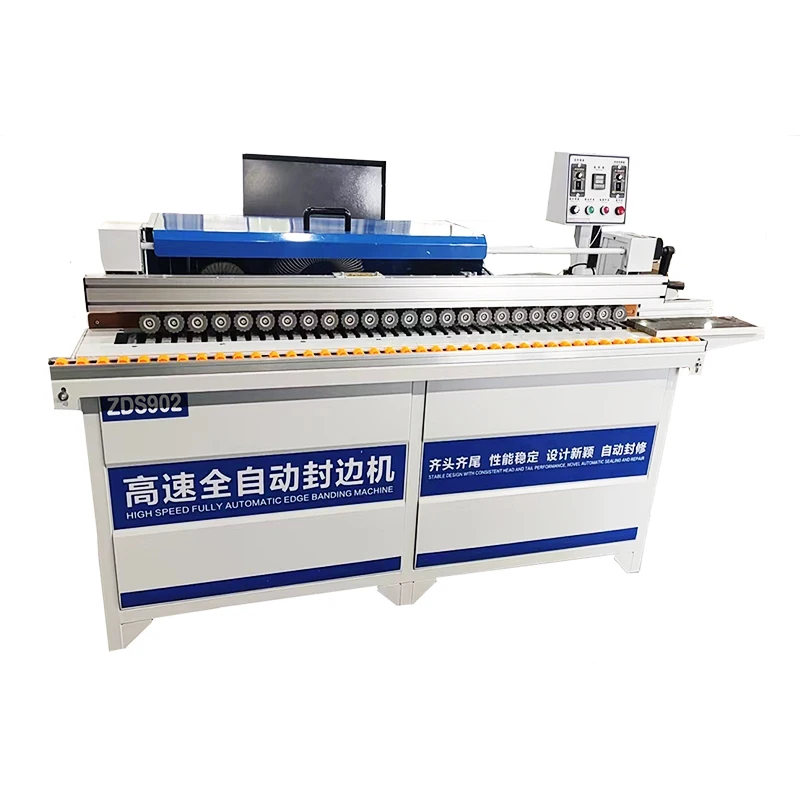
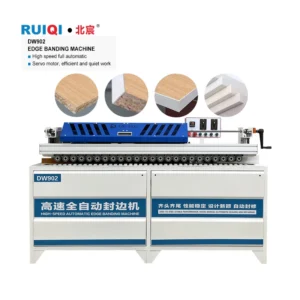
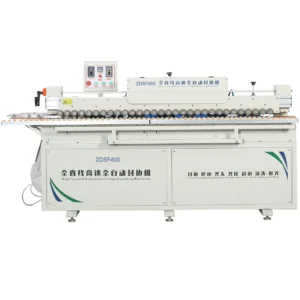
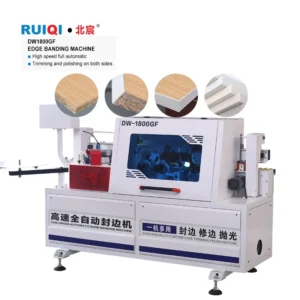
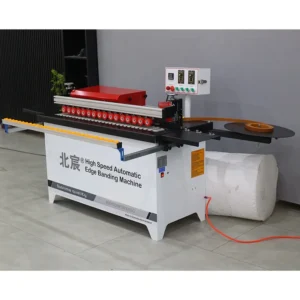
Precision-Ground Build — Every component in this automatic edge banding machine is verified through four-stage QC before leaving the factory floor, ensuring repeatable edge quality across long production runs.
Technical Specifications
| Parameter |
Value |
| Product Type |
Automatic Edge Banding Machine |
| Voltage |
220V (frequency and phase to be confirmed) |
| Total Power |
4200W (rated or peak basis not stated in source) |
| Equipment Size |
207 × 60 × 122 cm |
| Weight |
245 kg |
| Edge Banding Type |
Linear Edge Banding Machine |
| Edge Band Height Range |
0–35 mm |
| Edge Band Thickness Range |
0.5–2.5 mm |
| Glue Pot Capacity |
4000 ml |
| Pressure System |
Integrated pressure beam, double rows of pressure wheels |
| Conveyor Belt Material |
Silicone |
| Trimming System |
Double high-speed trimming motors |
| Polishing System |
Dual up-and-down polishing motors |
| Edge Strip Cutting |
Pneumatically controlled |
| Feed Speed |
(basis not stated in source) |
| Panel Thickness Range |
(basis not stated in source) |
| Tolerance |
(basis not stated in source) |
| Control System |
(basis not stated in source) |
| Warranty |
One year |
Application Suitability
| Application |
Material or Output |
| Custom cabinet door edging |
MDF and plywood with PVC edge banding |
| Wardrobe and shelving panel finishing |
Particleboard with melamine paper edge banding |
| Solid wood furniture panel edging |
Solid wood panels with veneer edge banding |
| Small-batch bespoke joinery runs |
Mixed substrates across batch changeovers |
Why the Tolerance Claim Should Be Verified Before You Sign
Verifiable tolerance comes from the cutting mechanism, not the brochure.
I have walked factory floors where the edge bander looked right on paper but panels came off the line with visible glue lines that only showed up under the assembly clamp. A distributor placing a container order needs to confirm that the trimming and polishing units on an Automatic Edge Banding Machine factory OEM partner builds can hold tolerance on the actual substrates being processed, not just on a showroom sample. When tolerance is claimed but never documented in a factory test record, the problem surfaces only when cabinet doors fail to close flush. [NEED_CITE: industry tolerance standards for panel edge finishing]

Proprietary Cutting Mechanism and Component Integrity
The trimming and polishing units sit at the heart of edge quality. This machine carries double high-speed trimming motors and dual polishing motors, a configuration that allows each station to be tuned independently for the edge band material in use. The cutting mechanism is designed in-house and subject to precision grinding at the component level before assembly. For an Automatic Edge Banding Machine factory OEM partner, this matters because it means the geometry of the trimmer blade path is controlled from design through final inspection, rather than inherited from a generic sub-assembly.
Four-Stage QC from Incoming Steel to Crate
Quality control here is not a single checkpoint at the loading bay. Incoming material is inspected before it enters production, sub-assemblies are verified during machining, the finished machine undergoes functional testing, and a pre-shipment verification run is performed with documented results. For distributors evaluating an Automatic Edge Banding Machine factory OEM arrangement, this layered approach means each unit in a production run is held to the same standard. Factory test records are provided before dispatch, so you can review actual performance data rather than relying on specification sheets alone. [NEED_CITE: QC verification protocols in woodworking machinery manufacturing]
What the Specs Mean on the Shop Floor
The 4000 ml glue pot capacity supports sustained runs without frequent refills, which matters when a batch of cabinet panels must be edged in a single pass without temperature fluctuation in the adhesive. The 0.5–2.5 mm edge band thickness range covers PVC, melamine paper, and thin veneer — but switching between these materials requires adjusting glue temperature and feed speed. The silicone conveyor belt provides grip without marring the panel surface, and the integrated pressure beam with double rows of pressure wheels keeps the panel stable through each station. The 0–35 mm edge band height range accommodates most standard panel thicknesses used in furniture and joinery work. Pneumatically controlled edge strip cutting ensures a clean cutoff at the panel ends, reducing the need for manual touch-up downstream.
The Cost of Skipping a Material Test Run
I once saw a workshop order a machine based on a PVC edge band sample, then switch to melamine paper banding for production without adjusting the glue temperature or feed rate. The edge strips blistered and lifted off the panels, and an entire batch of cabinet doors had to be reworked. When a distributor commits to a container load without requesting a sample processing test on the actual materials their end customers use, that risk scales across every unit shipped. The rework cost lands on the installer, but the reputation cost lands on the distributor. [NEED_CITE: adhesive temperature and feed speed interaction in edge banding]
Why Source the Build from This Factory
The cutting mechanism is designed and ground in-house, so tolerance is controlled at the component level rather than hoped for at assembly. Voltage customization from 110V to 440V is standard, which means a distributor can stock machines configured for their specific regional grid without re-engineering after arrival. Control panels are available in multiple languages, so the operator in the destination country can read the interface on day one. The four-stage QC process with pre-shipment verification gives you documented proof before the crate is sealed. OEM branding, including custom logo application, is supported from single units through full production runs.
Documentation & Verification
- CE declaration of conformity for machinery directive compliance
- ISO 9001 certificate covering the manufacturing quality system
- Factory test record on your specified panel and edge band materials before dispatch
- Electrical schematic with confirmed voltage and frequency for your market
- Operation and maintenance manual in the agreed language
- Spare parts list matched to the machine configuration shipped
Installation, Commissioning & Support
- Dedicated power circuit required for the 4200W total load at the confirmed voltage
- Machine footprint of 207 × 60 cm allows placement against a standard workshop wall
- Arrives assembled; requires leveling, belt tension check, and glue pot fill before first run
- Glue temperature and pressure beam setting must be calibrated to your specific edge band material
- Pneumatic cutting device requires connection to a workshop compressed air supply
- Trimming and polishing motor alignment verified during pre-shipment testing
What to Include in Your Inquiry
Provide the substrate types and edge band materials your end customers use most frequently, along with the local voltage and frequency at the installation site. Specify the control panel language required and whether OEM logo application is needed. If possible, ship sample panels and edge band strips so a processing test can be run before the machine is crated.
Frequently Asked Questions
Q: What is the OEM and private-label customization scope for this edge banding machine?
A: Custom logo application, voltage adaptation from 110V to 440V, multilingual control panels, and specification adjustments are all supported. Orders range from single evaluation units to large production runs. Each customization is documented in the specification sheet and confirmed before production begins.
Q: How can I verify tolerance claims before placing a bulk order?
A: You can request a sample processing test using your own panels and edge band materials, or arrange a factory visit to inspect the precision grinding processes and assembly line. Pre-shipment test records are provided for every unit before dispatch.
Q: What component sourcing and precision grinding processes are used?
A: Critical components including the trimming and polishing motor assemblies and the cutting mechanism are manufactured and ground in-house. Incoming materials are inspected before production, and each sub-assembly is verified during the machining stage.
Q: What documentation is provided for customs clearance and local compliance?
A: The package includes a CE declaration of conformity, ISO 9001 certificate, electrical schematic with voltage confirmation, machine specification sheet, packing photographs, and customs documentation support tailored to the destination market.
Q: What is the production lead time for OEM orders and how is quality verified?
A: Lead time varies with order volume and customization scope, typically spanning multiple weeks. Every unit undergoes four-stage QC including a pre-shipment verification run with documented factory test records shared before the machine is crated for dispatch.