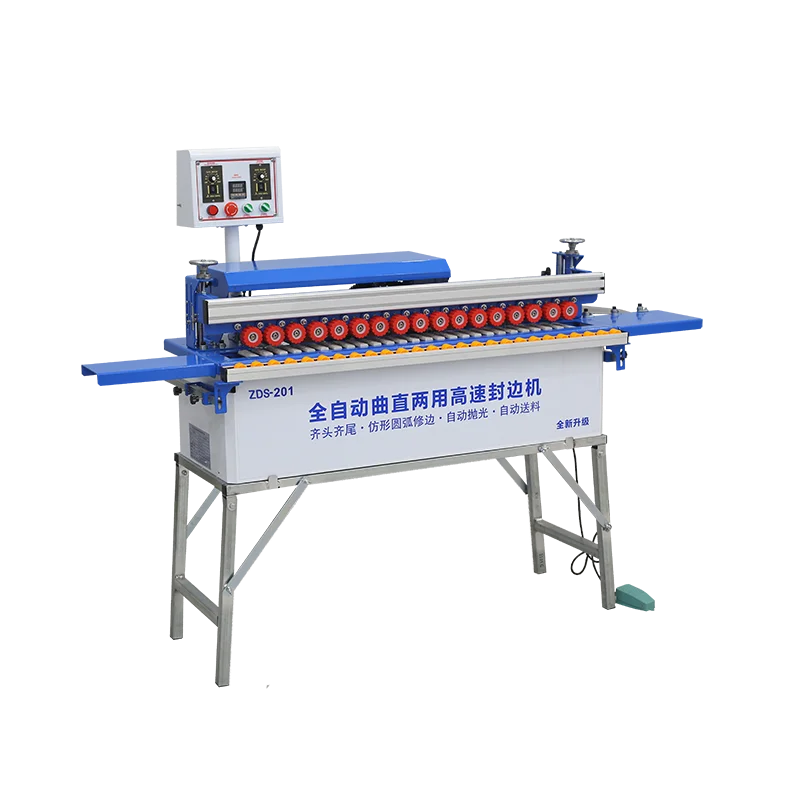
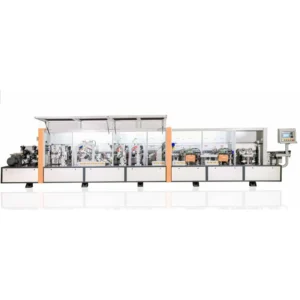
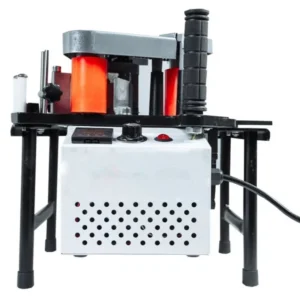
Precision-ground trimming components — Every curved and straight edge banding machine leaving our facility passes through four-stage quality control, with factory test records on your specified MDF thickness range provided before dispatch.
Technical Specifications
| Parameter |
Value |
| Product Type |
Curved and Straight Edge Banding Machine |
| Heating Power |
1.2 kW |
| Total Power |
3 kW |
| Edge Banding Speed |
0–26 cm/s |
| Feeding Speed |
0–15 m/min |
| Edge Banding Thickness Range |
0.3–3 mm |
| Panel Thickness Range |
8–50 mm |
| Trimming Mechanism |
Square slide rail profiling with imported 4-blade alloy arc knife |
| Crawler Transmission |
Steel rod slide rails |
| Pressure Beam |
Adjustable aluminum alloy |
| Edge Strip Cutting |
Pneumatically controlled device |
| Polishing Device |
Cross polishing, up and down |
| Dust Extraction |
Dual large-diameter dust collectors (collection efficiency basis not stated in source) |
| Control Panel |
Multi-function button operation |
| Curved Edge Banding |
Available after rotating unit 180 degrees |
| Overall Dimensions (L×W×H) |
1200×450×750 mm |
| Net Weight |
85 kg |
| Key Features |
Automatic trimming and buffing; curved and straight edge banding; edge banding tray included |
Application Suitability
| Application |
Material or Output |
| Furniture panel edge finishing |
MDF boards 8–50 mm thick with PVC or wood veneer edge strips |
| Cabinet component profiling |
Curved and straight edges on particleboard and plywood panels |
| Small-to-medium workshop edge banding |
Wood-based panels requiring trimming and buffing in a single pass |
| Custom joinery edge work |
Thin veneer and thick PVC banding on shaped furniture parts |
What "Factory-Direct" Really Means for Distributors Evaluating a Curved and Straight Edge Banding Machine OEM Factory
A machine badge means nothing if the distributor cannot verify how it was built.
Distributors committing to a regional equipment line need to know more than the sticker on the control panel. I have seen importers receive edge banders that looked right on paper, only to discover the trimming mechanism was sourced externally and the assembly tolerances were never verified before crating. When the first container arrives and the edge finish is inconsistent across MDF and plywood, the end customer blames the distributor — not the factory three time zones away. Sourcing from a curved and straight edge banding machine OEM factory that controls its own precision grinding and assembly changes that dynamic entirely [NEED_CITE: machinery directive requirements for OEM manufacturing documentation].

Private Label Readiness Beyond a Logo Sticker
Applying a distributor’s brand to a machine requires more than a printed nameplate. Voltage adaptation from 110V to 440V, multilingual control panels matching the target market’s operator language, and electrical schematics formatted for local compliance all need to be engineered into the build. This curved and straight edge banding machine OEM factory integrates those customizations at the production stage rather than retrofitting after assembly, which means the private label unit ships as a coherent product rather than a base machine with add-ons.
Assembly Depth That Distributors Can Verify On-Site
A distributor evaluating a manufacturing partner should be able to walk the assembly floor and see where precision grinding happens, where the four-stage QC checkpoints sit, and how pre-shipment testing is documented. Factory visits are welcomed here, and the production process — from incoming material inspection through to the final test run on your specified panel thickness — is open for review. Seeing the steel rod slide rail crawler transmission assembled in-house and the square slide rail profiling mechanism fitted with its imported 4-blade alloy arc knife gives a distributor the confidence to stand behind the product in their own market [NEED_CITE: OEM factory audit standards for woodworking machinery].
How Trimming and Feed Specs Translate to Edge Quality on MDF
The 0.3–3 mm edge banding thickness range covers both thin veneer strips and thicker PVC profiles, but the real variable is how the trimming mechanism handles each. The square slide rail profiling system with a 4-blade alloy arc knife is designed to follow curved contours without chatter, which matters when a cabinet door has a radiused corner. The feeding speed range of 0–15 m/min allows operators to slow down for curved sections and maintain a steady pace on straight runs. Panel thickness from 8 to 50 mm means the adjustable aluminum alloy pressure beam must be reset between jobs — a simple operation, but one that the multi-function button panel makes straightforward. The dual dust collectors address the fine MDF particles generated during trimming, keeping the work area clear and reducing the chance of debris marking the freshly banded edge.
The Cost of Skipping Voltage and Language Confirmation Before Ordering
I once worked with a distributor who ordered a batch of edge banders without confirming the end customer’s workshop voltage. The machines arrived with a 380V configuration in a region running 220V single-phase, and the heating elements could never reach the glue pot’s operating temperature. The pneumatically controlled edge strip cutting device stuttered, and the trimming quality degraded on every panel. A similar problem surfaces when the control panel arrives in a language the operator cannot read — commissioning stalls, the distributor’s service team spends days translating button labels, and the end customer loses confidence before the machine even runs production. These are not manufacturing defects; they are configuration oversights that a curved and straight edge banding machine OEM factory should catch during the specification confirmation stage [NEED_CITE: voltage and frequency standards by export market].
Manufacturing Commitments That Show Up in the Crate
In-house precision grinding of the trimming and slide rail components means tolerances are controlled before assembly rather than adjusted on the floor. The four-stage QC process covers incoming material, in-process checks, finished product inspection, and a pre-shipment verification test run on actual MDF panels. Full OEM capability extends to custom logos, private label documentation, and voltage configurations from 110V to 440V tailored to the distributor’s target market. Patented cutting mechanisms are built and tested within the same facility where final assembly happens. Engineer-led configuration recommendations arrive as a formal quotation, giving distributors a documented basis for their purchasing decision rather than a verbal promise.
Documentation & Verification
- CE declaration of conformity matching the machine’s configured voltage and power specifications
- ISO 9001 certificate covering the manufacturing and QC process for each production batch
- Factory test record documenting trimming quality on your specified MDF panel thickness and edge strip material
- Electrical schematic and voltage confirmation sheet aligned to the destination market’s power supply standards
- Operation and maintenance manual in the operator’s language with illustrated spare parts diagrams
- Pre-shipment verification report with photographs of the unit running under test conditions
Installation, Commissioning & Support
- The 3 kW total power requirement needs a dedicated circuit with proper grounding at the end customer’s workshop
- Overall dimensions of 1200×450×750 mm allow the unit to fit through standard workshop doors without disassembly
- First commissioning includes setting the 1.2 kW heating element to match the edge banding adhesive type specified
- Adjustable aluminum alloy pressure beam must be calibrated to the panel thickness range the customer will run most often
- Pneumatically controlled edge strip cutting device requires a clean, dry compressed air supply at the workshop
- Dual dust collector ports should be connected to the facility’s extraction system before the first production run
Preparing Your Inquiry for a Fast Configuration Match
Distributors evaluating this equipment for their regional market should share the target panel materials and edge strip types their customers typically run, along with the local voltage and frequency standard. Specifying whether end users need curved edge capability or primarily straight-run banding helps narrow the configuration. Indicating the preferred control panel language and whether private label documentation is required accelerates the engineering proposal.
Frequently Asked Questions
Q: What OEM and private label customization options are available for this edge banding machine?
A: Custom logos, private label nameplates, and branded documentation packages are available. Voltage can be configured from 110V to 440V, control panels can be produced in multiple languages, and technical specifications can be adjusted to match the distributor’s market requirements. Each customization is engineered into the build rather than applied after assembly.
Q: How is the four-stage QC process documented and shared before shipment?
A: Each unit passes through incoming material inspection, in-process checks, finished product verification, and a pre-shipment test run. The factory test record documents trimming performance on the panel thickness and edge material specified in the purchase order. This report, along with photographs of the running machine, is shared with the distributor before the crate is sealed.
Q: What voltage and frequency configurations can the factory produce for different regional markets?
A: The factory configures each unit to the destination market’s voltage and frequency standard, covering 110V through 440V. The electrical schematic and voltage confirmation sheet are included in the documentation package, ensuring the end customer’s electrician can verify the installation matches local codes.
Q: Can distributors arrange factory visits to inspect manufacturing depth and assembly quality?
A: Factory visits are welcomed at any stage of production. Distributors can observe precision grinding operations, assembly line QC checkpoints, and pre-shipment testing. On-site inspection of the trimming mechanism assembly and crawler transmission build gives buyers direct evidence of manufacturing depth before committing to a volume order.
Q: What spare parts and technical training support is provided to the distributor’s service team?
A: A spare parts list with illustrated diagrams is included with every shipment. The operation and maintenance manual covers routine service intervals and component replacement procedures. Technical training for the distributor’s own service team can be arranged during factory visits, covering the square slide rail profiling mechanism and pneumatic cutting device maintenance.