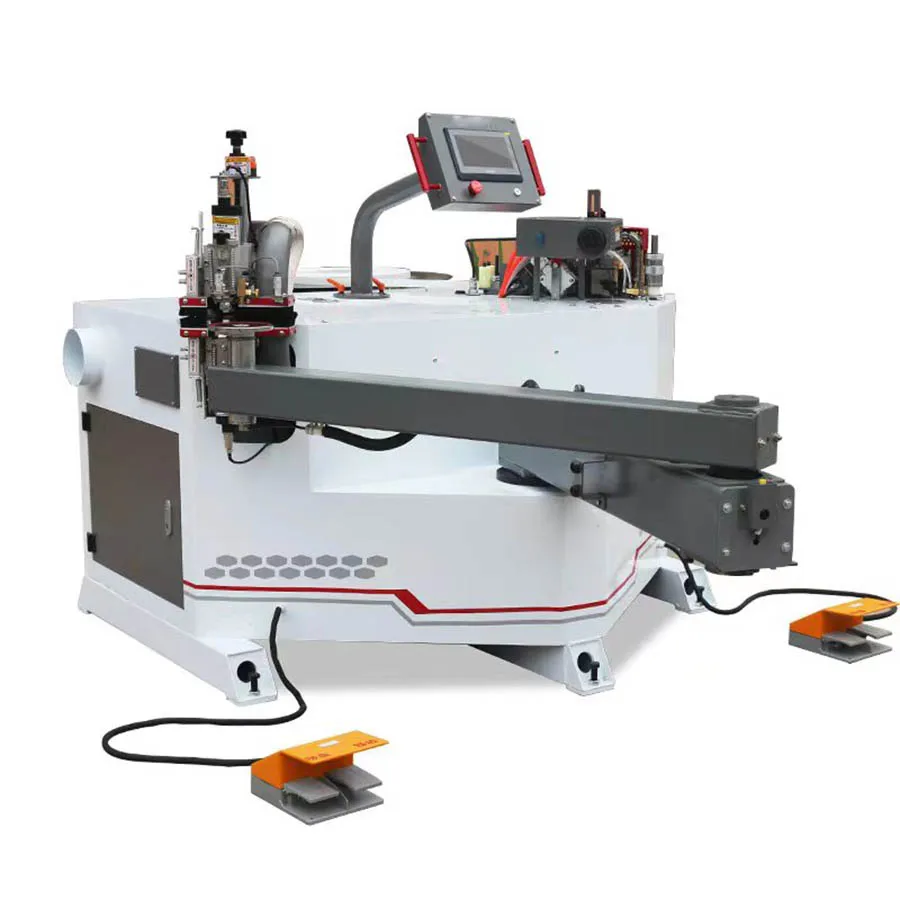
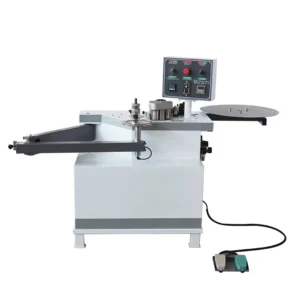
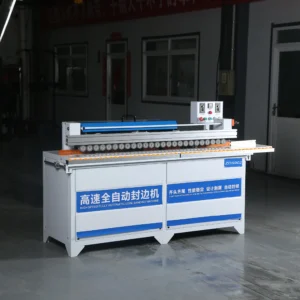
In-house precision manufacturing — every ZDS-700 unit is built and tested on our Shandong factory floor with four-stage quality control, from component sourcing through pre-shipment verification, ensuring curve edge banding tolerances are met before the crate is sealed.
Technical Specifications
| Parameter |
Value |
| Model |
ZDS-700 |
| Product Type |
Automatic Curve Edge Banding Machine with Trimming |
| Rated Power |
6 kW |
| Voltage & Frequency |
380V / 50Hz (confirm local market compatibility) |
| Control System |
PLC (HIU-XP) with industry IT7000 touch screen |
| Overall Dimensions (L×W×H) |
1550 × 1440 × 1350 mm |
| Net Weight |
451 kg |
| Edge Banding Speed |
0–22 m/min |
| Strip Thickness Range |
0.5–3 mm |
| Strip Width Range |
14–70 mm |
| Stacking Arm Length |
2270 mm |
| Air Supply Requirement |
0.6–0.8 MPa |
| Glue Pot Volume |
2600 mL |
| Glue Pot Operating Temperature |
110–210°C |
| Glue Type Compatibility |
PUR and EVA |
| Edge Banding Motor |
220V 400W servo motor |
| Trimming Profiling Motor |
220V 60W single-phase motor |
| Trimming High-Speed Motor |
220V 400Hz 24000 rpm |
| Frequency Transformer |
MD200 2.2 kW |
| Laser Displacement Sensor |
Model 1030 |
| Docking Error |
±0.3 mm |
| Touch Screen Data Storage |
20 form data sets |
| Pre-heating Device |
Hot air unit for improved strip-to-panel bonding |
| Cleaning Devices |
4 stations with automatic cleaning liquid spray |
| Dust Collection |
Enlarged suction port with air pump for scheduled cleaning |
| Warranty |
1 year |
Application Suitability
| Application |
Material or Output |
| Curved cabinet door edge finishing |
MDF and plywood panels with PVC edge banding 0.5–3 mm thick |
| Custom furniture contoured components |
Particleboard and solid wood panels with veneer strip 14–70 mm wide |
| Radius shelf and tabletop edge sealing |
MDF and plywood with PUR or EVA adhesive bonding |
| Workshop-scale shaped panel production |
Mixed substrate batches requiring frequent profile changeover |
Why Docking Tolerance Matters More Than Feed Speed on Curved Profiles
A laser-guided system that holds ±0.3 mm docking error eliminates the manual trimming guesswork that causes curved panel assemblies to fail at the joinery stage.
When I first started on the assembly floor, I watched operators spend twenty minutes hand-fitting edge banding on a single radius panel because the machine’s docking point drifted. That wasted time compounds quickly in a custom furniture shop running dozens of unique profiles per day. The ZDS-700 Automatic Curve Edge Banding Machine addresses this directly with its model 1030 laser displacement sensor, measuring strip position in real time and adjusting the servo-driven feed to maintain alignment. For OEM distributors evaluating manufacturing depth, this sensor-based approach means the tolerance you quote your end customers is the tolerance they actually get on the shop floor [NEED_CITE: laser displacement sensor accuracy standards in woodworking machinery].

How Servo Control Translates to Consistent Curves
The 400W servo motor driving the edge banding feed responds to curvature changes far faster than a standard induction motor setup. On tight radius profiles, the strip must decelerate into the curve and accelerate out of it without losing adhesion or creating overlap at the docking point. This Automatic Curve Edge Banding Machine factory configuration pairs the servo with the MD200 frequency transformer, giving the PLC precise control over the 0–22 m/min speed range. The result is a strip that follows the contour without wrinkling on the inside of the curve or stretching thin on the outside.
Glue Pot Design and Adhesive Versatility
The one-piece molded 2600 mL glue pot operates across the full 110–210°C temperature range required for both EVA and PUR adhesives. PUR demands higher operating temperatures and has a shorter open time, so the heat preservation design of this pot maintains thermal stability during the slower feed rates that curved panels require. The hot air pre-heating device warms the panel edge before glue application, which is particularly important when processing MDF in cooler workshop environments where the substrate can pull heat away from the adhesive bond line before the strip makes contact [NEED_CITE: PUR adhesive temperature requirements for wood panel edge banding].
What the Numbers Actually Mean for Your Production Floor
The ±0.3 mm docking error specification is not just a bench-test figure. It is the tolerance the laser displacement sensor maintains under production conditions with real strip material and real panel contours. The 2600 mL glue pot volume reduces refill interruptions during a production run — on a typical curved panel job running at moderate feed speed, this capacity supports continuous operation without pausing to top up adhesive. The 20 form data sets stored in the touch screen allow operators to recall saved profiles for recurring panel shapes, cutting changeover time between different curved components. For a workshop processing custom furniture with varied radius specifications, this memory function keeps throughput consistent across batches.
The Hidden Cost of Buying a Curve Bander Without Verifying Its Adhesive System
I have seen workshops purchase curve edge banders spec’d only for EVA, then struggle for weeks when a customer orders solid veneer banding that requires PUR for proper adhesion. The glue pot temperature range is not sufficient, the open time is wrong, and the finished edge develops bubbles or delaminates within days. Buyers who skip asking about adhesive compatibility during the quotation stage end up replacing the entire glue system or, worse, losing a customer contract over finish quality. The ZDS-700 is configured from the factory to handle both adhesive chemistries, but confirming your actual production needs upfront avoids costly field modifications [NEED_CITE: adhesive compatibility issues in wood panel edge banding operations].
What This Factory Builds Into Every Unit Before It Ships
Our Shandong facility runs a four-stage quality control process covering incoming material inspection, in-process assembly checks, finished product testing, and pre-shipment verification. Each ZDS-700 is fully assembled and tested before crating — we do not ship flat-pack kits that require your technician to calibrate servo motors and laser sensors on arrival. OEM customization is available as standard: private-label branding, voltage adaptation from 110V to 440V, and multilingual control panel interfaces are configured during production, not retrofitted afterward. Component sourcing is documented and traceable, and every unit ships with a factory test record showing performance on your specified panel material and strip width.
Documentation & Verification
- CE declaration of conformity covering the ZDS-700 electrical and mechanical safety systems
- ISO 9001 certificate for the manufacturing quality management process
- Factory test record showing docking accuracy and glue bond quality on your panel type
- Electrical schematic with confirmed voltage and frequency for your destination market
- Operation and maintenance manual written in your operator’s working language
- Spare parts list with part numbers for servo motor, laser sensor, and trimming heads
Installation, Commissioning & Support
- Requires 380V three-phase dedicated circuit rated for minimum 6 kW continuous draw
- Footprint of 1550 × 1440 mm with stacking arm extending to 2270 mm — verify floor space before delivery
- Arrives fully assembled; connect air supply at 0.6–0.8 MPa and power, then run calibration cycle
- PLC touch screen configured in your language with 20 form data sets pre-loaded at factory
- Four cleaning stations with automatic spray reduce daily maintenance time on glue residue
- Air pump dust collection system requires connection to your workshop extraction ductwork
Before You Request a Quotation
To configure the ZDS-700 correctly for your market, we need your local voltage and frequency specification, the panel substrates and edge banding materials you run most frequently, and whether you require OEM branding or private-label documentation. If you are evaluating this Automatic Curve Edge Banding Machine as an OEM partner or distributor, let us know your territory and the model mix your customers typically request so we can align the production schedule with your stocking plan.
Frequently Asked Questions
Q: What OEM customization is available for the ZDS-700 curve edge bander?
A: Private-label logos on the machine body and control panel, custom voltage from 110V to 440V, multilingual touch screen interfaces, and tailored documentation are all configured during factory production. Minimum order considerations depend on the scope of customization — single-unit branding is available, while full private-label programs with custom color schemes and packaging are structured for volume commitments.
Q: How does the factory confirm voltage compatibility before building my machine?
A: During the quotation stage, we request your local voltage and frequency specification and cross-reference it against the 6 kW rated power draw. The electrical schematic is prepared with your confirmed values, and the frequency transformer is calibrated accordingly. A voltage confirmation document is included in the pre-shipment documentation package.
Q: Can I visit the factory to inspect the manufacturing process and run a test piece?
A: Factory visits are welcomed at our Shandong facility. You can inspect the assembly line, review four-stage QC checkpoints, and run test pieces on the ZDS-700 using your actual panel material and edge banding strip. Sample processing tests are arranged in advance so the correct tooling and adhesive are prepared for your material combination.
Q: What spare parts and technical training does the factory provide for distributor service teams?
A: A detailed spare parts list ships with every unit, covering wear items for the servo motor, laser sensor, trimming heads, and cleaning stations. Distributor service teams receive technical documentation including electrical schematics and maintenance procedures. Training on diagnostic procedures and common fault resolution can be arranged during the factory visit or remotely.
Q: Which components are manufactured in-house versus sourced from suppliers?
A: The cutting mechanism and structural frame are fabricated and precision-ground at our facility. The PLC control system, servo motor, frequency transformer, and laser displacement sensor are sourced from specified industrial suppliers and verified during incoming material inspection. The four-stage QC process covers both in-house and sourced components through final assembly and pre-shipment testing.