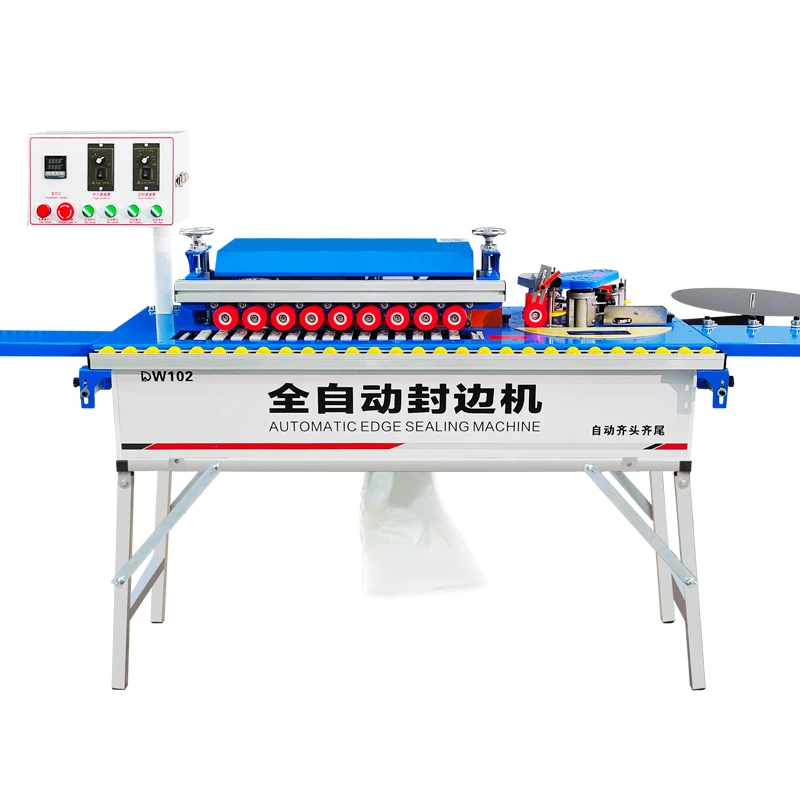
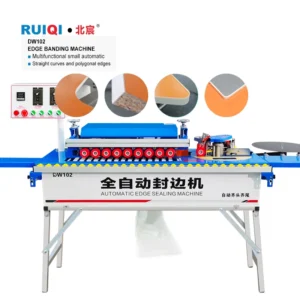
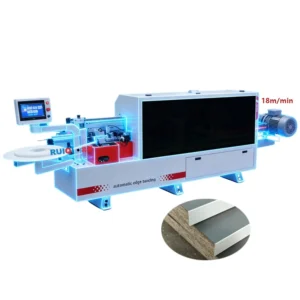
OEM Manufacturing Depth — DW102 curve and linear edge banders are produced in-house with patented cutting mechanisms, allowing private-label partners to specify custom voltage, multilingual controls, and branded enclosures before the first unit enters assembly.
Technical Specifications
| Parameter |
Value |
| Model |
DW102 |
| Product Type |
Automatic Curve and Linear Edge Banding Machine |
| Total Power |
3800W |
| Voltage & Frequency |
220V / 380V / Customization (frequency to be confirmed at order) |
| Overall Dimensions (L×W×H) |
128 × 47 × 69 cm |
| Net Weight |
75 kg |
| Minimum Sheet Length |
25 cm |
| Minimum Sheet Width |
5 cm |
| Edge Banding Height Range |
0–50 mm |
| Edge Banding Thickness Range |
0.3–3 mm |
| Edge Trimming Motor Power |
650W × 2 |
| Polishing Motor Power |
180W × 2 |
| Transmission Motor Power |
60W |
| Edge Feed Motor Power |
20W |
| Vacuum Power |
1200W |
| Air Source Pressure |
0.5–0.8 MPa |
| Glue Pot Capacity |
1000 ml |
| Key Features |
Curved and straight edge banding, edge trimming, polishing, automatic head and tail cutting, vacuum hold-down |
| Control Language |
Chinese and English standard; Spanish and other languages customizable |
| Assembly State |
Fully assembled |
| Certification |
CE, ISO 9001 (per-unit declaration available upon request) |
Application Suitability
| Application |
Material or Output |
| Cabinet door edge profiling |
MDF and plywood with PVC or veneer banding on curved and straight edges |
| Furniture panel finishing |
Particleboard and blockboard with 0.3–3 mm edge bands |
| Polymer door manufacturing |
Polymer substrates requiring tight-trim curve and linear banding |
| Small-batch custom joinery |
Mixed panel materials in workshops handling varied sheet dimensions |
Why the Voltage Conversation Must Happen Before the Quotation
A machine built for 380V/50Hz becomes a dead weight when it arrives at a 220V/60Hz workshop.
I have watched container shipments land at port with the wrong motor winding configuration because nobody confirmed the local grid standard during the quotation stage. The result is weeks of idle floor space while replacement transformers or rewound motors are sourced locally. For an Automatic Curve and Linear Edge Banding Machine OEM factory building for export markets, voltage and frequency confirmation is not a post-order detail — it is the foundation of the build specification. Regional distributors and OEM partners who skip this step absorb returns, rewiring costs, and damaged credibility with their own customers. [NEED_CITE: voltage and frequency standards by export market]

Private-Label Configuration From the Assembly Stage
Distributors adding this edge bander to a regional catalog need more than a sticker swap. The DW102 supports logo application on the enclosure, custom color specifications for machine body panels, and branded packaging artwork. Each of these customization points is addressed during the pre-production engineering review, not after the unit leaves the line. This approach ensures that an Automatic Curve and Linear Edge Banding Machine OEM factory delivers a product that looks and reads as the distributor’s own from the moment the crate is opened.
Multilingual Control Panels That Prevent Commissioning Delays
A control panel written in a language the operator cannot read stalls the entire commissioning process. The standard configuration ships with Chinese and English interfaces, while Spanish and additional languages are available on request. Language selection is locked in during the specification confirmation stage, so the operator sees familiar terminology the first time the machine powers on. [NEED_CITE: CE machinery directive requirements for industrial equipment]
Reading the Specs That Matter for Panel Edge Quality
The dual 650W edge trimming motors handle the bulk of material removal after banding application, while the twin 180W polishing motors refine the edge surface. This motor pairing matters because underpowered trimming on dense MDF leaves chatter marks that polishing cannot correct. The 1000 ml glue pot capacity provides enough adhesive volume for sustained runs on batch orders without frequent refills, which matters when a distributor’s customer is processing a full kitchen cabinet set in one session. The 0.3–3 mm banding thickness range covers PVC, melamine, and thin veneer — the materials most commonly specified by furniture manufacturers in export markets. Vacuum hold-down at 1200W keeps panels seated during curved edge traversal, where centrifugal force on smaller radii can shift unsecured stock.
The Hidden Cost of Skipping Pre-Shipment Electrical Verification
Machines quoted without confirmed voltage and plug type arrive at destination with incompatible connectors or incorrect motor rotation. I have traced commissioning failures back to a simple plug mismatch — the machine works, but nobody can plug it in without an adapter rated for the full 3800W load. For OEM partners reselling under their own brand, a field failure traced to a factory documentation error reflects directly on their reputation, not the manufacturer’s. Distributors who request electrical schematics and voltage confirmation documents before production avoid these failures entirely. [NEED_CITE: electrical safety compliance for imported machinery]
What Manufacturing Depth Means for Your OEM Order
The DW102 is built entirely in-house, from precision-ground components through final assembly — not sourced from trading desks. The four-stage quality control process covers incoming material inspection, in-process checks, finished-product testing, and pre-shipment verification with photographic documentation. Private-label partners receive formal engineering drawings reflecting their customizations, and sample units are available for pre-test evaluation before batch commitment. Production runs maintain consistent specification across units because the same facility handles machining, assembly, and testing under one roof.
Documentation & Verification
- CE declaration of conformity matched to the specific DW102 configuration shipped
- ISO 9001 certificate covering the manufacturing process for this edge bander series
- Electrical schematic confirming voltage, frequency, and plug type as ordered
- Factory test record documenting edge trimming tolerance on your specified panel material
- Pre-shipment verification photographs showing packing, crating, and container loading
- Operation and maintenance manual in the confirmed control language
Installation, Commissioning & Support
- Requires a dedicated circuit rated for the full 3800W load at the confirmed voltage
- Compact 128 × 47 × 69 cm footprint fits standard workshop layouts without floor reinforcement
- Arrives fully assembled — position, level, connect power and air supply at 0.5–0.8 MPa
- First-run calibration covers glue pot temperature, trimming depth, and vacuum hold-down settings
- Spare parts list with edge trimming and polishing consumables included at shipment
- Operator training covers curved and straight edge transitions and banding thickness changeover
What to Include With Your Inquiry
OEM partners and distributors should specify the destination market’s voltage and frequency standard, the required control panel language, and any branding or color customization for the enclosure. If the DW102 will be integrated into an existing production line, include the upstream panel saw model and downstream boring equipment so feed height and throughput compatibility can be confirmed. Sample unit requests should note the panel materials and edge banding types intended for testing.
Frequently Asked Questions
Q: What OEM customization options are available for branding and technical specifications?
A: The DW102 supports custom logo printing on the machine enclosure, bespoke color specifications, voltage adaptation across 220V and 380V configurations, and multilingual control panels including Spanish. Custom engineering drawings reflecting your specifications are provided before production begins, and all modifications are documented in the final shipment paperwork.
Q: How is the correct voltage and plug type confirmed before production starts?
A: During the specification confirmation stage, you provide the destination market voltage, frequency, and plug standard. The factory generates an electrical schematic and voltage confirmation document for your approval. Production does not proceed until this document is signed off, ensuring the motor winding, transformer, and plug match your local grid.
Q: What documentation accompanies each OEM unit at shipment?
A: Every DW102 ships with a CE declaration of conformity, ISO 9001 manufacturing certificate, electrical schematic, factory test record, packing photographs, operation manual in the agreed language, and a spare parts list. Customs documentation support is also provided to facilitate smooth import clearance at destination.
Q: Can I order a sample unit before committing to a batch order?
A: Yes. A single sample unit can be produced with your full OEM specifications — logo, voltage, language, and color — so you can evaluate build quality and edge banding performance on your target panel materials before placing a volume order. Lead time for sample units follows the standard production schedule.
Q: How does the factory handle quality control for OEM batch production runs?
A: Each batch passes through four-stage quality control: incoming material inspection, in-process assembly checks, finished-product functional testing, and pre-shipment verification with photographic evidence. Tolerance and performance results are documented per unit, and the complete inspection record is available to the OEM partner before container loading.