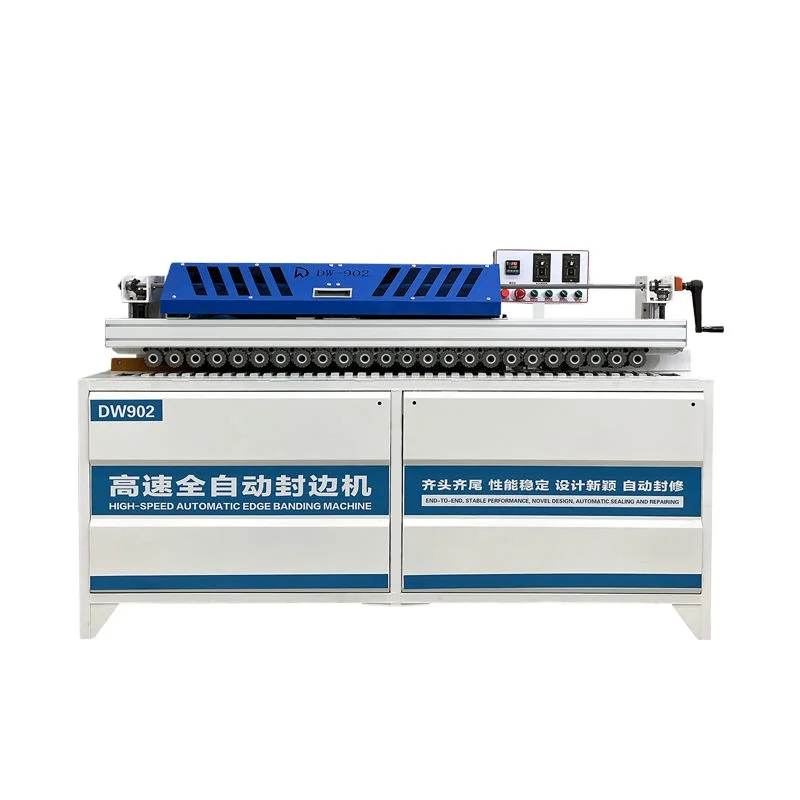
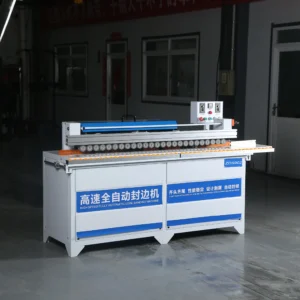
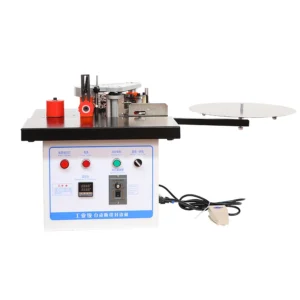
In-house manufacturing depth — Every DW902 edge banding machine is built, tested, and documented on our own production floor before OEM branding or private label is applied.
Technical Specifications
| Parameter |
Value |
| Model |
DW902 |
| Product Type |
High-speed Fully Automatic Edge Banding Machine |
| Function Stations |
Gluing, Trimming, End cutting, Scraping, Polishing |
| Voltage |
220V (50/60Hz — confirm local standard before order) |
| Rated Power |
3300W |
| Board Thickness Range |
0–50mm |
| Strip Thickness Range |
0.5–3mm |
| Glue Pot Capacity |
4000ml |
| Overall Dimensions (L×W×H) |
175×60×112 cm |
| Net Weight |
240kg |
| Pressure Beam |
Integrated, double rows of pressure wheels, adjustable via handle |
| Conveyor Belt |
Silicone material |
| Edge Strip Cutting |
Pneumatically controlled |
| Trimming Motors |
Double high-speed, up and down trimming |
| Polishing Motors |
Dual motor configuration, up and down |
Application Suitability
| Application |
Material or Output |
| PVC edge banding on MDF and particleboard panels |
Furniture components with clean edge finish |
| Plywood cabinet door and carcass edging |
Smooth-trimmed edges ready for assembly |
| Custom furniture panel finishing |
Board edging across 0–50mm thickness range |
| Small to mid-volume woodworking workshop output |
Continuous runs on wood-based panel substrates |
Why the Voltage Conversation Must Happen Before the Quotation
Confirming local voltage and frequency before production prevents motor protection shutdowns that stall commissioning for weeks.
An edge banding machine factory that ships without locking in the destination electrical standard is handing the buyer a two-week delay wrapped in a crate. I have stood on a factory floor in Southeast Asia watching a brand-new edger sit idle because the motor tripped on arrival — the machine was wired for 380V while the workshop ran 415V three-phase. That kind of mismatch does not show up in a brochure. It shows up on day one of production, and every hour the machine is down costs the buyer real output. For OEM buyers and importers evaluating an edge banding machine factory, electrical confirmation is not a footnote. It is the first checkpoint [NEED_CITE: voltage and frequency standards by export market].

How Component Sourcing Shapes Machine Longevity
The DW902 uses dual high-speed trimming motors and a dual-motor polishing configuration. When an OEM edge bander is assembled with matched motor pairs from verified suppliers, the edge finish stays consistent across long production runs. Sourcing is traceable — every incoming component passes the first stage of a four-stage QC protocol before it reaches the assembly bench.
What Four-Stage QC Actually Catches Before Shipment
Incoming material inspection filters out substandard bearings and electrical components before they enter the build. In-process checks verify pressure beam alignment and pneumatic cutting accuracy on the assembly line. Finished-product testing runs the DW902 through its full station sequence under load. Pre-shipment verification documents the results so the OEM partner receives a test record, not just a packing list [NEED_CITE: industrial machinery quality control standards for export].
Reading the Specs That Matter for Edge Quality
The 0–50mm board thickness range and pneumatically controlled strip cutting work together: thicker panels demand more cutting force, and pneumatic actuation delivers that force consistently without operator fatigue. The 4000ml glue pot capacity reduces refill interruptions during continuous runs, which matters when you are processing a full batch of cabinet panels. Double rows of pressure wheels on the integrated beam keep the panel stable through all five stations — gluing, trimming, end cutting, scraping, and polishing — so the edge strip seats evenly regardless of where the board sits in the thickness range. The silicone conveyor belt grips without marking the panel surface, which is critical when running finished veneer or melamine-faced stock.
The Cost of Skipping Configuration Verification
An edge bander specified without confirming the glue type matched to local PVC strip formulations will produce visible glue lines on certain substrates. Operators then spend time adjusting feed parameters that were never the real problem. When a distributor stocks machines without matching the control panel language to the end user’s workshop, commissioning stalls until someone translates the interface. These are not engineering failures — they are configuration oversights, and they compound across every unit in a bulk order [NEED_CITE: common causes of edge banding machine commissioning delays].
Why OEM and Distributor Buyers Source Here
The DW902 is built on a single production line where the same team handles assembly, testing, and OEM customization — logo application, voltage adjustment from 110V to 440V, and multilingual control panel configuration are done before the machine leaves the floor. A four-stage QC process with pre-shipment documentation means the importer receives verifiable test records, not just a certificate on the wall. The factory welcomes visits so distributors can inspect precision grinding and assembly practices before committing to a regional stocking agreement. Private-label packaging and branding are handled in-house, keeping lead times predictable. Configuration proposals are engineer-led, so a distributor specifying machines for a humid tropical market gets recommendations grounded in actual workshop conditions, not a generic catalog page [NEED_CITE: CE machinery directive requirements for industrial equipment].
Documentation & Verification
- Factory test record run on your specified board thickness range before dispatch
- Electrical schematic with voltage and frequency confirmed against your local supply standard
- CE declaration of conformity matched to the exported machine configuration
- Operation and maintenance manual written in your agreed language
- Spare parts list itemized by station for regional inventory planning
Installation, Commissioning & Support
- 175×60×112 cm footprint requires level floor with clearance for the pressure beam handle swing
- 3300W rated power demands a dedicated circuit matching confirmed local voltage
- Machine ships fully assembled — position, level, and connect air supply before first run
- Initial calibration of trimming and scraping stations verified against your panel material
- Silicone conveyor belt and pneumatic cutter require scheduled inspection intervals
- Dual polishing motors and glue pot heating element covered in the spare parts list
What We Need to Configure Your Order
To prepare an accurate configuration proposal for the DW902, provide the panel materials and thickness range you process most often, the local voltage and frequency at the installation site, and the preferred control panel language. If you are a distributor planning a regional model mix, share the market segment and typical workshop scale so the recommendation covers the right configuration spread.
Frequently Asked Questions
Q: What OEM and private-label customization is available for the DW902?
A: Custom logo placement, private-label packaging, voltage configuration from 110V to 440V, and multilingual control panels are all handled in-house. Each customization is confirmed in writing before production begins, and the final configuration is documented in the pre-shipment test record so you receive exactly what was specified.
Q: What does the four-stage QC process cover for each unit?
A: Incoming material inspection, in-process assembly checks, finished-product functional testing under load, and pre-shipment verification with documented results. Every DW902 ships with a factory test record showing performance across all five stations — gluing, trimming, end cutting, scraping, and polishing — tested on your specified board thickness.
Q: Can I visit the factory before placing a bulk OEM order?
A: Factory visits are welcomed at any stage. You can inspect component sourcing records, observe precision grinding and assembly on the production floor, and witness a live test run of the DW902 configured to your voltage and panel specifications before committing to order volume.
Q: What spare parts and technical training support do distributors receive?
A: A station-by-station spare parts list ships with every unit, enabling regional inventory planning. Technical training for your service team covers the dual high-speed trimming motors, pneumatic cutting system, and pressure beam adjustment so your local technicians can handle first-line support independently.
Q: What is the production lead time for OEM-configured machines?
A: Lead time depends on the customization scope and order volume. Voltage reconfiguration, multilingual panel setup, and private-label packaging each add processing steps. Confirm your required delivery window during the quotation stage so the production schedule accounts for all OEM modifications before the ship date.